



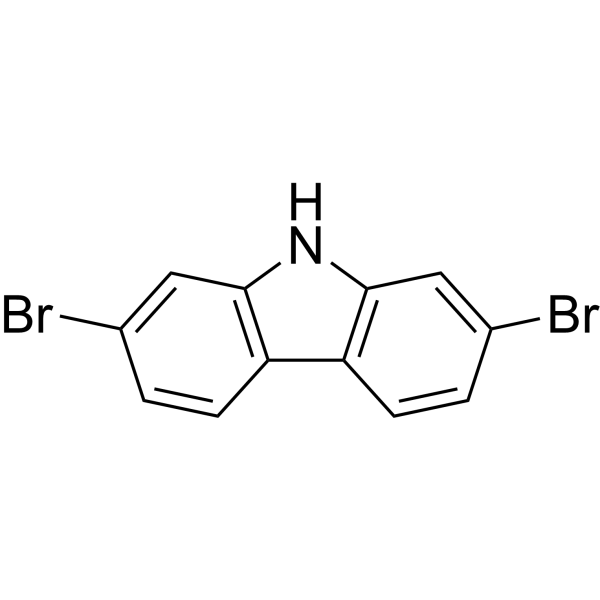
2,7-Dibromocarbazole

Based on 1 Customer Validation
2,7-Dibromocarbazole (2,7-DBCZ) is an orally active AhR agonist and MAOB inhibitor that can cross the blood-brain barrier. 2,7-Dibromocarbazole induces CYP1A/CYP1B1, developmental toxicity and oxidative toxicity, Akt phosphorylation, apoptosis, mitochondrial depolarization, and calcium elevation. 2,7-Dibromocarbazole disrupts dopamine homeostasis, promotes α-synuclein aggregation and transcriptomic dysregulation, leading to hepatic lipid accumulation, liver lesions, brain injury, and angiogenesis/energy metabolism disorders, while activating ERα and inhibiting GRα. 2,7-Dibromocarbazole can be used in research on cardiotoxicity and Parkinson's disease.
For research use only. We do not sell to patients.
- Purity : 99.96%
- CAS No.: 136630-39-2
- Formula: C12H7Br2N
- Molecular Weight:325.00
-
Storage:Powder -20°C, 3 years , 4°C, 2 years ; In solvent -80°C, 6 months , -20°C, 1 month

To place orders, for customer services and technical support, please contact: MedChemExpress USA
Tel: 609-228-6898 E-mail: [email protected] [email protected]


-
 Biological Activity
-
Chemical Information
-
Solvent & Solubility
- Protocols
- Purity & Documentation
- References
-
 Help & FAQs




Biological Activity
Description
|
MAO-B |
AhR |
CYP1A |
CYP1B1 |
Akt |
α-synuclein |
ERα |
GRα |
In Vitro
2,7-Dibromocarbazole (10 μM; 48 h) co-modulates apoptosis, Akt phosphorylation, and Ca2+ elevation in H9c2 cells together with SC79/BAPTA-AM/Ppp2ca RNAi (10-100 μM; 1-3 h pre-exposure)[2].
2,7-Dibromocarbazole (100 nM-10 μM; 48 h) alters angiogenesis-related gene expression in HUVECs, most strongly upregulating Ang2 while decreasing VEGFB[7].
2,7-Dibromocarbazole (10 μM; 48 h post-transfection) inhibited HUVEC tube formation, whereas Ang2 silencing restored it[7].
2,7-Dibromocarbazole (10 μM-0.1 μM; 48 h) showed weak AhR agonist activity in a recombinant HepG2 luciferase reporter gene assay[1].
2,7-Dibromocarbazole (2,7-DBCZ) (10 nM-100 μM; 48 h) reduces H9c2 cell viability, with 100 μM being cytotoxic[2].
2,7-Dibromocarbazole (10 μM; 48 h) demethylates the Ang2 promoter in HUVECs, reducing region 2 by approximately 11%[7].
2,7-Dibromocarbazole (0.1-2 μM; 96 h) induced developmental toxicity and pericardial edema in wild-type zebrafish embryos, with a 96-h LC50 of 581.8 μg/L and an EC50 for pericardial edema of 201.5 μg/L[8].
2,7-Dibromocarbazole upregulates the expression of AhR1 and CYP1A in zebrafish embryos, consistent with AhR activation[8].
MedChemExpress (MCE) has not independently confirmed the accuracy of these methods. They are for reference only.
-
Cell Line:H9c2 rat cardiomyocytes
-
Concentration:10 nM-100 μM; 10 μM
-
Incubation Time:48 h
-
Result:Reduced cell viability significantly versus control at 100 μM after 48 h.
Showed no significant cytotoxicity at other concentrations.
Selected 10 μM as the in vitro working concentration.
-
Cell Line:H9c2 rat cardiomyocytes
-
Concentration:10 μM
-
Incubation Time:48 h
-
Result:Increased early apoptotic cells by 44% and late-apoptotic cells by 57% relative to control after 48 h.
Showed 5.79% late-apoptotic, 2.68% early apoptotic, and 91.07% normal cells by flow cytometry.
Elevated J-monomers by 25%.
Reduced normalized MMP to 72% of control.
-
Cell Line:H9c2 rat cardiomyocytes
-
Concentration:10 μM
-
Incubation Time:48 h
-
Result:Activated CYP1A1, CYP1B1, CD40LG, and ANXA5 expression after 2,7-DBCZ exposure.
Suppressed this activation with CH-223191 HY-12684) co-exposure.
Decreased CYP1A1 expression by 27-48%.
Decreased CYP1B1 expression by 18.5-36.5%.
Decreased CD40LG expression by 56%.
Showed ANXA5 expression at 25% of the 2,7-DBCZ-exposed group.
In Vivo
MedChemExpress (MCE) has not independently confirmed the accuracy of these methods. They are for reference only.
-
Animal Model:Tg(cyp1a-12DRE:EGFP) transgenic line (embryos, 0.5-1.0 h post fertilization)[1]
-
Dosage:100 nM, 1 μM, and 10 μM
-
Administration:waterborne exposure; renewal every 24 h; 96 h
-
Result:Induced EGFP fluorescence intensity of 4,310,000 at 10 μM.
Induced EGFP fluorescence intensity of 767,000 at 1 μM.
Induced EGFP fluorescence intensity of 530,000 at 100 nM.
Induced stronger EGFP fluorescence than TCDD by 4.50-fold at 10 μM.
Induced the utmost EGFP signal among tested PHCZs, equal to 79.9% of the TCDD group, at 1 μM.
Induced the highest EGFP signal among tested PHCZs, up to 55.3% of the TCDD group, at 100 nM.
Induced EGFP expression equal to 55.3% of that induced by TCDD at 100 nM (32.5 µg/L).
Ranked 1st among tested PHCZs for TCDD potency in the transgenic zebrafish assay.
-
Animal Model:Sprague-Dawley (male, six-week-old)[2]
-
Dosage:100 μg/kg/d; 100 mg/kg/d
-
Administration:i.g.; once daily; 14 days
-
Result:Reported cardiac tissue 2,7-DBCZ concentrations of 1.73 and 3.43 μg/kg after 14 days of intragastric infusion.
Increased apoptotic cardiac tissue cell proportions by 46.5% and 95% at 100 μg/kg/d and 100 mg/kg/d, respectively, versus corn oil controls.
Activated CYP1B1 expression by 17% in cardiac tissue at 100 μg/kg/d 2,7-DBCZ only.
Induced CYP1A1 and CYP1B1 expression by 409% and 65%, respectively, in cardiac tissue at 100 mg/kg/d 2,7-DBCZ.
Enhanced CD40LG and ANXA5 expression by 53% each in cardiac tissue at 100 mg/kg/d 2,7-DBCZ.
- Reproductive and Developmental Toxicity Study
- Western Blot
- Mitochondrial membrane-potential fluorescent assay
- Human pluripotent stem cell endothelial-cell differentiation
- Vascular/Branching Fractal Analysis
- Annexin V plus membrane-impermeant dye apoptosis staining
- Kinase activity and phosphorylation assays
- 3T3-L1 preadipocyte-to-adipocyte differentiation
- Detection of Apoptosis
- TUNEL staining for apoptotic DNA fragmentation
- Human pluripotent stem cell midbrain dopaminergic neuron differentiation
- Endothelial Tube Formation Assay
- Apoptosis Solutions
- Protocol for Kinase activity and phosphorylation assays
- Endothelial Cell Migration/Angiogenic Sprouting Assay
- Lipid Droplets: Oil Red O/Sudan Dye Lipid Staining


Chemical Information
-
CAS No. 136630-39-2
-
Appearance Solid
-
Molecular Weight 325.00
-
Formula C12H7Br2N
-
Color White to off-white
-
SMILES
BrC1=CC2=C(C=C1)C3=C(C=C(Br)C=C3)N2
-
Synonyms
2,7-DBCZ
-
Shipping
Room temperature in continental US; may vary elsewhere.
-
Storage
Powder -20°C 3 years 4°C 2 years In solvent -80°C 6 months -20°C 1 month


Solvent & Solubility
In Vitro:
DMSO : 100 mg/mL (307.69 mM; Need ultrasonic; Hygroscopic DMSO has a significant impact on the solubility of product, please use newly opened DMSO)
Please refer to the solubility information to select the appropriate solvent. Once prepared, please aliquot and store the solution to prevent product inactivation from repeated freeze-thaw cycles.
Storage method and period of stock solution: -80°C, 6 months; -20°C, 1 month. When stored at -80°C, please use it within 6 months. When stored at -20°C, please use it within 1 month.
Concentration (start) × Volume (start) = Concentration (final) × Volume (final)


Purity & Documentation
-
Data Sheet (295 KB)
-
SDS (481 KB)
- English - EN (481 KB)
- Français - FR (481 KB)
- Deutsch - DE (481 KB)
- Norwegian - NO (481 KB)
- Español - ES (481 KB)
- Swedish - SV (481 KB)
- Italian - IT (481 KB)
- Korean - KR (481 KB)
- Portuguese - PT (481 KB)
-
Handling Instructions (2659 KB)
References


Complete Stock Solution Preparation Table
Please refer to the solubility information to select the appropriate solvent. Once prepared, please aliquot and store the solution to prevent product inactivation from repeated freeze-thaw cycles.
Storage method and period of stock solution: -80°C, 6 months; -20°C, 1 month. When stored at -80°C, please use it within 6 months. When stored at -20°C, please use it within 1 month.
| Optional Solvent | Concentration Solvent Mass | 1 mg | 5 mg | 10 mg | 25 mg |
|---|---|---|---|---|---|
| DMSO | 1 mM | 3.0769 mL | 15.3846 mL | 30.7692 mL | 76.9231 mL |
| 5 mM | 0.6154 mL | 3.0769 mL | 6.1538 mL | 15.3846 mL | |
| 10 mM | 0.3077 mL | 1.5385 mL | 3.0769 mL | 7.6923 mL | |
| 15 mM | 0.2051 mL | 1.0256 mL | 2.0513 mL | 5.1282 mL | |
| 20 mM | 0.1538 mL | 0.7692 mL | 1.5385 mL | 3.8462 mL | |
| 25 mM | 0.1231 mL | 0.6154 mL | 1.2308 mL | 3.0769 mL | |
| 30 mM | 0.1026 mL | 0.5128 mL | 1.0256 mL | 2.5641 mL | |
| 40 mM | 0.0769 mL | 0.3846 mL | 0.7692 mL | 1.9231 mL | |
| 50 mM | 0.0615 mL | 0.3077 mL | 0.6154 mL | 1.5385 mL | |
| 60 mM | 0.0513 mL | 0.2564 mL | 0.5128 mL | 1.2821 mL | |
| 80 mM | 0.0385 mL | 0.1923 mL | 0.3846 mL | 0.9615 mL | |
| 100 mM | 0.0308 mL | 0.1538 mL | 0.3077 mL | 0.7692 mL |


2,7-Dibromocarbazole Related Classifications
HY-34464 Related Classifications
 Powered by Bioz