



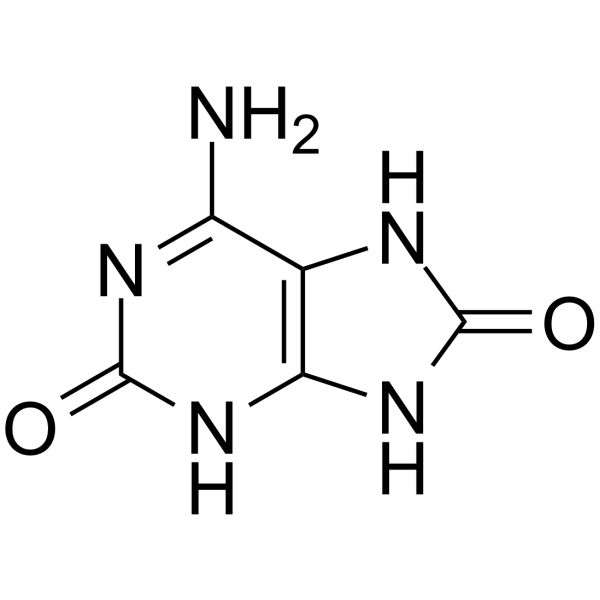
2,8-Dihydroxyadenine
2,8-Dihydroxyadenine is an endogenous metabolite that forms crystals in urine, leading to kidney stone formation and crystal deposition in the kidney. 2,8-Dihydroxyadenine induces crystal-induced tubular injury, inflammation, and fibrosis through crystal deposition in renal tubules, where crystals are excreted in urine, internalized by tubular epithelial cells, and transported to the interstitium. 2,8-Dihydroxyadenine upregulates CD44 expression near crystals, TNF-α signaling through NF-κB, and mTORC1 signaling, while inducing actin stress fiber formation and cytoskeletal remodeling. 2,8-Dihydroxyadenine downregulates epithelial-mesenchymal transition pathways and oxidative phosphorylation, and induces changes affecting inflammation, metabolism, and cell cycle regulation. 2,8-Dihydroxyadenine can be used in research on kidney disease, adenine phosphoribosyltransferase deficiency, and kidney stone disease.
For research use only. We do not sell to patients.
- CAS No.: 30377-37-8
- Formula: C5H5N5O2
- Molecular Weight:167.13
-
Storage:Powder -20°C, 3 years , 4°C, 2 years ; In solvent -80°C, 6 months , -20°C, 1 month

To place orders, for customer services and technical support, please contact: MedChemExpress USA
Tel: 609-228-6898 E-mail: [email protected] [email protected]


-
 Biological Activity
-
Chemical Information
-
Solvent & Solubility
- Protocols
- Purity & Documentation
- References
-
 Help & FAQs


All Endogenous Metabolite Isoforms
More

Biological Activity
Description
|
CD44 |
NF-κB |
mTORC1 |
TNF-α |
In Vitro
2,8-Dihydroxyadenine (50 μM) oxidation at a GCE is pH-dependent, occurring with a 2-electron transfer and forming a strongly adsorbing electroactive product P2,8-DHA, with maximum oxidation current at pH 4.5[2].
2,8-Dihydroxyadenine reduction at a GCE is reversible in the absence of oxygen, but molecular oxygen interferes with the reductive electron transfer, shifting the reduction potential and increasing the reduction current[2].
2,8-Dihydroxyadenine (DHA) (60-480 µg/mL; 72 h) reduces viability of HEK293, MDCK, and HK-2 cells in a dose-dependent manner, with HEK293 cells showing the greatest decrease to approximately 40% at 480 µg/mL[3].
2,8-Dihydroxyadenine (120-480 µg/mL; 24 h) impairs wound closure in HEK293, MDCK, and HK-2 cells, with HEK293 cells treated with 480 µg/mL DHA achieving only ~50% closure at 72 h compared to full closure in controls, and HK-2 cells reaching ~70-80% closure at 72 h[3].
2,8-Dihydroxyadenine (120-480 µg/mL; 72 h) upregulates CD44 gene expression in HK-2 cells, while HEK293 cells show increased CD44 gene expression at higher DHA concentrations, but MDCK cells do not show increased CD44 gene expression[3].
2,8-Dihydroxyadenine (120-480 µg/mL; 72 h) increases CD44 protein expression in HEK293, MDCK, and HK-2 cells, with CD44 localized adjacent to DHA crystals[3].
MedChemExpress (MCE) has not independently confirmed the accuracy of these methods. They are for reference only.
-
Cell Line:HEK293, MDCK, and HK-2
-
Concentration:60 µg/mL, 120 µg/mL, 240 µg/mL, 480 µg/mL
-
Incubation Time:72 h
-
Result:Decreased viability in a dose-dependent manner.
Reduced viability to approximately 40% in HEK293 cells at 480 µg/mL.
Reduced viability to 80% in MDCK cells at 480 µg/mL.
Reduced viability to 70% in HK-2 cells at 480 µg/mL.
-
Cell Line:HEK293, MDCK, and HK-2
-
Concentration:120 µg/mL, 480 µg/mL
-
Incubation Time:24 h
-
Result:Impaired wound closure.
HEK293 cells treated with 480 µg/mL DHA closed ~50% of the wound at 72 h.
HK-2 cells reached ~80% closure at 120 µg/mL and ~70% closure at 480 µg/mL at 72 h.
-
Cell Line:HEK293, HK-2, and MDCK
-
Concentration:120 µg/mL, 480 µg/mL
-
Incubation Time:72 h
-
Result:Induced a statistically significant upregulation of CD44 expression in HK-2 cells at 480 µg/mL.
Increased CD44 gene expression in HEK293 cells at 480 µg/mL.
Did not increase CD44 gene expression in MDCK cells.
-
Cell Line:HEK293, MDCK, and HK-2
-
Concentration:120, 480 µg/mL
-
Incubation Time:72 h
-
Result:Increased CD44 protein expression in HEK293, MDCK, and HK-2 cells.
CD44 expression was localized adjacent to DHA crystals.
- Fibrosis/Collagen Morphometry
- Kinase activity and phosphorylation assays
- Collagen: Sirius Red Staining
- RNA extraction experimental
- Western Blot
- Flow cytometric DNA-content cell-cycle staining
- BrdU Incorporation Assay
- Connective Tissue: Masson's Trichrome/Collagen Trichrome Staining
- Protocol for Cell Cycle
- Research Protocol for Inflammation-related Diseases
- Protocol for Kinase activity and phosphorylation assays
- Phalloidin F-actin cytoskeleton staining


Chemical Information
-
CAS No. 30377-37-8
-
Appearance Solid
-
Molecular Weight 167.13
-
Formula C5H5N5O2
-
Color White to light yellow
-
SMILES
O=C1NC2=C(NC(N2)=O)C(N)=N1
-
Structure Classification
-
Initial Source
-
Shipping
Room temperature in continental US; may vary elsewhere.
-
Storage
Powder -20°C 3 years 4°C 2 years In solvent -80°C 6 months -20°C 1 month


Solvent & Solubility
In Vitro:
H2O : 2.2 mg/mL (13.16 mM; Need ultrasonic and warming)
Please refer to the solubility information to select the appropriate solvent. Once prepared, please aliquot and store the solution to prevent product inactivation from repeated freeze-thaw cycles.
Storage method and period of stock solution: -80°C, 6 months; -20°C, 1 month. When stored at -80°C, please use it within 6 months. When stored at -20°C, please use it within 1 month.
* Note: If you choose water as the stock solution, please dilute it to the working solution, then filter and sterilize it with a 0.22 μm filter before use.
Concentration (start) × Volume (start) = Concentration (final) × Volume (final)


Purity & Documentation
-
Data Sheet (291 KB)
-
SDS (393 KB)
- English - EN (393 KB)
- Français - FR (393 KB)
- Deutsch - DE (393 KB)
- Norwegian - NO (393 KB)
- Español - ES (393 KB)
- Swedish - SV (393 KB)
- Italian - IT (393 KB)
- Korean - KR (393 KB)
- Portuguese - PT (393 KB)
-
Handling Instructions (2659 KB)
References


Complete Stock Solution Preparation Table
Please refer to the solubility information to select the appropriate solvent. Once prepared, please aliquot and store the solution to prevent product inactivation from repeated freeze-thaw cycles.
Storage method and period of stock solution: -80°C, 6 months; -20°C, 1 month. When stored at -80°C, please use it within 6 months. When stored at -20°C, please use it within 1 month.
| Optional Solvent | Concentration Solvent Mass | 1 mg | 5 mg | 10 mg | 25 mg |
|---|---|---|---|---|---|
| H2O | 1 mM | 5.9834 mL | 29.9168 mL | 59.8337 mL | 149.5842 mL |
| 5 mM | 1.1967 mL | 5.9834 mL | 11.9667 mL | 29.9168 mL | |
| 10 mM | 0.5983 mL | 2.9917 mL | 5.9834 mL | 14.9584 mL |
* Note: If you choose water as the stock solution, please dilute it to the working solution, then filter and sterilize it with a 0.22 μm filter before use.


2,8-Dihydroxyadenine Related Classifications
HY-N9941 Related Classifications
 Powered by Bioz