



Antioxidant peptide A
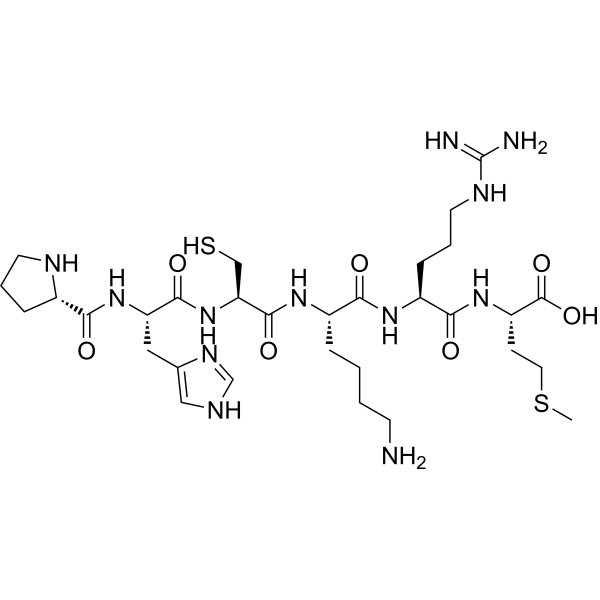
Antioxidant peptide A is a short peptide, which contains alternative aromatic or sulfur-containing amino acid. The side chains of Antioxidant peptide A are believed to contribute to strong radical scavenging activities of peptides in the cancer cell.
For research use only. We do not sell to patients.
- CAS No.: 159147-88-3
- Formula: C31H54N12O7S2
- Molecular Weight:770.97
-
Storage:
Please store the product under the recommended conditions in the Certificate of Analysis.

To place orders, for customer services and technical support, please contact: MedChemExpress USA
Tel: 609-228-6898 E-mail: [email protected] [email protected]


-
 Biological Activity
-
Chemical Information
-
Solvent & Solubility
- Purity & Documentation
- References
-
 Help & FAQs


Biological Activity
Description
In Vitro
The effects of 10-100 μM of Antioxidant peptide A (Pep-A) concentrations are studied on the superoxide dismutase (SOD) enzyme activity. The enzyme activity decreases by 0.5 and 0.7-folds at 10 and 50 μM Antioxidant peptide A concentrations, respectively, and increases by 1.79-folds at 100 μM Antioxidant peptide A treatment, indicating that this concentration can be ideal for the treatment on Y79 a, RB cells. Furthermore, the Antioxidant peptide A can be involved in decreasing the ROS by increasing the antioxidant enzyme activity. A similar increase in the antioxidative enzyme levels in the presence of Hoki skin antioxidative peptide in hepatocarcinoma cells is attributed to the peptide’s role in maintaining the redox balance in the cellular environment. Cell viability analysis results show that the Antioxidant peptide A shows no toxicity to cancerous (Y79) cells and non-cancerous cells even after 48 h of treatment. The Y79 RB cell viability ranges between 115 and 157 % and 111-126 % after 24 and 48 h of exposures with Antioxidant peptide A, respectively. The cancer cell death from the treatment of 10-100 μM GNPs concentration is studied[1].
MedChemExpress (MCE) has not independently confirmed the accuracy of these methods. They are for reference only.


Chemical Information
-
CAS No. 159147-88-3
-
Molecular Weight 770.97
-
Formula C31H54N12O7S2
-
Sequence
Pro-His-Cys-Lys-Arg-Met
-
Sequence Shortening
PHCKRM
-
Shipping
Room temperature in continental US; may vary elsewhere.
-
Storage
Please store the product under the recommended conditions in the Certificate of Analysis.


Solvent & Solubility
In Vitro
H2O
Peptide Solubility and Storage Guidelines:
1. Calculate the length of the peptide.
2. Calculate the overall charge of the entire peptide according to the following table:
| Contents | Assign value | |
|---|---|---|
| Acidic amino acid | Asp (D), Glu (E), and the C-terminal -COOH. | -1 |
| Basic amino acid | Arg (R), Lys (K), His (H), and the N-terminal -NH2 | +1 |
| Neutral amino acid | Gly (G), Ala (A), Leu (L), Ile (I), Val (V), Cys (C), Met (M), Thr (T), Ser (S), Phe (F), Tyr (Y), Trp (W), Pro (P), Asn (N), Gln (Q) | 0 |
3. Recommended solution:
| Overall charge of peptide | Details |
|---|---|
| Negative (<0) |
1. Try to dissolve the peptide in water first. 2. If water fails, add NH4OH (<50 μL). 3. If the peptide still does not dissolve, add DMSO (50-100 μL) to solubilize the peptide. |
| Positive (>0) |
1. Try to dissolve the peptide in water first. 2. If water fails, try dissolving the peptide in a 10%-30% acetic acid solution. 3. If the peptide still does not dissolve, try dissolving the peptide in a small amount of DMSO. |
| Zero (=0) |
1. Try to dissolve the peptide in organic solvent (acetonitrile, methanol, etc.) first. 2. For very hydrophobic peptides, try dissolving the peptide in a small amount of DMSO, and then dilute the solution with water to the desired concentration. |


Purity & Documentation
References

Calculators
Concentration (start) × Volume (start) = Concentration (final) × Volume (final)


Antioxidant peptide A Related Classifications
HY-P1512 Related Classifications
 Powered by Bioz