



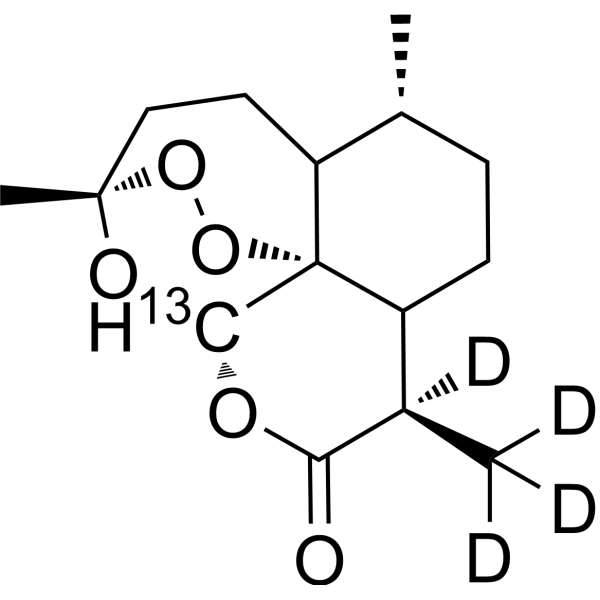
Artemisinin-13C,d4
Artemisinin-13C,d4 is 13C and deuterated labeled Artemisinin (HY-B0094). Artemisinin (Qinghaosu), a sesquiterpene lactone, is an anti-malarial agent isolated from the aerial parts of Artemisia annua L. plants. Artemisinin inhibits AKT signaling pathway by decreasing pAKT in a dose-dependent manner. Artemisinin reduces cancer cell proliferation, migration, invasion, tumorigenesis and metastasis and has neuroprotective effects.
For research use only. We do not sell to patients.
- Formula: C1413CH18D4O5
- Molecular Weight:287.35
-
Storage:
Please store the product under the recommended conditions in the Certificate of Analysis.

To place orders, for customer services and technical support, please contact: MedChemExpress USA
Tel: 609-228-6898 E-mail: [email protected] [email protected]


-
 Biological Activity
-
Chemical Information
- Protocols
- Purity & Documentation
- References
-
 Help & FAQs


All Parasite Isoforms
More

Biological Activity
Description
In Vitro
Stable heavy isotopes of hydrogen, carbon, and other elements have been incorporated into drug molecules, largely as tracers for quantitation during the drug development process. Deuteration has gained attention because of its potential to affect the pharmacokinetic and metabolic profiles of drugs[1].
Artemisinin (Qinghaosu) (25 or 50 μM; 24 hours) concentration-dependently suppresses Aβ25-35 induced cytotoxicity in PC12 cells[2].
Artemisinin (1-100 μM; 24 hours) selectively inhibits cancer cell growth in a dose-dependent manner with IC50 values of 31.30 ± 0.73 μM in UMRC-2 cells and 23.97 ± 0.92 CAKI-2 cells[3].
Artemisinin (25, 50 μM; 24 hours) suppresses the phosphorylation of AKT in UMRC-2 and CAKI-2 cells in a dose-dependent manner[3].
MedChemExpress (MCE) has not independently confirmed the accuracy of these methods. They are for reference only.
In Vivo
MedChemExpress (MCE) has not independently confirmed the accuracy of these methods. They are for reference only.
- BrdU Incorporation Assay
- Cell migration
- Somatic Cell Culture
- CFSE Dye Dilution Proliferation Assay
- Dye-dilution cell tracking and proliferation staining
- CCK-8/WST-8 Cell Proliferation Assay
- Protocol for Cell Cycle
- Cell Counting-Based Growth Curve Assay
- Colony Formation (Clonogenic) Assay
- Cell Viability Determination by MTT Colorimetric Assay
- EdU Incorporation Assay (Click Chemistry-Based DNA Synthesis Measurement)
- Ki-67 Immunostaining Proliferation Assay
- PCNA Immunodetection Proliferation Assay
- Protocol for Cell Counting and Cell Density Analysis
- Cell invasion
- MTT Cell Proliferation Assay
- Orthotopic Cell-Line Xenograft
Application
1. This compound can be used as a tracer
2. This compound can be used as an internal standard for quantitative analysis by NMR, GC-MS, or LC-MS.


Chemical Information
-
Unlabeled CAS 63968-64-9
-
Molecular Weight 287.35
-
Formula C1413CH18D4O5
-
SMILES
O=C(O1)[C@]([2H])(C([2H])([2H])[2H])C2CC[C@@H](C)C3CC[C@@]4(C)OO[C@]32[13C@H]1O4
-
Synonyms
Qinghaosu-13C,d4; NSC 369397-13C,d4
-
Shipping
Room temperature in continental US; may vary elsewhere.
-
Storage
Please store the product under the recommended conditions in the Certificate of Analysis.


Purity & Documentation
References
[1]. Russak EM, et al. Impact of Deuterium Substitution on the Pharmacokinetics of Pharmaceuticals. Ann Pharmacother. 2019 Feb;53(2):211-216. [Content Brief]
[2]. Lin SP, et al. Artemisinin Prevents Glutamate-Induced Neuronal Cell Death Via Akt Pathway Activation. Front Cell Neurosci. 2018 Apr 20;12:108. [Content Brief]
[3]. Zeng Z, et al. Artemisinin protects PC12 cells against β-amyloid-induced apoptosis through activation of the ERK1/2 signaling pathway. Redox Biol. 2017 Apr 4;12:625-633. [Content Brief]

Calculators
Concentration (start) × Volume (start) = Concentration (final) × Volume (final)


Artemisinin-13C,d4 Related Classifications
HY-B0094S3 Related Classifications
 Powered by Bioz