



BIBN-99

Based on 1 Customer Validation
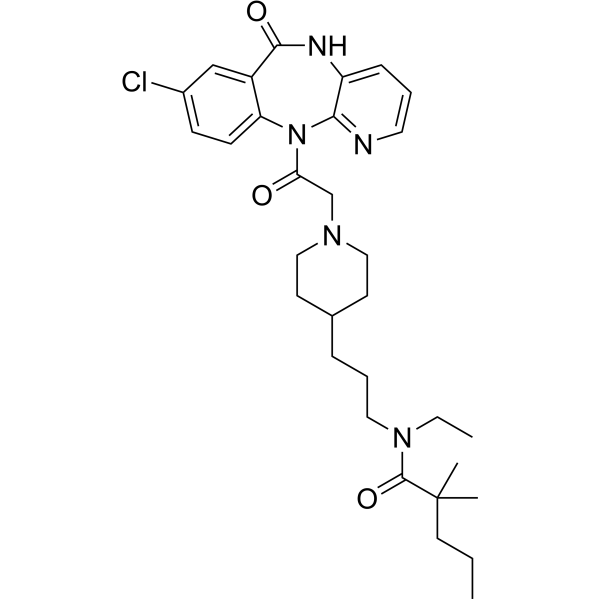
BIBN-99 is a lipophilic M2 muscarinic receptor antagonist that crosses the blood-brain barrier (human pKi = 7.52; rat pKi = 7.57). BIBN-99 enhances acetylcholine release by blocking presynaptic M2 autoreceptors and heteroreceptors, and reverses impaired acetylcholine release. BIBN-99 can be used in research on dementia, age-related cognitive decline, Alzheimer's disease, and traumatic brain injury.
For research use only. We do not sell to patients.
- Purity : 98.02%
- CAS No.: 145301-48-0
- Formula: C31H42ClN5O3
- Molecular Weight:568.15
-
Storage:Powder -20°C, 3 years , 4°C, 2 years ; In solvent -80°C, 6 months , -20°C, 1 month

To place orders, for customer services and technical support, please contact: MedChemExpress USA
Tel: 609-228-6898 E-mail: [email protected] [email protected]


-
 Biological Activity
-
Chemical Information
-
Solvent & Solubility
- Protocols
- Purity & Documentation
- References
-
 Help & FAQs


Biological Activity
Description
IC50 & Target
[4]|
mAChR2 7.52 (pKi, human) |
mAChR2 7.57 (pKi, rat) |
In Vitro
BIBN-99 antagonizes guinea pig atrial M2 receptors mediating changes in contractile force, with a pA2 of 7.2[5].
BIBN-99 (45 min) exhibits the highest affinity for cloned human M2 receptors (pKi = 7.52), moderate affinity for M4 receptors (pKi = 6.76), and lower affinity for M1/M3/M5 receptors, with a 48-fold selectivity for M2 over M5[4].
BIBN-99 binds rat cardiac M2 receptors with Ki = 30 nM and displays high M2 selectivity among rat cortical M1, cardiac M2, and glandular M3 binding sites[5].
BIBN-99 binds the M2 receptor expressed in CHO with pKi = 7.5 and shows 30-fold M2/M1 selectivity[5].
BIBN-99 binds to rat hippocampal presynaptic M2 receptors mediating ACh release with pKb = 6.7[5].
BIBN-99 is a selective M2 muscarinic receptor antagonist with a binding affinity Ki of 32 nM and 30-fold/25-fold selectivity over M1/M3 receptors[6].
BIBN-99 exhibits the highest binding affinity for the M2 muscarinic receptor subtype among the M1-M5 subtypes (Ki = 30.2 nM)[7].
BIBN-99 (1 µM; 180 min at room temperature) inhibits [125I]Z-IQNP binding in postmortem human brain cryosections, inhibiting approximately 70% in M2-rich cerebellum and 40% in pons[7].
BIBN-99 acts most potently on cloned M2 muscarinic receptors expressed in CHO cells, with a pKi of 7.5, whereas its pKi values for M4, M3, M1, and M5 are 5.8-6.8[8].
MedChemExpress (MCE) has not independently confirmed the accuracy of these methods. They are for reference only.
In Vivo
BIBN 99 (1.93 mg/kg; i.v.) antagonizes acetylcholine-induced bradycardia in anesthetized guinea pigs with an ED50 of 1.93 mg/kg, whereas at doses up to 10 mg/kg it does not produce 50% inhibition of airway or bladder responses[4].
BIBN 99 (3.80 mg/kg; i.v.; single bolus) crosses the blood-brain barrier and inhibits centrally mediated arecoline pressor responses in anesthetized rats, with an ID50 of 3.80 mg/kg[4].
BIBN 99 (3.0 mg/kg; s.c.; single dose) does not increase heart rate and does not significantly affect blood pressure in conscious chronically catheterized rats[4].
BIBN-99 (0.5 mg/kg; s.c.; once daily; for an additional 3 training days) improves spatial learning performance in the Morris water maze in aged-impaired Fischer 344 rats[2].
BIBN 99 (0.25 mg/kg; s.c.) improves the learning process in aged cognitively impaired rats[4].
BIBN 99 (0.25 mg/kg; s.c.) improves Morris maze performance in age-impaired rats to normal levels[5].
BIBN-99 (0.50 mg/kg; s.c.; 60 min before training) reverses Scopolamine (HY-N0296)-induced amnesia in young rats[8].
BIBN-99 (0.5 mg/kg) increases total exploration time in the object recognition task in both aging-impaired and aging-unimpaired rats, but does not affect prepulse inhibition[9].
MedChemExpress (MCE) has not independently confirmed the accuracy of these methods. They are for reference only.
-
Animal Model:Fischer 344 (male, aged 24-26 months)[2]
-
Dosage:0.5 mg/kg
-
Administration:s.c.; once daily 45 min before training; 3 additional training days
-
Result:In aged-impaired F344 rats, BIBN-99 produced significantly shorter escape latencies than vehicle-treated controls during the additional 3 days of water maze training.
In the probe trial, BIBN-99 significantly reduced latency to first entry into the annulus-40 and significantly increased dwell time in the annulus-40.
Swim speed was not significantly altered by BIBN-99 (20.4 cm/sec).
-
Animal Model:Chbb: Thom (300-350 g)[4]
-
Dosage:3.11 mg/kg (ID50); 3 mg/kg (duration)
-
Administration:i.v.; single injection; 5 min before vagal stimulation
-
Result:The ID50 value of BIBN 99 for inhibition of the bradycardia due to vagal stimulation was 3.11 mg/kg.
The half-maximal duration of the antagonistic effect of a 3 mg/kg dose of BIBN 99 was approximately 5 min in this in vivo model.
-
Animal Model:DHP (either sex, 550-660 g)[4]
-
Dosage:1.93 mg/kg (ED50); up to 10 mg/kg
-
Administration:i.v.; 5 min before acetylcholine challenge
-
Result:Antagonized the bradycardic response with an ED50 value of 1.93 mg/kg.
Doses up to 10 mg/kg did not cause 50% inhibition of airway or bladder responses.
-
Animal Model:Chbb:Thom (300-350 g)[4]
-
Dosage:3.80 mg/kg (ID50); 10 mg/kg (duration)
-
Administration:i.v.; single bolus; 5 min before arecoline challenge
-
Result:This centrally mediated increase in blood pressure was antagonized by BIBN 99 with an ID50 value of 3.80 mg/kg.
The effects occurred rapidly (< 1 min) after i.v. injection of the compound but had a short duration of action (t1/2 approximately 20 min at a dose of 10 mg/kg i.v.).
-
Animal Model:Chbb:THOM (male, 350-400 g)[4]
-
Dosage:3.0 mg/kg
-
Administration:s.c.; once
-
Result:Basal heart rate in the BIBN 99 group was 385 beats/min; basal blood pressure was 96 mm Hg.
The s.c. administration of BIBN 99 at 3.0 mg/kg showed no effect on heart rate.
Neither compound had a significant effect on blood pressure.
-
Animal Model:Long-Evans (male, 24-25 months old)[8]
-
Dosage:0.5 mg/kg
-
Administration:s.c.; single injection
-
Result:In AI rats, BIBN-99 (0.5 mg/kg s.c.) produced hippocampal ACh release at 153% of basal.
In AU rats, BIBN-99 (0.5 mg/kg s.c.) produced hippocampal ACh release at 98% of basal.
ACh release returned to baseline in the AI group at time sample 12.
-
Animal Model:Long-Evans (male, 24-25 months old)[8]
-
Dosage:0.25 mg/kg
-
Administration:s.c.
-
Result:Facilitated cognitive performance of impaired animals to a level similar to that of unimpaired or young rats.
Similar improvements were seen after 1 or 4 hr, but not 24 hr, post injection.
-
Animal Model:Long-Evans (male, 6 months old)[8]
-
Dosage:0.50 mg/kg
-
Administration:s.c.; 60 min before session
-
Result:Reversed scopolamine-induced amnesia.


Chemical Information
-
CAS No. 145301-48-0
-
Appearance Solid
-
Molecular Weight 568.15
-
Formula C31H42ClN5O3
-
Color White to off-white
-
SMILES
CCCC(C)(C(N(CC)CCCC1CCN(CC1)CC(N2C3=NC=CC=C3NC(C4=CC(Cl)=CC=C42)=O)=O)=O)C
-
Shipping
Room temperature in continental US; may vary elsewhere.
-
Storage
Powder -20°C 3 years 4°C 2 years In solvent -80°C 6 months -20°C 1 month


Solvent & Solubility
In Vitro:
DMSO : 50 mg/mL (88.00 mM; ultrasonic and warming and heat to 60°C; Hygroscopic DMSO has a significant impact on the solubility of product, please use newly opened DMSO)
Please refer to the solubility information to select the appropriate solvent. Once prepared, please aliquot and store the solution to prevent product inactivation from repeated freeze-thaw cycles.
Storage method and period of stock solution: -80°C, 6 months; -20°C, 1 month. When stored at -80°C, please use it within 6 months. When stored at -20°C, please use it within 1 month.
Concentration (start) × Volume (start) = Concentration (final) × Volume (final)


Purity & Documentation
-
Data Sheet (288 KB)
-
SDS (252 KB)
- English - EN (252 KB)
- Français - FR (252 KB)
- Deutsch - DE (252 KB)
- Norwegian - NO (252 KB)
- Español - ES (252 KB)
- Swedish - SV (252 KB)
- Italian - IT (252 KB)
- Korean - KR (252 KB)
- Portuguese - PT (252 KB)
-
Handling Instructions (2659 KB)
References


Complete Stock Solution Preparation Table
Please refer to the solubility information to select the appropriate solvent. Once prepared, please aliquot and store the solution to prevent product inactivation from repeated freeze-thaw cycles.
Storage method and period of stock solution: -80°C, 6 months; -20°C, 1 month. When stored at -80°C, please use it within 6 months. When stored at -20°C, please use it within 1 month.
| Optional Solvent | Concentration Solvent Mass | 1 mg | 5 mg | 10 mg | 25 mg |
|---|---|---|---|---|---|
| DMSO | 1 mM | 1.7601 mL | 8.8005 mL | 17.6010 mL | 44.0025 mL |
| 5 mM | 0.3520 mL | 1.7601 mL | 3.5202 mL | 8.8005 mL | |
| 10 mM | 0.1760 mL | 0.8800 mL | 1.7601 mL | 4.4002 mL | |
| 15 mM | 0.1173 mL | 0.5867 mL | 1.1734 mL | 2.9335 mL | |
| 20 mM | 0.0880 mL | 0.4400 mL | 0.8800 mL | 2.2001 mL | |
| 25 mM | 0.0704 mL | 0.3520 mL | 0.7040 mL | 1.7601 mL | |
| 30 mM | 0.0587 mL | 0.2933 mL | 0.5867 mL | 1.4667 mL | |
| 40 mM | 0.0440 mL | 0.2200 mL | 0.4400 mL | 1.1001 mL | |
| 50 mM | 0.0352 mL | 0.1760 mL | 0.3520 mL | 0.8800 mL | |
| 60 mM | 0.0293 mL | 0.1467 mL | 0.2933 mL | 0.7334 mL | |
| 80 mM | 0.0220 mL | 0.1100 mL | 0.2200 mL | 0.5500 mL |


BIBN-99 Related Classifications
HY-119953 Related Classifications
 Powered by Bioz