



Carubicin hydrochloride (Standard)
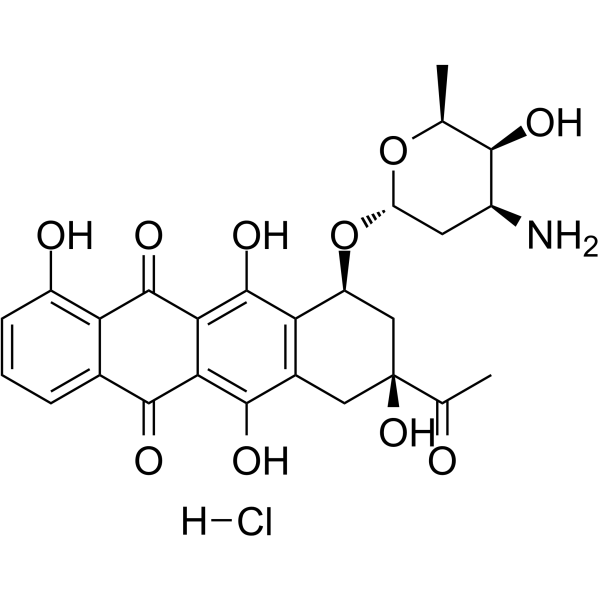
Carubicin hydrochloride (Standard) (Carminomycin hydrochloride (Standard)) is the analytical standard of Carubicin hydrochloride (HY-B2171A). This product is intended for research and analytical applications. Carubicin hydrochloride is a microbially-derived compound. Carubicin hydrochloride is an effective inhibitor of VHL-defective (VHL?/?) CCRCC cell proliferation. Carubicin hydrochloride also induces apoptosis by a mechanism independent of p53 or hypoxia-inducible factor HIF2. Carubicin hydrochloride has the potential for the research of cancer diseases.
For research use only. We do not sell to patients.
- CAS No.: 52794-97-5
- Formula: C26H28ClNO10
- Molecular Weight:549.95
-
Storage:
Please store the product under the recommended conditions in the Certificate of Analysis.


To place orders, for customer services and technical support, please contact: MedChemExpress USA
Tel: 609-228-6898 E-mail: [email protected] [email protected]


-
 Product Information
-
Chemical Information
- Purity & Documentation
-
 Help & FAQs




Product Information
Information
Application
The compound is the grade of analytical standard, which is the reference standard supplied assay. It is commonly used in qualitative, quantitative and methodological research experiments in HPLC, GC and MS.


Chemical Information
-
CAS No. 52794-97-5
-
Molecular Weight 549.95
-
Formula C26H28ClNO10
-
SMILES
OC1=C2C(C(C3=C(O)C=CC=C3C2=O)=O)=C(O)C([C@H]4O[C@H]5C[C@@H]([C@@H]([C@@H](O5)C)O)N)=C1C[C@](O)(C4)C(C)=O.[H]Cl
-
Synonyms
Carminomycin hydrochloride (Standard); Carminomicin I hydrochloride (Standard)
-
Structure Classification
-
Initial Source
-
Shipping
Room temperature in continental US; may vary elsewhere.
-
Storage
Please store the product under the recommended conditions in the Certificate of Analysis.


Purity & Documentation
References
[1]. Woldemichael GM, et al. Carminomycin I is an apoptosis inducer that targets the Golgi complex in clear cell renal carcinoma cells. Cancer Res. 2011 Jan 1;71(1):134-42. [Content Brief]
[2]. Tevyashova AN, et al. Carminomycin, 14-hydroxycarminomycin and its novel carbohydrate derivatives potently kill human tumor cells and their multidrug resistant variants. J Antibiot (Tokyo). 2004 Feb;57(2):143-50. [Content Brief]

Calculators
Concentration (start) × Volume (start) = Concentration (final) × Volume (final)


Carubicin hydrochloride (Standard) Related Classifications
HY-B2171AR Related Classifications
 Powered by Bioz