



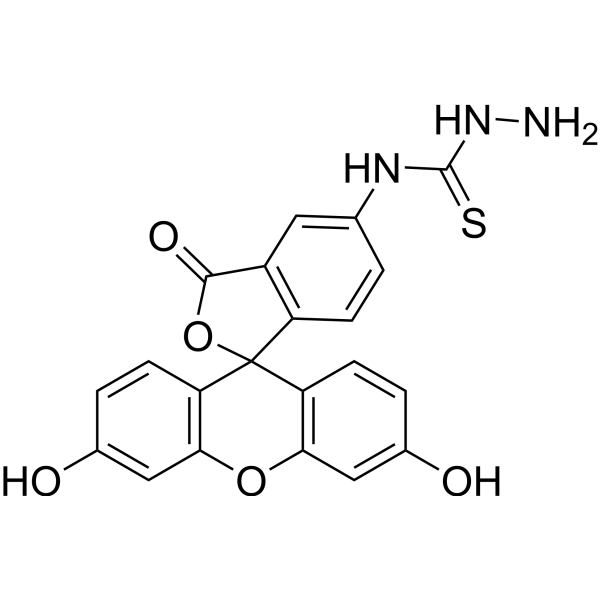
Fluorescein-5-thiosemicarbazide

Based on 1 Customer Validation
Fluorescein-5-thiosemicarbazide is a green fluorescent probe used for carbonyl labeling. The thiosemicarbazide group of FTSC reacts with aldehyde groups at the reducing ends of carbohydrates via reductive amination, and can also undergo chemoselective ligation with ketone groups in systems such as 2-keto Ac4GalNAc to form stable fluorescent derivatives. FTSC is applicable for fluorescent labeling of carbohydrates and enables fluorescence imaging of mucin-type O-linked glycoproteins in the 2-keto Ac4GalNAc metabolic labeling system. Free FTSC exhibits Ex/Em = 495/517 nm in PBS. FTSC is suitable for carbohydrate labeling and cellular glycosylation imaging studies.
For research use only. We do not sell to patients.
- Purity : 97.0%
- CAS No.: 76863-28-0
- Formula: C21H15N3O5S
- Molecular Weight:421.43
-
Storage:
4°C, protect from light
* In solvent : -80°C, 6 months; -20°C, 1 month (protect from light)

To place orders, for customer services and technical support, please contact: MedChemExpress USA
Tel: 609-228-6898 E-mail: [email protected] [email protected]


-
 Biological Activity
-
Chemical Information
-
Solvent & Solubility
- Protocols
- Purity & Documentation
- References
-
 Help & FAQs




Biological Activity
Description
In Vitro
1. Stock Solution Preparation
1.1 Solvent: In the literature, it is directly dissolved in PBS buffer (pH 7.0) to prepare a 100 μM solution.
1.2 Concentration Recommendation: It is generally recommended to prepare a high-concentration stock solution of 1-10 mM.
2. Working Solution Preparation
2.1 Diluent: Prepare the working solution using PBS (pH 7.0).
2.2 Working Concentration: For chemoselective labeling of CHO and HeLa cells, the working concentration of Fluorescein-5-thiosemicarbazide is 100 μM. For carbohydrate reductive amination labeling, the optimized Fluorescein-5-thiosemicarbazide:carbohydrate molar ratio is 6:1, the reaction temperature is 75 °C, the reaction time is 1 h, and the HOAc addition volume is 30 μL.
2.3 Note: Adjust the working solution concentration as needed; prepare fresh before use.
3. Staining Procedure
3.1 Cell Samples: Suitable for CHO and HeLa adherent cells; in the literature, cells are first treated with 2-keto Ac4GalNAc analogue (50 μM) for 2 days.
3.2 Incubation Conditions: Add Fluorescein-5-thiosemicarbazide (100 μM, PBS, pH 7.0) and incubate at 37 °C for 1 h.
3.3 Washing Steps: After the reaction, wash 3 times with cold PBS to remove unbound Fluorescein-5-thiosemicarbazide.
4. Controls
4.1 Medium Control: Treat with medium only.
4.2 2-keto Ac4GalNAc analogue Control: Treat with 2-keto Ac4GalNAc analogue only.
4.3 Fluorescein-5-thiosemicarbazide Control: Add Fluorescein-5-thiosemicarbazide only.
4.4 Complete Labeling Group: Perform Fluorescein-5-thiosemicarbazide labeling after 2-keto Ac4GalNAc analogue pretreatment.
5. Detection and Analysis
5.1 Instrument Settings: A confocal fluorescence microscope or flow cytometer can be used with a green fluorescence channel excited at 488 nm. The Ex/Em of free Fluorescein-5-thiosemicarbazide is 495/517 nm.
5.2 Result Analysis: After complete labeling, CHO and HeLa cells exhibit distinct green fluorescence signals, visible in the cell membrane, cytoplasm, and nucleus; the fluorescence of CHO cells is slightly higher than that of HeLa cells.
MedChemExpress (MCE) has not independently confirmed the accuracy of these methods. They are for reference only.
Emission (Em)
522


Chemical Information
-
CAS No. 76863-28-0
-
Appearance Solid
-
Molecular Weight 421.43
-
Formula C21H15N3O5S
-
Color Yellow to orange
-
SMILES
NNC(NC1=CC2=C(C3(C4=C(OC5=C3C=CC(O)=C5)C=C(O)C=C4)OC2=O)C=C1)=S
-
Shipping
Room temperature in continental US; may vary elsewhere.
-
Storage
4°C, protect from light
* In solvent : -80°C, 6 months; -20°C, 1 month (protect from light)


Solvent & Solubility
In Vitro:
DMSO : 125 mg/mL (296.61 mM; Need ultrasonic; Hygroscopic DMSO has a significant impact on the solubility of product, please use newly opened DMSO)
Please refer to the solubility information to select the appropriate solvent. Once prepared, please aliquot and store the solution to prevent product inactivation from repeated freeze-thaw cycles.
Storage method and period of stock solution: -80°C, 6 months; -20°C, 1 month (protect from light). When stored at -80°C, please use it within 6 months. When stored at -20°C, please use it within 1 month.
Concentration (start) × Volume (start) = Concentration (final) × Volume (final)


Purity & Documentation
-
Data Sheet (279 KB)
-
SDS (394 KB)
- English - EN (394 KB)
- Français - FR (394 KB)
- Deutsch - DE (394 KB)
- Norwegian - NO (394 KB)
- Español - ES (394 KB)
- Swedish - SV (394 KB)
- Italian - IT (394 KB)
- Korean - KR (394 KB)
- Portuguese - PT (394 KB)
-
Handling Instructions (2659 KB)
References


Complete Stock Solution Preparation Table
Please refer to the solubility information to select the appropriate solvent. Once prepared, please aliquot and store the solution to prevent product inactivation from repeated freeze-thaw cycles.
Storage method and period of stock solution: -80°C, 6 months; -20°C, 1 month (protect from light). When stored at -80°C, please use it within 6 months. When stored at -20°C, please use it within 1 month.
| Optional Solvent | Concentration Solvent Mass | 1 mg | 5 mg | 10 mg | 25 mg |
|---|---|---|---|---|---|
| DMSO | 1 mM | 2.3729 mL | 11.8644 mL | 23.7287 mL | 59.3218 mL |
| 5 mM | 0.4746 mL | 2.3729 mL | 4.7457 mL | 11.8644 mL | |
| 10 mM | 0.2373 mL | 1.1864 mL | 2.3729 mL | 5.9322 mL | |
| 15 mM | 0.1582 mL | 0.7910 mL | 1.5819 mL | 3.9548 mL | |
| 20 mM | 0.1186 mL | 0.5932 mL | 1.1864 mL | 2.9661 mL | |
| 25 mM | 0.0949 mL | 0.4746 mL | 0.9491 mL | 2.3729 mL | |
| 30 mM | 0.0791 mL | 0.3955 mL | 0.7910 mL | 1.9774 mL | |
| 40 mM | 0.0593 mL | 0.2966 mL | 0.5932 mL | 1.4830 mL | |
| 50 mM | 0.0475 mL | 0.2373 mL | 0.4746 mL | 1.1864 mL | |
| 60 mM | 0.0395 mL | 0.1977 mL | 0.3955 mL | 0.9887 mL | |
| 80 mM | 0.0297 mL | 0.1483 mL | 0.2966 mL | 0.7415 mL | |
| 100 mM | 0.0237 mL | 0.1186 mL | 0.2373 mL | 0.5932 mL |


Fluorescein-5-thiosemicarbazide Related Classifications
HY-D0099 Related Classifications
 Powered by Bioz