



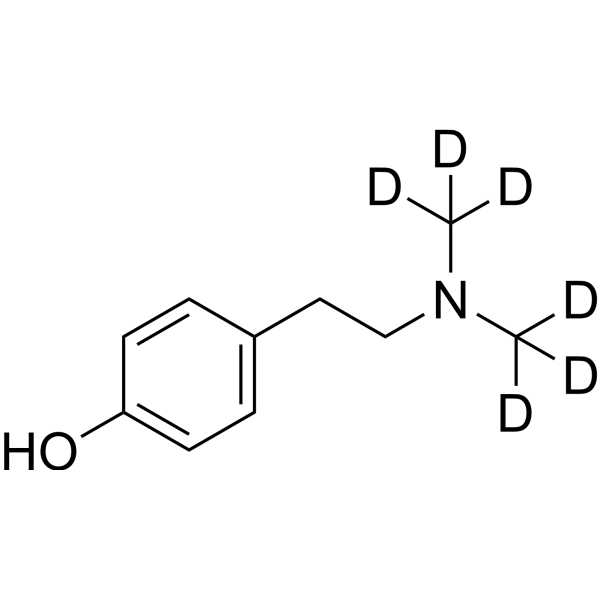
Hordenine-d6

Based on 1 Customer Validation
Hordenine-d6 (Ordenina-d6; Peyocactine-d6) is the deuterated-labeled Hordenine (HY-N0113). Hordenine (Ordenina; Peyocactine) is a multifunctional alkaloid with oral activity and blood-brain barrier penetration. Hordenine inhibits LPS-induced phosphorylation of p38, JNK, ERK1/2, p65, IκB, and AKT, prevents p65 nuclear translocation, and suppresses inflammatory cytokines and mediators. Hordenine promotes M2 macrophage polarization, restores blood-milk barrier integrity, alleviates oxidative stress by reducing ROS and MDA, and attenuates LPS-induced lung injury and pulmonary edema. Hordenine inhibits cAMP production, CREB phosphorylation, and MITF expression, thereby suppressing melanin synthesis in melanocytes and reconstructed epidermis. Hordenine activates the Wnt/β-catenin signaling pathway, promotes dermal papilla cell proliferation and hair shaft elongation, and accelerates hair regeneration. Hordenine activates DRD2, acts as a D3R partial agonist, α2A-AR full agonist, and 5-HT2A-R antagonist, and inhibits SERT and DAT. Hordenine inhibits α-synuclein accumulation and ameliorates motor deficits in Parkinson's disease models. Hordenine limits alcohol intake, reduces relapse drinking behavior, and modulates alcohol-induced conditioned place preference. Hordenine can be used for research on mastitis, skin pigmentation, acute lung injury, foodborne diseases, hair loss, Parkinson's disease, bacterial infections, and alcohol use disorder.
For research use only. We do not sell to patients.
- Purity : 98.03%
- CAS No.: 1346598-66-0
- Formula: C10H9D6NO
- Molecular Weight:171.27
-
Storage:
4°C, stored under nitrogen
* In solvent : -80°C, 6 months; -20°C, 1 month (stored under nitrogen)

To place orders, for customer services and technical support, please contact: MedChemExpress USA
Tel: 609-228-6898 E-mail: [email protected] [email protected]


-
 Biological Activity
-
Chemical Information
-
Solvent & Solubility
- Protocols
- Purity & Documentation
- References
-
 Help & FAQs


All Dopamine Receptor Isoforms
MoreAll Adrenergic Receptor Isoforms
MoreAll 5-HT Receptor Isoforms
MoreAll α-synuclein Isoforms
More

Biological Activity
Description
Application
1. This compound can be used as a tracer
2. This compound can be used as an internal standard for quantitative analysis by NMR, GC-MS, or LC-MS.


Chemical Information
-
CAS No. 1346598-66-0
-
Unlabeled CAS 539-15-1
-
Appearance Solid
-
Molecular Weight 171.27
-
Formula C10H9D6NO
-
Color White to off-white
-
SMILES
[2H]C([2H])([2H])N(C([2H])([2H])[2H])CCC1=CC=C(C=C1)O
-
Synonyms
Ordenina-d6; Peyocactine-d6
-
Shipping
Room temperature in continental US; may vary elsewhere.
-
Storage
4°C, stored under nitrogen
* In solvent : -80°C, 6 months; -20°C, 1 month (stored under nitrogen)


Solvent & Solubility
In Vitro:
DMF : ≥ 25 mg/mL (145.97 mM)
DMSO : ≥ 20 mg/mL (116.77 mM; Hygroscopic DMSO has a significant impact on the solubility of product, please use newly opened DMSO)
Ethanol : ≥ 5 mg/mL (29.19 mM)
* "≥" means soluble, but saturation unknown.
Please refer to the solubility information to select the appropriate solvent. Once prepared, please aliquot and store the solution to prevent product inactivation from repeated freeze-thaw cycles.
Storage method and period of stock solution: -80°C, 6 months; -20°C, 1 month (stored under nitrogen). When stored at -80°C, please use it within 6 months. When stored at -20°C, please use it within 1 month.
Concentration (start) × Volume (start) = Concentration (final) × Volume (final)


Purity & Documentation
-
Data Sheet (275 KB)
-
SDS (252 KB)
- English - EN (252 KB)
- Français - FR (252 KB)
- Deutsch - DE (252 KB)
- Norwegian - NO (252 KB)
- Español - ES (252 KB)
- Swedish - SV (252 KB)
- Italian - IT (252 KB)
- Korean - KR (252 KB)
- Portuguese - PT (252 KB)
-
Handling Instructions (2659 KB)
References
[2]. Kim SC, et al. Hordenine, a single compound produced during barley germination, inhibits melanogenesis in human melanocytes. Food chemistry. 2013 Nov 01;141(1):174-81. [Content Brief]
[6]. Li H, et al. Hordenine improves Parkinsonian-like motor deficits in mice and nematodes by activating dopamine D2 receptor-mediated signaling. Phytotherapy research : PTR. 2023 Aug;37(8):3296-3308. [Content Brief]


Complete Stock Solution Preparation Table
Please refer to the solubility information to select the appropriate solvent. Once prepared, please aliquot and store the solution to prevent product inactivation from repeated freeze-thaw cycles.
Storage method and period of stock solution: -80°C, 6 months; -20°C, 1 month (stored under nitrogen). When stored at -80°C, please use it within 6 months. When stored at -20°C, please use it within 1 month.
| Optional Solvent | Concentration Solvent Mass | 1 mg | 5 mg | 10 mg | 25 mg |
|---|---|---|---|---|---|
| Ethanol / DMSO / DMF | 1 mM | 5.8387 mL | 29.1937 mL | 58.3873 mL | 145.9684 mL |
| 5 mM | 1.1677 mL | 5.8387 mL | 11.6775 mL | 29.1937 mL | |
| 10 mM | 0.5839 mL | 2.9194 mL | 5.8387 mL | 14.5968 mL | |
| 15 mM | 0.3892 mL | 1.9462 mL | 3.8925 mL | 9.7312 mL | |
| 20 mM | 0.2919 mL | 1.4597 mL | 2.9194 mL | 7.2984 mL | |
| 25 mM | 0.2335 mL | 1.1677 mL | 2.3355 mL | 5.8387 mL | |
| DMSO / DMF | 30 mM | 0.1946 mL | 0.9731 mL | 1.9462 mL | 4.8656 mL |
| 40 mM | 0.1460 mL | 0.7298 mL | 1.4597 mL | 3.6492 mL | |
| 50 mM | 0.1168 mL | 0.5839 mL | 1.1677 mL | 2.9194 mL | |
| 60 mM | 0.0973 mL | 0.4866 mL | 0.9731 mL | 2.4328 mL | |
| 80 mM | 0.0730 mL | 0.3649 mL | 0.7298 mL | 1.8246 mL | |
| 100 mM | 0.0584 mL | 0.2919 mL | 0.5839 mL | 1.4597 mL |


Hordenine-d6 Related Classifications
HY-N0113S Related Classifications
 Powered by Bioz
Keywords
- Hordenine-d6
- 1346598-66-0
- Ordenina-d6
- Peyocactine-d6
- Isotope-Labeled Compounds
- Bacterial
- p38 MAPK
- JNK
- ERK
- Akt
- Interleukin Related
- TNF Receptor
- NO Synthase
- COX
- Reactive Oxygen Species (ROS)
- Microphthalmia Associated Transcription Factor (MITF)
- Wnt
- β-catenin
- Dopamine Receptor
- Adrenergic Receptor
- 5-HT Receptor
- Serotonin Transporter
- Dopamine Transporter
- α-synuclein
- TRP-1
- tyrosinase
- MITF
- cAMP
- Nrf2
- HO-1
- TLR4
- NF-κB
- AMPK
- MAPK
- Inhibitor
- inhibitor
- inhibit