



JNJ-46356479

Based on 1 Customer Validation
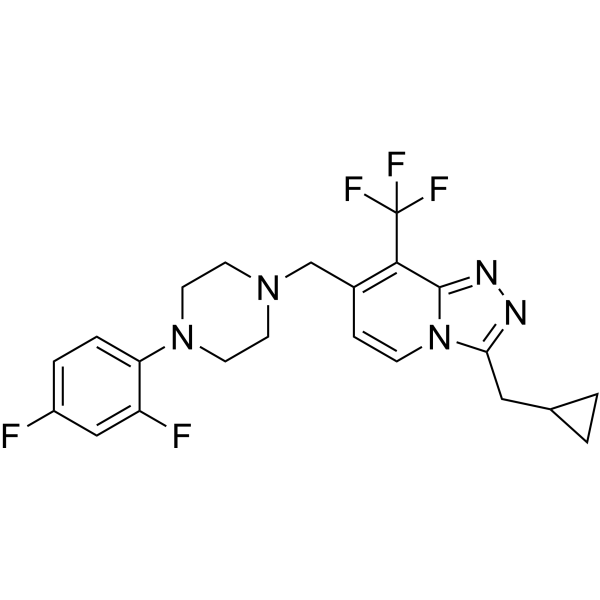
JNJ-46356479 is a blood-brain barrier-penetrant mGluR2/3 allosteric activator. JNJ-46356479 binds to the mGluR2 PAM site to enhance mGluR2 activity, thereby inhibiting presynaptic glutamate release and modulating adenylate cyclase (Adenylate Cyclase), calcium channel (CRAC Channel) activity, and neuronal excitability. JNJ-46356479 exhibits anticonvulsant activity in psychomotor seizures and corneal kindling, and can be used in the study of schizophrenia and epilepsy.
For research use only. We do not sell to patients.
- Purity : 99.77%
- CAS No.: 1254979-66-2
- Formula: C22H22F5N5
- Molecular Weight:451.44
-
Storage:Powder -20°C, 3 years , 4°C, 2 years ; In solvent -80°C, 6 months , -20°C, 1 month

To place orders, for customer services and technical support, please contact: MedChemExpress USA
Tel: 609-228-6898 E-mail: [email protected] [email protected]


-
 Biological Activity
-
Chemical Information
-
Solvent & Solubility
- Protocols
- Purity & Documentation
- References
-
 Help & FAQs


Biological Activity
Description
IC50 & Target
[1]|
mGluR2 |
mGluR3 |
Cellular Effect
|
Cell Line

|
Type | Value | Description | References |
|---|---|---|---|---|
| CHO | EC50 |
78 nM
Compound: 27; JNJ-46356479
|
Positive allosteric modulation of human mGlu2 receptor expressed in CHO cell membranes assessed as potentiation of glutamate-induced effect incubated for 30 mins prior to [35S]GTPgamma addition measured after 30 mins by scintillation counting method
Positive allosteric modulation of human mGlu2 receptor expressed in CHO cell membranes assessed as potentiation of glutamate-induced effect incubated for 30 mins prior to [35S]GTPgamma addition measured after 30 mins by scintillation counting method
|
[PMID: 27579727] |
| CHO-K1 | EC50 |
1410 nM
Compound: 27; JNJ-46356479
|
Positive allosteric modulation at human mGlu2 receptor N735D mutant expressed in CHO-K1 cells assessed as potentiation of glutamate-induced effect incubated for 30 mins prior to [35S]GTPgamma addition measured after 30 mins by scintillation counting metho
Positive allosteric modulation at human mGlu2 receptor N735D mutant expressed in CHO-K1 cells assessed as potentiation of glutamate-induced effect incubated for 30 mins prior to [35S]GTPgamma addition measured after 30 mins by scintillation counting metho
|
[PMID: 27579727] |
| CHO-K1 | EC50 |
2340 nM
Compound: 27; JNJ-46356479
|
Positive allosteric modulation at human mGlu2 receptor W773A mutant expressed in CHO-K1 cells assessed as potentiation of glutamate-induced effect incubated for 30 mins prior to [35S]GTPgamma addition measured after 30 mins by scintillation counting metho
Positive allosteric modulation at human mGlu2 receptor W773A mutant expressed in CHO-K1 cells assessed as potentiation of glutamate-induced effect incubated for 30 mins prior to [35S]GTPgamma addition measured after 30 mins by scintillation counting metho
|
[PMID: 27579727] |
| CHO-K1 | EC50 |
45.7 nM
Compound: 27; JNJ-46356479
|
Positive allosteric modulation of wild-type human mGlu2 receptor expressed in CHO-K1 cells assessed as potentiation of glutamate-induced effect incubated for 30 mins prior to [35S]GTPgamma addition measured after 30 mins by scintillation counting method
Positive allosteric modulation of wild-type human mGlu2 receptor expressed in CHO-K1 cells assessed as potentiation of glutamate-induced effect incubated for 30 mins prior to [35S]GTPgamma addition measured after 30 mins by scintillation counting method
|
[PMID: 27579727] |
| CHO-K1 | EC50 |
6610 nM
Compound: 27; JNJ-46356479
|
Positive allosteric modulation at human mGlu2 receptor F643A mutant expressed in CHO-K1 cells assessed as potentiation of glutamate-induced effect incubated for 30 mins prior to [35S]GTPgamma addition measured after 30 mins by scintillation counting metho
Positive allosteric modulation at human mGlu2 receptor F643A mutant expressed in CHO-K1 cells assessed as potentiation of glutamate-induced effect incubated for 30 mins prior to [35S]GTPgamma addition measured after 30 mins by scintillation counting metho
|
[PMID: 27579727] |
| CHO-K1 | EC50 |
977 nM
Compound: 27; JNJ-46356479
|
Positive allosteric modulation at wild type human mGlu2 receptor L732A mutant expressed in CHO-K1 cells assessed as potentiation of glutamate-induced effect preincubated for 30 mins prior to glutamate challenge measured after 30 mins by [35S]GTP-gammaS bi
Positive allosteric modulation at wild type human mGlu2 receptor L732A mutant expressed in CHO-K1 cells assessed as potentiation of glutamate-induced effect preincubated for 30 mins prior to glutamate challenge measured after 30 mins by [35S]GTP-gammaS bi
|
[PMID: 27579727] |
In Vitro
Parmacokinetics
| Species | Dose | Route | Plasma Concentration |
|---|---|---|---|
| Mice[5] | 2.5 (JNJ-46356479); 75 (VPA) (i.p.) mg/kg | s.c. | 0.48 μg/mL |
| Mice[5] | 5 (JNJ-46356479); 150 (VPA) (i.p.) mg/kg | s.c. | 0.85 μg/mL |
| Mice[5] | 10 (JNJ-46356479); 300 (VPA) (i.p.) mg/kg | s.c. | 1.77 μg/mL |
| Mice[5] | 2.5 (JNJ-46356479); 12.5 (LTG) (i.p.) mg/kg | s.c. | 0.38 μg/mL |
| Mice[5] | 5 (JNJ-46356479); 25 (LTG) (i.p.) mg/kg | s.c. | 0.99 μg/mL |
| Mice[5] | 10 (JNJ-46356479); 50 (LTG) (i.p.) mg/kg | s.c. | 2.19 μg/mL |
In Vivo
JNJ-46356479 (10 mg/kg; s.c.; once daily; from PND 80 throughout the study period) is associated with low PFC caspase-3 levels and a low PFC Bax/Bcl-2 ratio in non-induced C57BL/6J mice[6].
JNJ-46356479 (10 mg/kg; s.c.; once daily; from PND 80 throughout the study period) partially restores PFC Bcl-2 levels and the Bax/Bcl-2 ratio, and attenuates the induced pro-apoptotic state in a postpartum-induced C57BL/6J mouse model of schizophrenia[6].
JNJ-46356479 (10 mg/kg; s.c.; daily; PND 35-60) ameliorates cognitive and social deficits and normalizes hippocampal c-Fos immunoreactivity in a postpartum NMDA receptor antagonist C57BL/6J mouse model of schizophrenia[3].
JNJ-46356479 (10 mg/kg; s.c.; once daily; PND 35 to PND 60) administered during adolescence to C57BL/6J mice postnatally exposed to an NMDA receptor antagonist decreases hippocampal VGLUT1 levels in the CA1 and CA3 regions, partially reversing the NMDA receptor antagonist-induced elevation of this glutamatergic synaptic marker[4].
JNJ-46356479 (2.5-20 mg/kg; s.c.; single injection; 0.5 h before testing) is active in the more pharmacoresistant 6-Hz 44-mA model in adult male CF-1 mice, with an ED50 of 10.2 mg/kg[5].
JNJ-46356479 (0.3-5.1 mg/kg; s.c.; single injection; 0.5 h before testing) co-administered with LEV (11.3-271.5 mg/kg; i.p.; single injection; 1 h before testing) produces efficacy greater than the predicted additive effect at 1:1, 1:3, and 3:1 fixed-dose ratios in the 6-Hz 44-mA model in adult male CF-1 mice[5].
JNJ-46356479 (20-30 mg/kg; s.c.; single dose; 0.5 h before testing) combined with LEV (3 mg/kg; i.p.; single dose; 1 h before testing) produces complete seizure protection in the adult male CF-1 mouse corneal kindling model, with all mice protected at 30 mg/kg JNJ-46356479 plus 3 mg/kg LEV[5].
JNJ-46356479 (2.5-10 mg/kg; s.c.; single injection; 0.5 h before testing) combined with Valproic acid (VPA) (HY-10585) (37.5-300 mg/kg; i.p.; single injection; 0.25 h before testing) produces additive rather than synergistic anticonvulsant protection in the 6-Hz 44-mA model in adult male CF-1 mice[5].
JNJ-46356479 (2.5-10 mg/kg; s.c.; single injection; 0.5 h before testing) combined with Lamotrigine (LTG) (HY-B0495) (12.5-50 mg/kg; i.p.; single injection; 1 h before testing) produces additive rather than synergistic seizure protection in the 6-Hz 44-mA model in adult male CF-1 mice[5].
MedChemExpress (MCE) has not independently confirmed the accuracy of these methods. They are for reference only.
-
Animal Model:C57BL6J (male and female)[1]
-
Dosage:10 mg/kg
-
Administration:s.c.; daily; 2 weeks during adulthood (PND > 80; table reports PND 80)
-
Result:Working memory partially recovered (Y-maze).
Social motivation and social memory increased (TCST and 5T-SMT).
Parvalbumin-positive neurons increased.
c-Fos-positive neurons decreased.
Proapoptotic protein levels decreased.
Table 2 reported increased working memory, increased social motivation, increased social memory, increased parvalbumin-positive neurons, decreased c-Fos-positive neurons, and decreased proapoptotic protein levels.
-
Animal Model:C57BL6J (male and female)[1]
-
Dosage:10 mg/kg
-
Administration:s.c.; chronically; PND 35 to 60
-
Result:Working memory improved.
Social motivation increased.
Social memory increased.
Parvalbumin-positive neurons increased.
c-Fos-positive neurons increased.
Nitrosative stress decreased.
Effects were observed in adult mice and maintained during adulthood.
Table 2 reported increased working memory, increased social motivation, increased social memory, increased parvalbumin-positive neurons, increased c-Fos-positive neurons, and decreased nitrosative stress.
-
Animal Model:wildtype (mGluR2 WT littermate; weight 200-600 g)[2]
-
Dosage:4 mg/kg
-
Administration:i.v.; single injection; during scanning at 30 min after radiotracer injection
-
Result:No displacement of 11C-JNJ-42491293 binding was observed after JNJ-46356479 (4 mg/kg, i.v.) in wildtype rats.
-
Animal Model:mGluR2 knockout (weight 200-600 g)[2]
-
Dosage:4 mg/kg
-
Administration:i.v.; single injection; during scanning at 30 min after radiotracer injection
-
Result:No displacement of 11C-JNJ-42491293 binding was observed after JNJ-46356479 (4 mg/kg, i.v.) in mGluR2 knockout rats.
-
Animal Model:C57BL/6J (male and female; postnatal NMDA receptor antagonist model; JNJ-46356479 administration during PND 35-60; behavioral testing at PND >90)[3]
-
Dosage:10 mg/kg
-
Administration:s.c.; daily; PND 35-60
-
Result:In the Novel Object Recognition test, JNJ-46356479 mice and NMDA receptor antagonist + JNJ-46356479 mice showed preference for the novel object; NMDA receptor antagonist-exposed mice did not show this preference, and this preference was recovered by JNJ-46356479.
In the three-chamber social novelty test, JNJ-46356479 mice showed preference for the novel animal, and NMDA receptor antagonist + JNJ-46356479 mice recovered this preference.
In the sociability phase, JNJ-46356479 mice preferred a familiar littermate over a toy mouse.
In the five-trial social memory test, the JNJ-46356479 group showed a progressive reduction in time exploring the same animal across trials 1-4: 18.0 s, 13.8 s, 10.2 s, and 7.5 s, respectively.
After four trials, JNJ-46356479 and NMDA receptor antagonist + JNJ-46356479 mice showed increased interaction with a novel mouse in the fifth trial; NMDA receptor antagonist + JNJ-46356479 mice recovered interest in the novel animal.
In the Y-maze, JNJ-46356479 animals showed spontaneous alternation around 80%.
In the rotarod acceleration cycle, JNJ-46356479 mice showed a lower latency to fall compared with controls.
NMDA receptor antagonist + JNJ-46356479 mice recovered prehensile reflex and traction capacity to control levels.
In the mPFC, the NMDA receptor antagonist reduced PV+ interneuron density by almost 25%; the NMDA receptor antagonist + JNJ-46356479 group was included in PV/c-Fos analyses and representative confocal images, while the NMDA receptor antagonist + comparator group recovered control PV values; mPFC c-Fos differences between groups were not significant.
In the hippocampus, JNJ-46356479 normalized c-Fos immunoreactivity in sections DG, CA1, CA2, and CA3, completely reversing the up to 40% NMDA receptor antagonist-induced reduction in c-Fos expression; Bonferroni comparisons showed differences between the NMDA receptor antagonist and NMDA receptor antagonist + JNJ-46356479 groups in DG, CA1, CA2, and CA3.
No significant differences in PV+ cells were detected between groups.
-
Animal Model:C57BL/6J (male and female; administered during adolescence PND 35-60 and assessed in adulthood PND 120)[4]
-
Dosage:10 mg/kg
-
Administration:s.c.; once daily; PND 35 to PND 60
-
Result:In NMDA receptor antagonist-exposed mice, VGLUT1 levels were increased in all HPC regions, with significant increases in CA3 and almost significant increases in CA1 versus control.
Administration in NMDA receptor antagonist-exposed mice restored VGLUT1 levels toward control levels in the hippocampus.
Significantly reduced VGLUT1 levels in hippocampal CA1 and CA3 compared with NMDA receptor antagonist+vehicle.
In CA3, VGLUT1 levels in NMDA receptor antagonist+JNJ-46356479 mice were significantly lower than in NMDA receptor antagonist+clozapine mice.
In the PFC, no significant differences were found in VGLUT1, GAD65/67, or their ratio.
No significant differences were found in GAD65/67 levels or in the VGLUT1/GAD65-67 ratio in any HPC region.
No significant differences between groups survived Bonferroni correction in the expression analysis of 240 selected glutamate/GABA pathway genes.
-
Animal Model:CF-1 (adult male, 25-40 g)[5]
-
Dosage:0.5, 2.5, 5, 10, and 20 mg/kg
-
Administration:s.c.; single injection; 0.5 h before testing
-
Result:In the 6-Hz 32-mA assay, JNJ-46356479 produced seizure protection as follows: 0.5 mg/kg = 1/8 protected; 2.5 mg/kg = 7/16 protected; 5 mg/kg = 8/12 protected; 10 mg/kg = 7/8 protected; 20 mg/kg = 8/8 protected.
Rotarod failures were: 0.5 mg/kg = 0/8; 2.5 mg/kg = 0/16; 5 mg/kg = 0/12; 10 mg/kg = 0/8; 20 mg/kg = 1/8.
ED50 (95% CI) = 2.8 mg/kg (1.3-4.3).
-
Animal Model:CF-1 (adult male, 25-40 g)[5]
-
Dosage:2.5, 10, 15, and 20 mg/kg
-
Administration:s.c.; single injection; 0.5 h before testing
-
Result:In the 6-Hz 44-mA assay, JNJ-46356479 produced seizure protection as follows: 2.5 mg/kg = 0/8 protected; 10 mg/kg = 4/8 protected; 15 mg/kg = 7/8 protected; 20 mg/kg = 8/8 protected.
Rotarod failures were: 2.5 mg/kg = 0/8; 10 mg/kg = 0/8; 15 mg/kg = 0/8; 20 mg/kg = 1/8.
ED50 (95% CI) = 10.2 mg/kg (3.1-12.4).
-
Animal Model:CF-1 (adult male, 25-40 g)[5]
-
Dosage:20 or 30 mg/kg (JNJ-46356479); 3 mg/kg (LEV)
-
Administration:s.c. for JNJ-46356479 and i.p. for LEV; single dose; 0.5 h before testing for JNJ-46356479 and 1 h before testing for LEV
-
Result:20 mg/kg alone produced 5/16 protected (31% protected).
30 mg/kg alone produced 3/12 protected (25% protected).
LEV 3 mg/kg + JNJ-46356479 20 mg/kg produced 7/10 protected (70% protected).
LEV 3 mg/kg + JNJ-46356479 30 mg/kg produced 10/10 protected (100% protected).
No notable motor toxicity was observed after JNJ-46356479 alone or in combination in corneal kindled mice.
-
Animal Model:CF-1 (adult male, 25-40 g)[5]
-
Dosage:JNJ-46356479 2.5, 5, and 10 mg/kg s.c. with LTG 12.5, 25, and 50 mg/kg i.p.
-
Administration:s.c. for JNJ-46356479 and i.p. for LTG; single injection; 0.5 h before testing for JNJ-46356479 and 1 h before testing for LTG
-
Result:For JNJ-46356479 + LTG at 2.5 + 12.5 mg/kg, protected/n was 0/8 and rotarod failures were 1/8.
At 5 + 25 mg/kg, protected/n was 6/8 and rotarod failures were 0/8.
At 10 + 50 mg/kg, protected/n was 8/8 and rotarod failures were 2/8.
ED50,exp and ED50,add for the JNJ-46356479/LTG combination did not differ.
-
Animal Model:C57BL/6J (male and female; Veh+JNJ group N=5, 2 males and 3 females; started at adulthood PND80)[6]
-
Dosage:10 mg/kg
-
Administration:s.c.; once daily; from PND 80 through the study period
-
Result:In PFC, caspase-3 protein levels were 42.54 densitometry arbitrary units in the Veh+JNJ group.
In PFC, the Bax/Bcl-2 ratio was 64.97 in the Veh+JNJ group.
No significant differences in Bax protein levels were seen in any brain tissue.
-
Animal Model:C57BL/6J (male and female; model+JNJ group N=6, 3 males and 3 females; started at adulthood PND80)[6]
-
Dosage:10 mg/kg
-
Administration:s.c.; once daily; from PND 80 through the study period
-
Result:In PFC, Bcl-2 protein levels were 119 densitometry arbitrary units in the model+JNJ group; JNJ administration partially restored the induced reduction in Bcl-2.
The Bax/Bcl-2 ratio in PFC and HPC was partially restored to control values in induced animals that received JNJ.
No significant differences in Bax protein levels were seen in any brain tissue.


Chemical Information
-
CAS No. 1254979-66-2
-
Appearance Solid
-
Molecular Weight 451.44
-
Formula C22H22F5N5
-
Color White to off-white
-
SMILES
FC1=CC=C(C(F)=C1)N2CCN(CC2)CC3=C(C4=NN=C(N4C=C3)CC5CC5)C(F)(F)F
-
Shipping
Room temperature in continental US; may vary elsewhere.
-
Storage
Powder -20°C 3 years 4°C 2 years In solvent -80°C 6 months -20°C 1 month


Solvent & Solubility
In Vitro:
DMSO : 100 mg/mL (221.51 mM; Need ultrasonic; Hygroscopic DMSO has a significant impact on the solubility of product, please use newly opened DMSO)
Please refer to the solubility information to select the appropriate solvent. Once prepared, please aliquot and store the solution to prevent product inactivation from repeated freeze-thaw cycles.
Storage method and period of stock solution: -80°C, 6 months; -20°C, 1 month. When stored at -80°C, please use it within 6 months. When stored at -20°C, please use it within 1 month.
Concentration (start) × Volume (start) = Concentration (final) × Volume (final)
In Vivo:
Select the appropriate dissolution method based on your experimental animal and administration route.
- For the following dissolution methods, please ensure to first prepare a clear stock solution using an In Vitro approach and then sequentially add co-solvents:
- To ensure reliable experimental results, the clarified stock solution can be appropriately stored based on storage conditions. As for the working solution for In Vivo experiments, it is recommended to prepare freshly and use it on the same day.
- The percentages shown for the solvents indicate their volumetric ratio in the final prepared solution. If precipitation or phase separation occurs during preparation, heat and/or sonication can be used to aid dissolution.
Add each solvent one by one: 10% DMSO 40% PEG300 5% Tween-80 45% Saline
Solubility: ≥ 2.5 mg/mL (5.54 mM); Clear solution
This protocol yields a clear solution of ≥ 2.5 mg/mL (saturation unknown).
Taking 1 mL working solution as an example, add 100 μL DMSO stock solution (25.0 mg/mL) to 400 μL PEG300, and mix evenly; then add 50 μL Tween-80 and mix evenly; then add 450 μL Saline to adjust the volume to 1 mL.
Preparation of Saline: Dissolve 0.9 g sodium chloride in ddH₂O and dilute to 100 mL to obtain a clear Saline solution.
Add each solvent one by one: 10% DMSO 90% (20% SBE-β-CD in Saline)
Solubility: ≥ 2.5 mg/mL (5.54 mM); Clear solution
This protocol yields a clear solution of ≥ 2.5 mg/mL (saturation unknown).
Taking 1 mL working solution as an example, add 100 μL DMSO stock solution (25.0 mg/mL) to 900 μL 20% SBE-β-CD in Saline, and mix evenly.
Preparation of 20% SBE-β-CD in Saline (4°C, storage for one week): 2 g SBE-β-CD powder is dissolved in 10 mL Saline, completely dissolve until clear.
In Vivo Dissolution Calculator
Please enter the basic information of animal experiments:
-
-
-
-
Recommended: Prepare an additional quantity of animals to account for potential losses during experiments.
Please enter your animal formula composition:
-
%DMSO +
Recommended: Keep the proportion of DMSO in working solution below 2% if your animal is weak.
-
%+
-
+%Tween-80 + +
-
%Saline +
The co-solvents required include: DMSO, . All of co-solvents are available by MedChemExpress (MCE). , Tween 80. All of co-solvents are available by MedChemExpress (MCE).
Working solution concentration: 0.22 mg/mL
Method for preparing stock solution: mg drug dissolved in μL DMSO. Stock solution concentration: mg/mL.
1. Take μL DMSO stock solution;
2. Add μL .
μL , mix evenly;
3. Then add μL Tween 80, mix evenly;
4. Then add μL
Please ensure that the stock solution in the first step is dissolved to a clear state, and add co-solvents in sequence. You can use ultrasonic heating (ultrasonic cleaner, recommended frequency 20-40 kHz), vortexing, etc. to assist dissolution.


Purity & Documentation
-
Data Sheet (296 KB)
-
SDS (394 KB)
- English - EN (394 KB)
- Français - FR (394 KB)
- Deutsch - DE (394 KB)
- Norwegian - NO (394 KB)
- Español - ES (394 KB)
- Swedish - SV (394 KB)
- Italian - IT (394 KB)
- Korean - KR (394 KB)
- Portuguese - PT (394 KB)
-
Handling Instructions (2659 KB)
References


Complete Stock Solution Preparation Table
Please refer to the solubility information to select the appropriate solvent. Once prepared, please aliquot and store the solution to prevent product inactivation from repeated freeze-thaw cycles.
Storage method and period of stock solution: -80°C, 6 months; -20°C, 1 month. When stored at -80°C, please use it within 6 months. When stored at -20°C, please use it within 1 month.
| Optional Solvent | Concentration Solvent Mass | 1 mg | 5 mg | 10 mg | 25 mg |
|---|---|---|---|---|---|
| DMSO | 1 mM | 2.2151 mL | 11.0757 mL | 22.1513 mL | 55.3783 mL |
| 5 mM | 0.4430 mL | 2.2151 mL | 4.4303 mL | 11.0757 mL | |
| 10 mM | 0.2215 mL | 1.1076 mL | 2.2151 mL | 5.5378 mL | |
| 15 mM | 0.1477 mL | 0.7384 mL | 1.4768 mL | 3.6919 mL | |
| 20 mM | 0.1108 mL | 0.5538 mL | 1.1076 mL | 2.7689 mL | |
| 25 mM | 0.0886 mL | 0.4430 mL | 0.8861 mL | 2.2151 mL | |
| 30 mM | 0.0738 mL | 0.3692 mL | 0.7384 mL | 1.8459 mL | |
| 40 mM | 0.0554 mL | 0.2769 mL | 0.5538 mL | 1.3845 mL | |
| 50 mM | 0.0443 mL | 0.2215 mL | 0.4430 mL | 1.1076 mL | |
| 60 mM | 0.0369 mL | 0.1846 mL | 0.3692 mL | 0.9230 mL | |
| 80 mM | 0.0277 mL | 0.1384 mL | 0.2769 mL | 0.6922 mL | |
| 100 mM | 0.0222 mL | 0.1108 mL | 0.2215 mL | 0.5538 mL |


JNJ-46356479 Related Classifications
HY-124372 Related Classifications
 Powered by Bioz
Keywords
- JNJ-46356479
- 1254979-66-2
- JNJ46356479
- JNJ 46356479
- mGluR
- Adenylate Cyclase
- CRAC Channel
- 6-Hz model
- NMDA receptor
- VGLUT1
- Wistar rat
- adenylate cyclase
- apoptosis
- blood-brain barrier
- c-Fos
- calcium channel
- caspase-3
- corneal kindling
- epilepsy
- glutamate release
- mGluR2
- mGluR2/3
- nitrosative stress
- parvalbumin-positive neurons
- schizophrenia
- social memory
- working memory
- Inhibitor
- inhibitor
- inhibit