



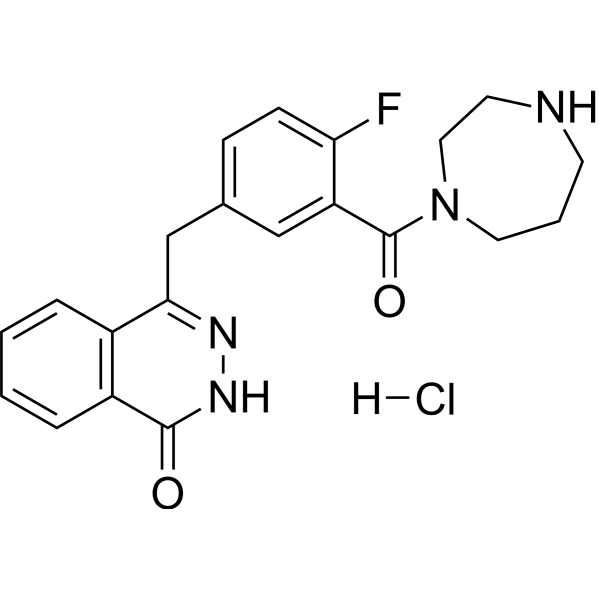
KU-0058948 hydrochloride
KU-0058948 hydrochloride is a potent PARP1 inhibitor with an IC50 of 3.4 nM. KU-0058948 hydrochloride induces the accumulation of DNA double-strand breaks through inhibition of PARP1, triggering chromosomal aberrations, cell cycle arrest, and apoptosis in homologous recombination-deficient cells, while impeding the recruitment of the NuRD/PcG complex to affect chromatin remodeling. KU-0058948 hydrochloride can be used for research on cancers such as myeloid leukemia.
For research use only. We do not sell to patients.
- CAS No.: 2108829-86-1
- Formula: C21H22ClFN4O2
- Molecular Weight:416.88
-
Storage:
Please store the product under the recommended conditions in the Certificate of Analysis.

To place orders, for customer services and technical support, please contact: MedChemExpress USA
Tel: 609-228-6898 E-mail: [email protected] [email protected]


-
 Biological Activity
-
Chemical Information
- Protocols
- Purity & Documentation
- References
-
 Help & FAQs


Biological Activity
Description
IC50 & Target
[1]|
PARP-1 3.4 nM (IC50) |
In Vitro
KU-0058948 (1 μM; 24 h) hydrochloride significantly increases γH2AX phosphorylation foci and reduces rad51 foci formation in sensitive leukemia cell lines (P39, Mutz-3) and primary AML cells, thereby confirming the presence of homologous recombination deficiency in these cells[2].
KU-0058948 (5-10 nM; 5-14 days) hydrochloride does not enhance the cytotoxicity of the DNA methyltransferase inhibitor (5'-aza-2'-CdR) (HY-A0004) in AML primary cells and leukemia cell lines (P39, HL60, Mutz-3), but produces a strong synergistic effect with the histone deacetylase (HDAC) inhibitor MS275 (HY-12163), significantly enhancing the cytotoxicity of MS275[2].
KU-0058948 (100 μM; 24 h) hydrochloride in P39 and Mutz-3 cells, when combined with 100 nM MS275 exposure, extremely significantly increases γH2AX phosphorylation focus formation compared with the product alone[2].
KU-0058948 (10 µM; 3 h) hydrochloride inhibits local UV-induced loss of GFP-H1 and GFP-H4 in damaged U2OS cells[3].
KU-0058948 (1 μM; 4-16 h) hydrochloride significantly inhibits the large-scale chromatin decondensation induced by tethered DDB2 in human U2OS 2-6-3 cells containing a LacO array[3].
KU-0058948 (10 µM; 3 h) hydrochloride significantly inhibits the recruitment of the repair protein XPC to UV-induced DNA damage sites and limits its immobilization on chromatin in human U2OS cells and XP4PA cells[3].
KU-0058948 hydrochloride (1 μM; 1 h before UV laser microirradiation) abolishes the recruitment of MEL-18 to UV laser-induced DNA damage sites in HeLa cells[4].
KU-0058948 hydrochloride inhibits the recruitment of MTA1 and CHD4 to UV laser-induced DNA damage sites in cells[4].
KU-0058948 (1 h before UV laser microirradiation) hydrochloride reverses the manifestation of PARG siRNA-induced m7G cap and RNAP2-ser2 resistance stripes at UV laser microirradiation sites in HeLa cells, indicating that PARP activity is required for transcriptional repression at DNA damage sites[4].
KU-0058948 hydrochloride (1 µM; 1 h) inhibits PARP1 poly (ADP-ribosyl) ation but does not alter the kinetics of Menadione (HY-B1897A)-induced global CSB-chromatin binding in CS1AN-CSBWT cells[5].
KU-0058948 hydrochloride (1 µM; 1 h) reduces Menadione-induced CSB occupancy at chrX-1 and chrX-2 in CS1AN-CSBWT cells, but does not affect chr17-1 or chr19-2[5].
KU-0058948 (1 µM; 24 h) hydrochloride increases NHEJ end-joining efficiency and error-prone repair frequency in fibroblast nuclear extracts, with BLM−/− error-prone repair rising from 8.7% to 15.9%[6].
KU-0058948 (10 pM-10 µM; 12-14 days) hydrochloride reduces clonogenic survival of chromosomally unstable fibroblasts, with BRCA2−/− cells exhibiting 10-fold greater sensitivity than ATM−/− and NBS1−/− cells[6].
KU-0058948 (1 µM; 24 h) hydrochloride eliminates Rad51 foci in BRCA2−/−, ATM−/−, and NBS1−/− fibroblasts but does not affect BLM−/− or DNL IV−/− fibroblasts[6].
KU-0058948 (0.1-10 μM; 7-10 days) hydrochloride reduces clonogenic survival to a greater extent in Brca1S971A/S971A MEFs than in Brca1C/C MEFs in the p53−/− background, indicating moderate PARP inhibitor hypersensitivity[7].
KU-0058948 hydrochloride potently and completely blocks PARP enzyme activity in purified HDAC enzyme and recombinant human PARP enzyme reaction systems but has no direct inhibitory effect on HDAC enzyme activity[2].
KU-0058948 (10 μM; 30 min) hydrochloride inhibits recombinant H. aurantiacus PARP self-modification in a DNA-dependent cell-free assay[8].
KU-0058948 (2-20 min after microirradiation) hydrochloride does not alter the relocalization of PARP3 to laser-induced DNA damage sites in Cos1 cells[9].
KU-0058948 hydrochloride eliminates PARP3-stimulated tankyrase 1 auto-ADP-ribosylation and NuMA hetero-ADP-ribosylation in in vitro assays[9].
MedChemExpress (MCE) has not independently confirmed the accuracy of these methods. They are for reference only.
-
Cell Line:P39 and HL60 leukemic cell lines
-
Concentration:1 μM
-
Incubation Time:48, 72, 120 h
-
Result:Caused an accumulation of cells in the S phase and an increase in the G2/M population.
-
Cell Line:P39 cells
-
Concentration:1 μM
-
Incubation Time:24, 48, 72, 120 h
-
Result:Induced profound levels of apoptosis specifically in the repair-defective P39 cells, as confirmed by Annexin V staining and sub-G1 peak analysis at 120 h.
-
Cell Line:P39, Mutz-3 and primary AML patient cells
-
Concentration:1 μM, 100 μM
-
Incubation Time:24 h
-
Result:Induced significantly increased γH2AX phosphorylation foci in sensitive leukemic cells while failing to elicit Rad51 foci formation, confirming that the target cells lack an effective homologous recombination DNA repair pathway.
-
Cell Line:HeLa cells
-
Concentration:1 μM
-
Incubation Time:1 h before UV laser microirradiation
-
Result:Control cells efficiently recruited MEL-18 to DNA lesions.
MEL-18 recruitment was largely abrogated, while γH2AX stripes remained detectable at DNA damage sites.
-
Cell Line:CS1AN-CSBWT cells (CS1AN-sv cells stably expressing wild-type CSB)
-
Concentration:1 µM
-
Incubation Time:1 h
-
Result:Decreased poly(ADP-ribosyl)ation activity was observed by anti-PAR Western blot.
The kinetics of menadione-induced global CSB-chromatin association were not significantly changed; percent CSB co-fractionating with chromatin was similar to DMSO control across the indicated times.
-
Cell Line:CS1AN-CSBWT cells
-
Concentration:1 µM
-
Incubation Time:1 h
-
Result:CSB occupancy was significantly decreased at chrX-1 and chrX-2, but not at chr17-1 or chr19-2.


Chemical Information
-
CAS No. 2108829-86-1
-
Molecular Weight 416.88
-
Formula C21H22ClFN4O2
-
SMILES
O=C1NN=C(CC2=CC=C(F)C(C(N3CCNCCC3)=O)=C2)C4=C1C=CC=C4.[H]Cl
-
Shipping
Room temperature in continental US; may vary elsewhere.
-
Storage
Please store the product under the recommended conditions in the Certificate of Analysis.


Purity & Documentation
References
[1]. Farmer H, et al. Targeting the DNA repair defect in BRCA mutant cells as a therapeutic strategy. Nature. 2005 Apr 14;434(7035):917-21. [Content Brief]
[2]. Gaymes TJ, et al. Inhibitors of poly ADP-ribose polymerase (PARP) induce apoptosis of myeloid leukemic cells: potential for therapy of myeloid leukemia and myelodysplastic syndromes. Haematologica. 2009 May;94(5):638-46. [Content Brief]
[8]. Slade D, et al. The structure and catalytic mechanism of a poly(ADP-ribose) glycohydrolase. Nature. 2011 Sep 04;477(7366):616-20. [Content Brief]
[9]. Boehler C, et al. Poly(ADP-ribose) polymerase 3 (PARP3), a newcomer in cellular response to DNA damage and mitotic progression. Proceedings of the National Academy of Sciences of the United States of America. 2011 Feb 15;108(7):2783-8. [Content Brief]

Calculators
Concentration (start) × Volume (start) = Concentration (final) × Volume (final)


KU-0058948 hydrochloride Related Classifications
HY-136489A Related Classifications
 Powered by Bioz