



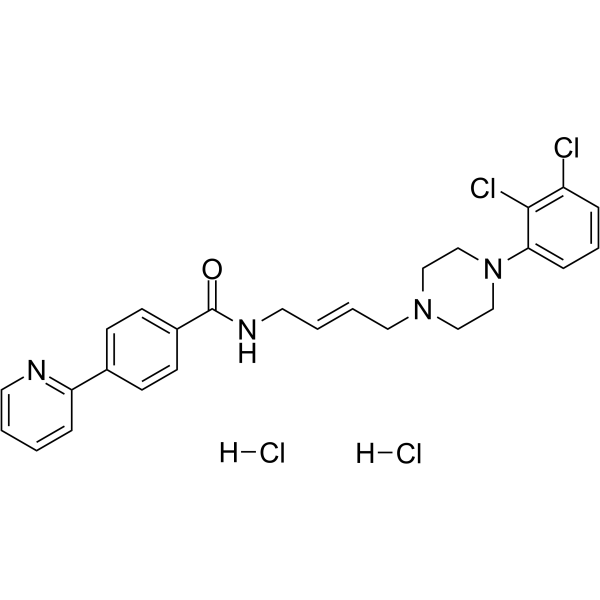
PG01037 dihydrochloride

Based on 1 Customer Validation
PG01037 dihydrochloride is a blood-brain barrier-penetrant selective dopamine D3 receptor antagonist, and blocks D3R signaling in the nucleus accumbens, with a Ki of 0.7 nM. PG01037 dihydrochloride enhances psychostimulant-induced locomotion, locomotor sensitization, and dopamine release, and promotes excitation of D1-expressing medium spiny neurons through D1-like signaling. PG01037 dihydrochloride attenuates psychostimulant-associated reward and relapse behaviors, and alleviates MPTPp-induced motor impairment and dopaminergic neurodegeneration. PG01037 dihydrochloride can be used in research related to Parkinson's disease, addictive disorders, and cancer.
For research use only. We do not sell to patients.
- Purity : 99.35%
- CAS No.: 675599-62-9
- Formula: C26H28Cl4N4O
- Molecular Weight:554.34
-
Storage:
4°C, sealed storage, away from moisture
* In solvent : -80°C, 6 months; -20°C, 1 month (sealed storage, away from moisture)

To place orders, for customer services and technical support, please contact: MedChemExpress USA
Tel: 609-228-6898 E-mail: [email protected] [email protected]


-
 Biological Activity
-
Chemical Information
-
Solvent & Solubility
- Protocols
- Purity & Documentation
- References
-
 Help & FAQs


All Dopamine Receptor Isoforms
More

Biological Activity
Description
IC50 & Target
[8]|
D3 Receptor 0.7 nM (Ki) |
In Vitro
PG01037 (0.1-10 μM; 72 h) dihydrochloride enhances Mitoxantrone cytotoxicity and reduces the number of viable cells in H460-MX20 cells[6].
PG01037 (5 μM; 24-48 h) dihydrochloride decreases ABCG2 protein expression in H460-MX20 cells[6].
PG01037 (5 μM; 48 h) dihydrochloride reduces ABCG2 immunofluorescence in H460-MX20 cells[6].
PG01037 (5 μM; pre-incubation for 1 h and efflux for 1-2 h) dihydrochloride inhibits ABCG2-mediated rhodamine 123 efflux in H460-MX20 cells, maintaining intracellular dye levels[6].
PG01037 dihydrochloride reverses ABCG2-mediated drug resistance in HEK293/ABCG2, H460/MX-20, S1-M1-80, and A549-MX-10 cells by enhancing the efficacy of Mitoxantrone (HY-13502) and Doxorubicin (HY-15142A) and reducing Rhodamine 123 (HY-D0816) efflux and ABCG2 protein levels[7].
PG01037 (1 nM) dihydrochloride enhances DA-mediated excitation of D1-MSNs in NAc slices from Drd1a-tdTomato mice, increasing spike frequency and F-I slope and decreasing rheobase, whereas PG01037 alone does not alter D1-MSN activity[1].
PG01037 (1 nM) dihydrochloride does not reverse DA-mediated inhibition of D2-MSNs in NAc slices from Drd2-EGFP mice, but combined application of PG01037 and L-741,626 attenuates the DA-induced decrease in D2-MSN spike frequency[1].
PG01037 dihydrochloride inhibits D2R and D3R in G protein nanoBRET assays[5].
PG01037 (10 µM) dihydrochloride blocks Sumanirole (HY-70081)-mediated cAMP inhibition and ML417-induced isoproterenol-induced cAMP sensitization in CaMKIIα-Cre:CAMPER+/- CA1 hippocampal neurons[5].
MedChemExpress (MCE) has not independently confirmed the accuracy of these methods. They are for reference only.
-
Cell Line:H460-MX20 cells
-
Concentration:0.1, 0.5, 1, 2.5, 5, and
10 μM -
Incubation Time:72 h
-
Result:Enhanced the cytotoxicity of mitoxantrone and reduced the number of viable cells.
-
Cell Line:H460-MX20 cells
-
Concentration:5 μM
-
Incubation Time:24 h and 48 h
-
Result:Incubation of H460-MX20 cells with 5 μM PG01037 for 24 or 48 h reduced ABCG2 protein expression levels.
-
Cell Line:H460-MX20 cells
-
Concentration:5 μM
-
Incubation Time:48 h
-
Result:PG01037 at 5 μM significantly down-regulated ABCG2 transporter immunofluorescence in H460-MX20 cells; fluorescence-integrated density was reduced compared with control cells.
Parmacokinetics
| Species | Dose | Route | T1/2 (Plasma) | Tmax (Plasma) | Cmax | AUC0-last | T1/2 (Brain) | Tmax (Brain) |
|---|---|---|---|---|---|---|---|---|
| Mice[2] | 15 mg/kg | i.p. | 0.69 h | 0.27 h | 13.43 μg/mL | 17.68 μg·h/mL | 2.17 h | 0.67 h |
In Vivo
PG01037 (10.0 mg/kg; i.p.; once daily for 5 consecutive days) dihydrochloride enables low, ineffective doses of psychostimulants to induce locomotor sensitization in C57BL/6 mice[1].
PG01037 (3 µg/0.3 µL per side; bilateral intra-NAc infusion; once) dihydrochloride enhances psychomotor activator-induced locomotor activity in C57BL/6 mice, suggesting the involvement of nucleus accumbens D3R blockade[1].
PG01037 (10.0 mg/kg; i.p.; co-administered with SCH23390 (HY-19545) at 0.03-0.3 mg/kg as a pretreatment reagent) dihydrochloride reverses the attenuating effect of low-dose D1-like receptor blockade on psychostimulant-induced locomotor activity, but does not reverse the attenuating effect produced by higher doses of D1-like receptor blockade[1].
PG01037 (30 mg/kg; i.p.; re-injected at -24 h, +24 h, +72 h, and +120 h relative to 6-OHDA lesion) dihydrochloride attenuates dopaminergic neurodegeneration in 6-OHDA-lesioned mice[2].
PG01037 (3-30 mg/kg; i.p.; once 30 min before testing) dihydrochloride reduces the breakpoint of progressive-ratio psychoactive drug self-administration but does not alter FR2 psychoactive drug self-administration[3].
PG01037 (0.06 mg/kg/infusion; i.v.; 3 h daily for 5 consecutive days) dihydrochloride fails to maintain stable self-administration behavior when substituted for the original drug in rats with a history of methamphetamine self-administration[3].
PG01037 (3-30 mg/kg; i.p.; once 30 min before testing) dihydrochloride reduces the breakpoint for progressive-ratio oral sucrose self-administration without altering FR2 sucrose self-administration[3].
PG01037 (3-30 mg/kg; i.p.; once 30 min before testing) dihydrochloride attenuates relapse to psychostimulant-associated cue-induced seeking behavior[3].
PG01037 (3-30 mg/kg; i.p.; once 30 min before psychostimulant or vehicle administration) dihydrochloride attenuates psychostimulant-enhanced brain stimulation reward, and when administered alone at 30 mg/kg, it elevates the BSR threshold[3].
MedChemExpress (MCE) has not independently confirmed the accuracy of these methods. They are for reference only.
-
Animal Model:C57BL/6[1]
-
Dosage:1.0; 10.0 mg/kg
-
Administration:i.p.; single pre-administration; 30 min before psychostimulant
-
Result:Neither active dose of this compound (1.0 or 10.0 mg/kg) significantly affected locomotor activity compared with vehicle during the first 30 min after administration.
Psychostimulant-induced increases in locomotor activity were enhanced following this compound pre-administration.
The 10.0 mg/kg this compound dose produced a leftward and upward shift of the psychostimulant dose-response function.
The potentiation occurred immediately upon psychostimulant administration and was not attributable to a prolongation of psychostimulant’s time course of action.
-
Animal Model:C57BL/6[1]
-
Dosage:10.0 mg/kg
-
Administration:i.p.; once daily for 5 consecutive days; 30 min before vehicle or psychostimulant
-
Result:Mice pre-administered daily with 10.0 mg/kg this compound prior to 5.0 mg/kg psychostimulant developed sensitized locomotor responses.
Mice given 10.0 mg/kg this compound + saline failed to exhibit sensitization.
-
Animal Model:C57BL/6[1]
-
Dosage:3 µg/0.3 µL per side (bilateral intra-NAc infusion, once immediately before i.p. psychostimulant)
-
Administration:bilateral intra-NAc infusion; once immediately before i.p. psychostimulant; test sessions separated by 1 week
-
Result:Intra-NAc delivery of this compound enhanced psychostimulant-induced locomotor activity.
-
Animal Model:C57BL/6[1]
-
Dosage:10.0 mg/kg (co-administered with SCH23390 0.03 or 0.3 mg/kg as a pre-administration, followed by 3.0 mg/kg psychostimulant i.p.)
-
Administration:i.p.; single pre-administration
-
Result:Pre-administration with low-dose SCH23390 (0.03 mg/kg) caused a modest ~45% attenuation of the locomotor-activating effects of 3.0 mg/kg psychostimulant; co-administration of 10.0 mg/kg this compound reversed this attenuation.
Increasing the SCH23390 dose 10-fold (0.3 mg/kg) caused a greater ~63% reduction in psychostimulant-induced locomotion, and co-administration of 10.0 mg/kg this compound had no impact on the effects of this higher SCH23390 dose.
-
Animal Model:C57BL/6 (adult male, 25-30 g, 3 months of age)[2]
-
Dosage:5 mg/kg (chronic); 15 mg/kg (chronic); 30 mg/kg (chronic); 30 mg/kg (acute); 15 mg/kg (with probenecid and MPTP vehicle)
-
Administration:i.p.; twice weekly for 5 weeks (chronic); single injection after the second MPTPp injection (acute); with probenecid and MPTP vehicle (control)
-
Result:5.\tChronic this compound (15 and 30 mg/kg) reduced the time needed to reach the end of the coat-hanger in MPTPp-intoxicated mice; acute this compound (30 mg/kg) produced no significant difference in motor behavior.
MPTPp-intoxicated mice administered this compound 30 mg/kg chronically or acutely showed increased density of striatal DAT+ and TH+ immunopositive terminals.
In MPTPp-intoxicated mice, this compound 30 mg/kg, irrespective of the administration regime (acute or chronic), resulted in an increase in the number of dopaminergic TH+ neurons in the SNpc.
The MPTPp-induced decrease in the ramification density of Iba1+ microglial cells was inhibited by chronic this compound (30 mg/kg); no differences were observed in microglial body area and cell density.
Chronic this compound (30 mg/kg) exacerbated MPTPp-induced astrogliosis, as determined by densitometric quantification of GFAP labeling.
-
Animal Model:C57BL/J6 (adult male, 27-30 g)[2]
-
Dosage:30 mg/kg
-
Administration:i.p.; at -24 h, +24 h, +72 h, and +120 h relative to 6-OHDA lesion
-
Result:Systemic administration of this compound in 6-OHDA-intoxicated mice ameliorated the extent of dopaminergic neurodegeneration in the striatum and SNpc.
-
Animal Model:Long-Evans (male, initially 250-300 g)[3]
-
Dosage:3, 10, or 30 mg/kg
-
Administration:i.p.; once 30 min before the FR2 or PR self-administration test session
-
Result:Under FR2 reinforcement, this compound at 3, 10, and 30 mg/kg failed to alter i.v. psychostimulant self-administration.
Under PR reinforcement, this compound significantly lowered psychostimulant break-point levels; individual comparisons showed significant reductions after 10 mg/kg and 30 mg/kg this compound, but not after 3 mg/kg, compared with vehicle.
A representative PR response record showed a break-point of 268 after vehicle pretreatment and a break-point of 50 after 10 mg/kg this compound pretreatment.
-
Animal Model:Long-Evans (male, initially 250-300 g)[3]
-
Dosage:0.06 mg/kg/infusion
-
Administration:i.v.; self-administered over five consecutive daily 3-hour sessions
-
Result:This compound replacement for psychostimulant failed to maintain self-administration in psychostimulant self-administering rats.
-
Animal Model:Long-Evans (male, initially 250-300 g)[3]
-
Dosage:3, 10, or 30 mg/kg
-
Administration:i.p.; once 30 min before the sucrose self-administration test session
-
Result:Under FR2 reinforcement, this compound at 3, 10, and 30 mg/kg failed to alter oral sucrose self-administration.
Under PR reinforcement, this compound produced a significant reduction in PR break-point levels for oral sucrose self-administration; individual comparisons showed significant reductions after 10 mg/kg and 30 mg/kg PG01037, but not after 3 mg/kg, compared with vehicle.
-
Animal Model:Long-Evans (male, initially 250-300 g)[3]
-
Dosage:3, 10, or 30 mg/kg
-
Administration:i.p.; once 30 min before the 3-hour reinstatement test
-
Result:Non-contingent presentations of psychostimulant-associated cues produced a profound increase in psychostimulant-seeking behavior, which was dose-dependently inhibited by this compound pretreatment.
Individual group comparisons revealed a significant reduction in cue-induced reinstatement after 10 mg/kg and 30 mg/kg this compound, compared with the vehicle group.
-
Animal Model:Long-Evans (male, initially 250-300 g)[3]
-
Dosage:3, 10, or 30 mg/kg
-
Administration:i.p.; once 30 min before i.p. psychostimulant (0.2 mg/kg) or vehicle; 5-7 days restabilization between tests
-
Result:Psychostimulant (0.2 mg/kg) produced a significant enhancement of BSR.
Significantly reduced psychostimulant-enhanced BSR after 10 mg/kg and 30 mg/kg, but not after 3 mg/kg, compared with the vehicle group.
Alone at 30 mg/kg produced a significant reduction in BSR (increase in BSR threshold), while 3 and 10 mg/kg did not.
Did not significantly alter Ymax levels.


Chemical Information
-
CAS No. 675599-62-9
-
Appearance Solid
-
Molecular Weight 554.34
-
Formula C26H28Cl4N4O
-
Color White to off-white
-
SMILES
O=C(NC/C=C/CN1CCN(C2=CC=CC(Cl)=C2Cl)CC1)C3=CC=C(C4=NC=CC=C4)C=C3.[H]Cl.[H]Cl
-
Shipping
Room temperature in continental US; may vary elsewhere.
-
Storage
4°C, sealed storage, away from moisture
* In solvent : -80°C, 6 months; -20°C, 1 month (sealed storage, away from moisture)


Solvent & Solubility
In Vitro:
DMSO : 100 mg/mL (180.39 mM; ultrasonic and warming and heat to 60°C; Hygroscopic DMSO has a significant impact on the solubility of product, please use newly opened DMSO)
Please refer to the solubility information to select the appropriate solvent. Once prepared, please aliquot and store the solution to prevent product inactivation from repeated freeze-thaw cycles.
Storage method and period of stock solution: -80°C, 6 months; -20°C, 1 month (sealed storage, away from moisture). When stored at -80°C, please use it within 6 months. When stored at -20°C, please use it within 1 month.
Concentration (start) × Volume (start) = Concentration (final) × Volume (final)
In Vivo:
Select the appropriate dissolution method based on your experimental animal and administration route.
- For the following dissolution methods, please ensure to first prepare a clear stock solution using an In Vitro approach and then sequentially add co-solvents:
- To ensure reliable experimental results, the clarified stock solution can be appropriately stored based on storage conditions. As for the working solution for In Vivo experiments, it is recommended to prepare freshly and use it on the same day.
- The percentages shown for the solvents indicate their volumetric ratio in the final prepared solution. If precipitation or phase separation occurs during preparation, heat and/or sonication can be used to aid dissolution.
Add each solvent one by one: 10% DMSO 40% PEG300 5% Tween-80 45% Saline
Solubility: ≥ 2.5 mg/mL (4.51 mM); Clear solution
This protocol yields a clear solution of ≥ 2.5 mg/mL (saturation unknown).
Taking 1 mL working solution as an example, add 100 μL DMSO stock solution (25.0 mg/mL) to 400 μL PEG300, and mix evenly; then add 50 μL Tween-80 and mix evenly; then add 450 μL Saline to adjust the volume to 1 mL.
Preparation of Saline: Dissolve 0.9 g sodium chloride in ddH₂O and dilute to 100 mL to obtain a clear Saline solution.
Add each solvent one by one: 10% DMSO 90% (20% SBE-β-CD in Saline)
Solubility: ≥ 2.5 mg/mL (4.51 mM); Clear solution
This protocol yields a clear solution of ≥ 2.5 mg/mL (saturation unknown).
Taking 1 mL working solution as an example, add 100 μL DMSO stock solution (25.0 mg/mL) to 900 μL 20% SBE-β-CD in Saline, and mix evenly.
Preparation of 20% SBE-β-CD in Saline (4°C, storage for one week): 2 g SBE-β-CD powder is dissolved in 10 mL Saline, completely dissolve until clear.
In Vivo Dissolution Calculator
Please enter the basic information of animal experiments:
-
-
-
-
Recommended: Prepare an additional quantity of animals to account for potential losses during experiments.
Please enter your animal formula composition:
-
%DMSO +
Recommended: Keep the proportion of DMSO in working solution below 2% if your animal is weak.
-
%+
-
+%Tween-80 + +
-
%Saline +
The co-solvents required include: DMSO, . All of co-solvents are available by MedChemExpress (MCE). , Tween 80. All of co-solvents are available by MedChemExpress (MCE).
Working solution concentration: 0.22 mg/mL
Method for preparing stock solution: mg drug dissolved in μL DMSO. Stock solution concentration: mg/mL. * In solvent : -80°C, 6 months; -20°C, 1 month (sealed storage, away from moisture)
1. Take μL DMSO stock solution;
2. Add μL .
μL , mix evenly;
3. Then add μL Tween 80, mix evenly;
4. Then add μL
Please ensure that the stock solution in the first step is dissolved to a clear state, and add co-solvents in sequence. You can use ultrasonic heating (ultrasonic cleaner, recommended frequency 20-40 kHz), vortexing, etc. to assist dissolution.


Purity & Documentation
-
Data Sheet (304 KB)
-
SDS (252 KB)
- English - EN (252 KB)
- Français - FR (252 KB)
- Deutsch - DE (252 KB)
- Norwegian - NO (252 KB)
- Español - ES (252 KB)
- Swedish - SV (252 KB)
- Italian - IT (252 KB)
- Korean - KR (252 KB)
- Portuguese - PT (252 KB)
-
Handling Instructions (2659 KB)
References


Complete Stock Solution Preparation Table
Please refer to the solubility information to select the appropriate solvent. Once prepared, please aliquot and store the solution to prevent product inactivation from repeated freeze-thaw cycles.
Storage method and period of stock solution: -80°C, 6 months; -20°C, 1 month (sealed storage, away from moisture). When stored at -80°C, please use it within 6 months. When stored at -20°C, please use it within 1 month.
| Optional Solvent | Concentration Solvent Mass | 1 mg | 5 mg | 10 mg | 25 mg |
|---|---|---|---|---|---|
| DMSO | 1 mM | 1.8039 mL | 9.0197 mL | 18.0395 mL | 45.0987 mL |
| 5 mM | 0.3608 mL | 1.8039 mL | 3.6079 mL | 9.0197 mL | |
| 10 mM | 0.1804 mL | 0.9020 mL | 1.8039 mL | 4.5099 mL | |
| 15 mM | 0.1203 mL | 0.6013 mL | 1.2026 mL | 3.0066 mL | |
| 20 mM | 0.0902 mL | 0.4510 mL | 0.9020 mL | 2.2549 mL | |
| 25 mM | 0.0722 mL | 0.3608 mL | 0.7216 mL | 1.8039 mL | |
| 30 mM | 0.0601 mL | 0.3007 mL | 0.6013 mL | 1.5033 mL | |
| 40 mM | 0.0451 mL | 0.2255 mL | 0.4510 mL | 1.1275 mL | |
| 50 mM | 0.0361 mL | 0.1804 mL | 0.3608 mL | 0.9020 mL | |
| 60 mM | 0.0301 mL | 0.1503 mL | 0.3007 mL | 0.7516 mL | |
| 80 mM | 0.0225 mL | 0.1127 mL | 0.2255 mL | 0.5637 mL | |
| 100 mM | 0.0180 mL | 0.0902 mL | 0.1804 mL | 0.4510 mL |


PG01037 dihydrochloride Related Classifications
HY-103408 Related Classifications
 Powered by Bioz