6 Results for "

6PPD-Quinone

" in MedChemExpress (MCE) Product Catalog:
Products (6)

6 Results for "6PPD-Quinone" in MCE Product Catalog:

12
12 Cited Publications
Cat. No.: HY-153169
CAS No.: 2754428-18-5
Purity:  99.30%
Synonyms: 6PPD-Quinone
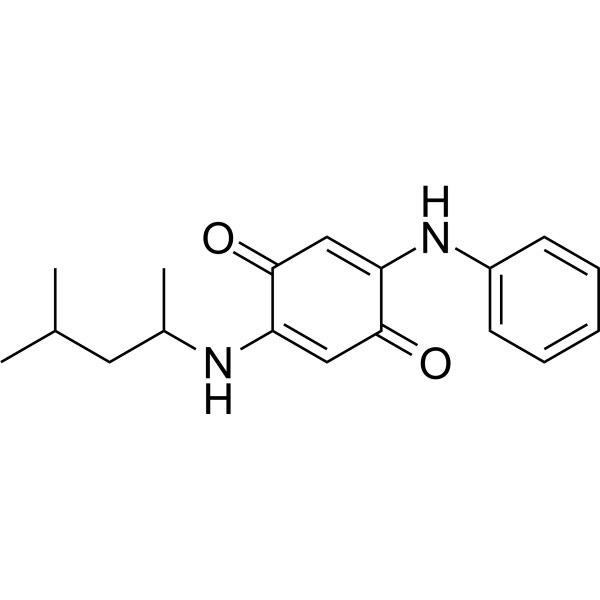
6PPD-Q (6PPD-Quinone) is an environmental pollutant that can be detected in human urine and is widely present in the environment. 6PPD-Q targets and binds to CNR2, CNR1, AA2AR, LCAT, and TRPA1, with CNR2 exhibiting the highest binding affinity, potentially acting as a CNR2 receptor agonist to activate cannabinoid receptors. 6PPD-Q induces intestinal inflammation and barrier damage by disrupting mitochondrial function, reducing neuronal glycolysis metabolites and TCA cycle intermediates, and exacerbating α-synuclein (α-syn) aggregation. 6PPD-Q is applicable in research on environmental toxicology, neurodegenerative diseases, and inflammation-related disorders .
loading...
    loading...
Cat. No.: HY-152039S
CAS No.: 2750119-14-1
Purity:  99.39%
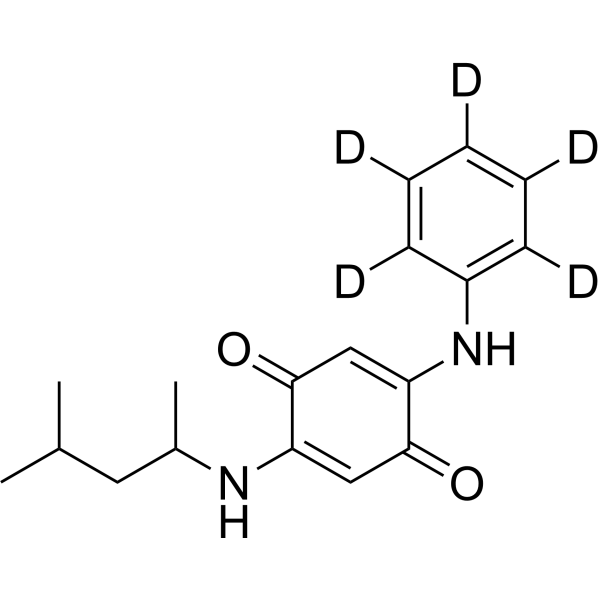
6PPD-quinone-d5 is the deuterium labeled 6PPD-quinone .
loading...
    loading...
Cat. No.: HY-152039S1
Purity:  ≥98.0%
Synonyms: 6PPD-Quinone-13C6
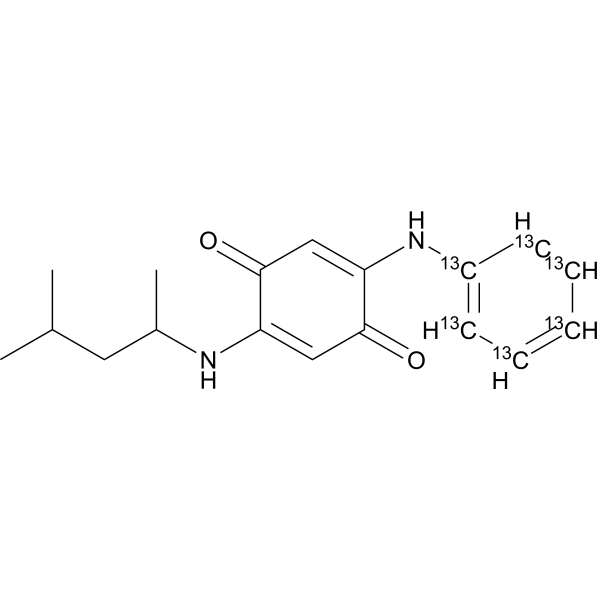
6PPD-quinone- 13C6 is the 13C labeled 6PPD-quinone .
loading...
    loading...
Cat. No.: HY-W754406
Synonyms: Methyl carboxylate 6PPD-Quinone-d5
6PPD-Quinone methyl ester-d5 (Methyl carboxylate 6ppd-quinone-d5) is the deuterium labeled 6PPD-Quinone methyl ester.
loading...
    loading...
Cat. No.: HY-175400
CAS No.: 3110535-99-1
Synonyms: 6-PPD-Quinone-4-OH
Research Areas:  

Others

6-PPD-Q-4-OH (6-PPD-quinone-4-OH) is a metabolite of 6PPD-Q (HY-153169). 6-PPD-Q-4-OH is applicable to exposure studies of 6PPD-Q, an environmental pollutant .
loading...
    loading...
Cat. No.: HY-153169R
CAS No.: 2754428-18-5
6PPD-Q (Standard) is the analytical standard of 6PPD-Q (HY-153169). This product is intended for research and analytical applications. 6PPD-Q (6PPD-Quinone) is an environmental pollutant that can be detected in human urine and is widely present in the environment. 6PPD-Q targets and binds to CNR2, CNR1, AA2AR, LCAT, and TRPA1, with CNR2 exhibiting the highest binding affinity, potentially acting as a CNR2 receptor agonist to activate cannabinoid receptors. 6PPD-Q induces intestinal inflammation and barrier damage by disrupting mitochondrial function, reducing neuronal glycolysis metabolites and TCA cycle intermediates, and exacerbating α-synuclein (α-syn) aggregation. 6PPD-Q is applicable in research on environmental toxicology, neurodegenerative diseases, and inflammation-related disorders .
loading...
    loading...

