7 Results for "

Deep tissue imaging

" in MedChemExpress (MCE) Product Catalog:
Products (7)

7 Results for "Deep tissue imaging" in MCE Product Catalog:

Cat. No.: HY-D1555
CAS No.: 2692677-77-1
Synonyms: Cy7 DBCO
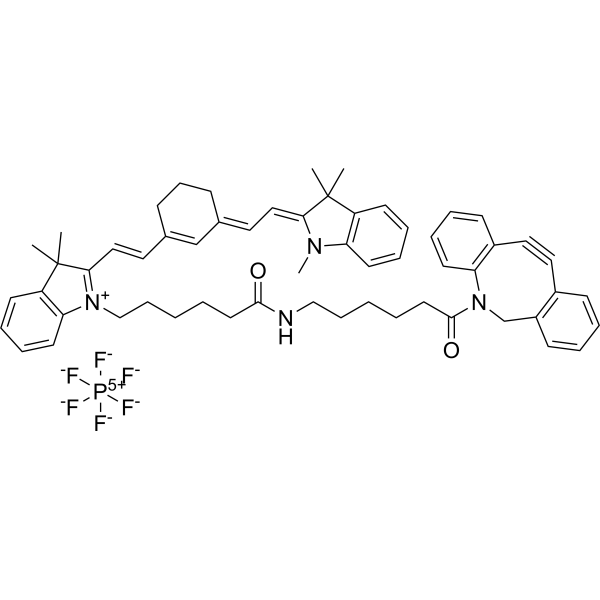
Cyanine7 DBCO (Cy7 DBCO) is a near-infrared fluorescent dye and an efficient bio-orthogonal quencher. Cyanine7 DBCO is formed by covalent connection of the near-infrared fluorescent dye Cy7 and the dibenzocyclooctyne (DBCO) functional group. After reacting with N3-Cy5-COOH, the fluorescence of Cy5 decreases by 90% within 90 minutes, and rapid signal attenuation can be observed within 2-5 minutes. Cyanine7 DBCO can be used for the study of deep tissue imaging and receptor-targeted therapeutic strategies .
loading...
    loading...
Cat. No.: HY-W588722
CAS No.: 3024705-52-7
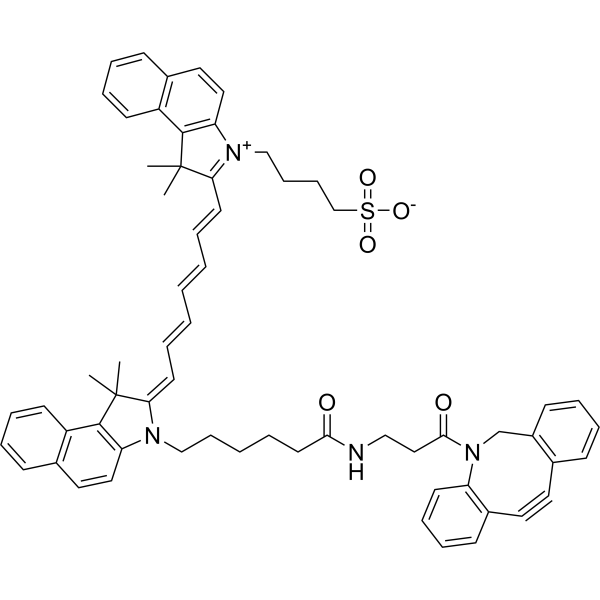
ICG-DBCO is a near-infrared fluorescent click chemistry reagent (Ex/Em = 789/813 nm), composed of Indocyanine green (ICG) (HY-D0711) and dibenzocyclooctyne (DBCO). ICG-DBCO enables copper-free, strain-promoted azide-alkyne cycloaddition (SPAAC) for labeling biomolecules such as antibodies, proteins and peptides, thereby facilitating deep tissue optical imaging .
loading...
    loading...
Cat. No.: HY-150970
CAS No.: 2863682-80-6
Target:  

Pyroptosis

Research Areas:  

Cancer

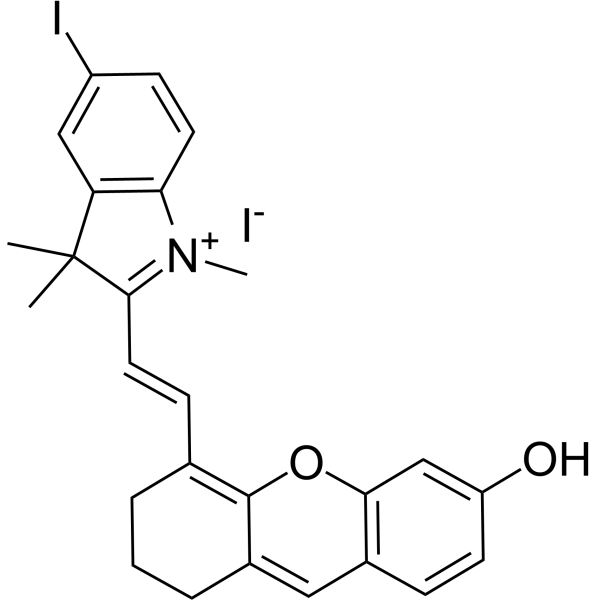
ICy-OH, an iodinated photosensitizer, is an effective anticancer agent. ICy-OH can be used not only for deep tissue imaging (λex=640 nm,λem=690-740 nm) but also to selectively induce cell death in pancreatic cancer cells via cell pyroptosis pathway .
loading...
    loading...
Cat. No.: HY-185960
Target:  

mRNA

Research Areas:  

Others

mNeptune2.5 mRNA (N1-methyl-pseudouridine) is a far-red fluorescent protein, mNeptune2.5, with strong tissue penetration, used for deep in vivo fluorescence imaging and tracing. mNeptune2.5 protein can be excited in the visible light range at wavelengths greater than 600 nm.
loading...
    loading...
Cat. No.: HY-D3369
CAS No.: 3114128-44-5
Target:  

Fluorescent Dye iGluR

Research Areas:  

Neurological Disease

Tz‑IFDL is a chemiluminescent probe for in vivo imaging of N‑methyl‑D‑aspartate receptors (NMDAR), which specifically binds to the NR2B subunit of NMDAR. Tz‑IFDL undergoes a bioorthogonal reaction with probe CL‑NC (HY-D3370), triggering molecular fragment release and chemiluminescence. The CL‑NC/Tz‑IFDL system composed of Tz‑IFDL exhibits a chemiluminescence emission wavelength of 710 nm. When combined with CL‑NC, Tz‑IFDL can be used for deep tissue imaging to distinguish NMDAR expression levels between Alzheimer's disease model mice and normal mice .
loading...
    loading...
Cat. No.: HY-D3159
CAS No.: 2304942-78-5
Research Areas:  

Others

BTC1070 is an anti-quenching pentamethine cyanine NIR-II fluorescent probe. BTC1070 exhibits high brightness and excellent photostability in aqueous solution (Ex/Em = 1015/1065 nm). BTC1070 can clearly visualize lymphatic structures after intradermal injection, and produces a ratiometric fluorescence response in the acidic range to non-invasively quantify gastric pH. BTC1070 is applicable to studies related to in vivo deep tissue imaging and gastric pH sensing .
loading...
    loading...
Cat. No.: HY-D3080
Target:  

Fluorescent Dye

Research Areas:  

Others

CR-1 is a ratiometric photoacoustic (PA) probe for in-situ real-time imaging of Zn 2+ in deep living tissues. CR-1 is formed by coupling the near-infrared cyanine dye IR825 with the Zn 2+ ligand tris (2-pyridylmethyl) amine (TMPA). Upon binding to Zn 2+, the five N atoms on TMPA coordinate with Zn 2+, leading to double bond rearrangement of IR825 and attenuation of its π-electron conjugated system. The absorption peak of CR-1 blue-shifts from 710 nm to 532 nm, enabling quantitative detection of Zn 2+ via the PA532/PA710 ratio. Free CR-1 generates a strong PA signal at 710 nm, while CR-1 bound to Zn 2+ produces a strong PA signal at 532 nm .
loading...
    loading...

