11 Results for "

H3K36me2

" in MedChemExpress (MCE) Product Catalog:
Products (11)

11 Results for "H3K36me2" in MCE Product Catalog:

1
1 Cited Publications
Cat. No.: HY-154812
CAS No.: 2604513-16-6
Purity:  99.81%
Synonyms: KTX-1001
Research Areas:  

Cancer

Gintemetostat (KTX-1001) is an orally active, highly specific NSD2/MMSET histone methyltransferase inhibitor with human NSD2 IC50 values ranging 0.460-2.17 nM and NSD2 SET domain IC50 of 2.32 nM and Kd values ranging 6.3-70.4 nM .Gintemetostat reduces H3K36me2 levels, impairs multiple myeloma cell adhesion and colony formation, enhances cytotoxicity, boosts T-cell activation, and sensitizes resistant multiple myeloma cells to other agents .Gintemetostat can be used for the research of multiple myeloma and relapsed and refractory multiple myeloma .
loading...
    loading...
Cat. No.: HY-145103
CAS No.: 2561494-77-5
Purity:  99.15%
Research Areas:  

Cancer

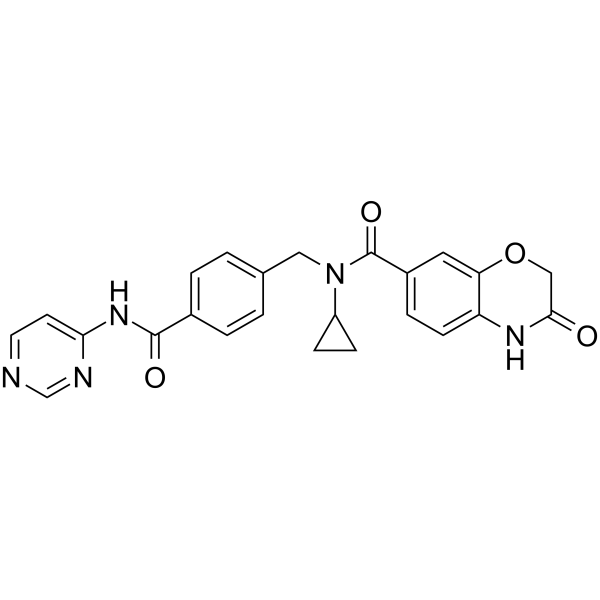
UNC6934 is a selective NSD2-PWWP1 antagonist with a Kd of 91 nM against human targets. UNC6934 binds to the canonical methyl-lysine binding pocket of NSD2-PWWP1 and directly competes with H3K36me2 for binding. UNC6934 induces the aggregation of NSD2 within the nucleolus, without altering ribosomal RNA transcription, global H3K36me2 levels or the proliferation of KMS-11 cells. UNC6934 can be used in studies related to multiple myeloma and diffuse intrinsic pontine glioma .
loading...
    loading...
Cat. No.: HY-157251
CAS No.: 2929304-61-8
Purity:  99.92%
Research Areas:  

Cancer

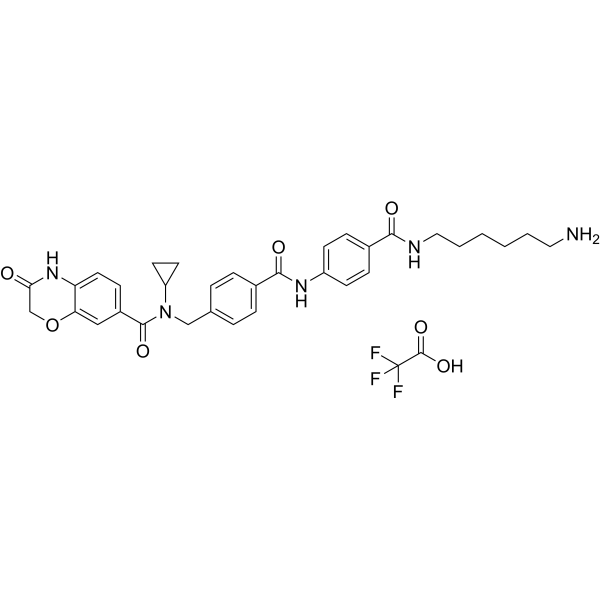
UNC8153 TFA is a potent and selective nuclear receptor-binding SET domain-containing 2 (NSD2)-targeted degrader with a Kd of 24 nM. UNC8153 TFA reduces the cellular levels of both NSD2 protein (DC50 in cell U2OS is 0.35 μM) and the H3K36me2 chromatin mark. UNC8153 TFA contains a simple warhead that confers proteasome-dependent degradation of NSD2 .
loading...
    loading...
Cat. No.: HY-179427
NSD2/H3K36me2 modulator-1 is an orally active NSD2/H3K36me2 modulator. NSD2/H3K36me2 modulator-1 competitively binds to the SAM pocket of NSD2, potently inhibits NSD2 expression and suppresses H3K36me2 methylation. NSD2/H3K36me2 modulator-1 reverses epithelial-mesenchymal transition (EMT), inhibits cell migration, and induces G0/G1 phase arrest and apoptosis. NSD2/H3K36me2 modulator-1 induces decreased Mitochondrial membrane potential (MMP) and subsequent Reactive oxygen species (ROS) generation. NSD2/H3K36me2 modulator-1 can be used to research the NSD2-targeting epigenetic anticancer strategies for hepatocellular carcinoma (HCC) .
loading...
    loading...
Cat. No.: HY-157251A
CAS No.: 2929304-60-7
Purity:  99.13%
Research Areas:  

Cancer

UNC8153 is a potent and selective nuclear receptor-binding SET domain-containing 2 (NSD2)-targeted degrader with a Kd of 24 nM. UNC8153 reduces the cellular levels of both NSD2 protein (DC50 in cell U2OS is 0.35 μM) and the H3K36me2 chromatin mark. UNC8153 contains a simple warhead that confers proteasome-dependent degradation of NSD2 .
loading...
    loading...
Cat. No.: HY-155817
Research Areas:  

Others

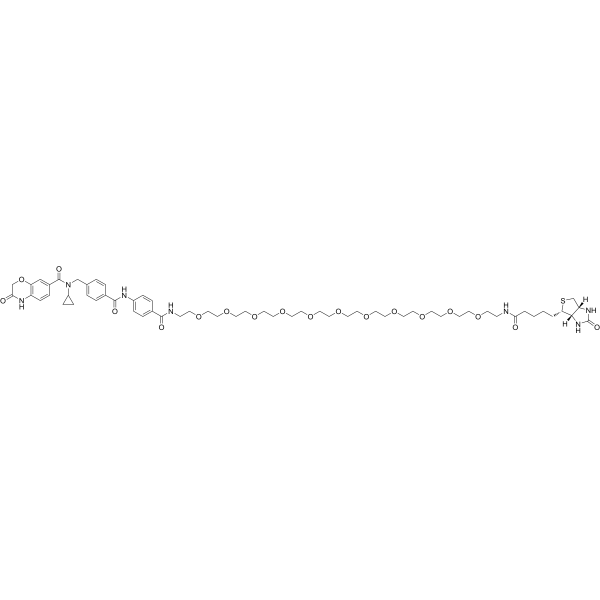
UNC7096 (compound 53) is a biotinylated affinity reagent. The phenyl ring of UNC7096 replaces the pyrimidine ring in UNC6934 (HY-145103) and introduces biotin at the para position of the phenyl ring, which has a high binding affinity to the NSD2-PWWP1 domain (Kd=46 nM). UNC7096 blocks the interaction between NSD2-PWWP1 and nucleosomal H3K36me2 by occupying the methyl-lysine binding pocket of NSD2-PWWP1. This binding is achieved by covalent binding through the formation of hydrogen bonds and a specific aromatic cage structure. UNC7096 can be used to capture proteins that interact with the NSD2-PWWP1 domain to further analyze the biological significance of these interactions .
loading...
    loading...
Cat. No.: HY-134085
CAS No.: 2351225-68-6
Research Areas:  

Cancer

NSD-IN-1 is a benzothiazole-based covalent inhibitor of NSD1. NSD-IN-1 covalently binds the NSD1 SET domain and reduces H3K36me2 levels, thereby inhibiting the proliferation of Nup98-NSD1 leukemia cells, downregulating the expression of Meis1, Hoxa5, and Hoxa9, and inducing cell differentiation. NSD-IN-1 can be used for research on Nup98-NSD1 acute myeloid leukemia .
loading...
    loading...
Cat. No.: HY-179651
CAS No.: 106664-01-1
Research Areas:  

Cancer

NSD2-PWWP1-IN-6 (Compound 16) is an effective NSD2-PWWP1 inhibitor with a Kd value of 30 nM. NSD2-PWWP1-IN-6 competitively blocks the recognition of H3K36me2 and DNA by NSD2-PWWP1, thereby weakening its binding ability to nucleosomes. NSD2-PWWP1-IN-6 can be used for cancer research .
loading...
    loading...
Cat. No.: HY-179650
CAS No.: 217798-45-3
Research Areas:  

Cancer

NSD2-PWWP1-IN-5 (Compound 13) is an effective NSD2-PWWP1 inhibitor with a Kd value of 78 nM. NSD2-PWWP1-IN-5 competitively blocks the recognition of H3K36me2 and DNA by NSD2-PWWP1, thereby weakening its binding ability to nucleosomes. NSD2-PWWP1-IN-5 inhibits the proliferation of U2OS osteosarcoma cells and induces cell cycle arrest and apoptosis. NSD2-PWWP1-IN-5 can be used for the study of osteosarcoma .
loading...
    loading...
Cat. No.: HY-180553
Research Areas:  

Cancer

NSD2-IN-6 is a selective and orally active NSD2 inhibitor with IC50s of 3.8  and 274 nM for NSD2 and NSD1 respectively. NSD2-IN-6 reduces H3K36me2 levels, reverses cell plasticity by restoring the androgen receptor ( AR) signaling pathway. NSD2-IN-6 reduces a shift from cluster 2 and 3 states towards the cluster 1 state in organoids. NSD2-IN-6 exerts antitumor activity by reversing tumor cell plasticity, suppressing growth, and promoting apoptosis in vivo. NSD2-IN-6 can be used for prostate cancer research .
loading...
    loading...
Cat. No.: HY-187178
CAS No.: 1966932-74-0
Target:  

Histone Demethylase

Research Areas:  

Cancer

KDM2A/7-IN-1 is a lysine demethylase 2A (KDM2A) inhibitor with a human IC50 of 11 nM. KDM2A/7-IN-1 requires co-factor 2-oxoglutarate (2OG) for binding and occupies the H3K36me2 substrate pocket via a dimethylated lysine 36-mimicking group. KDM2A/7-IN-1 represses E2F-regulated genes, induces epithelial-mesenchymal transition, DNA repair, and mTOR pathways in specific cells, and selectively inhibits proliferation of ALT-positive cancer cell lines. KDM2A/7-IN-1 can be used for the research of ALT-positive cancers .
loading...
    loading...
  • 1

