10 Results for "

INS-1 cell

" in MedChemExpress (MCE) Product Catalog:
Products (10)

10 Results for "INS-1 cell" in MCE Product Catalog:

2
2 Cited Publications
Cat. No.: HY-N0668
CAS No.: 64849-39-4
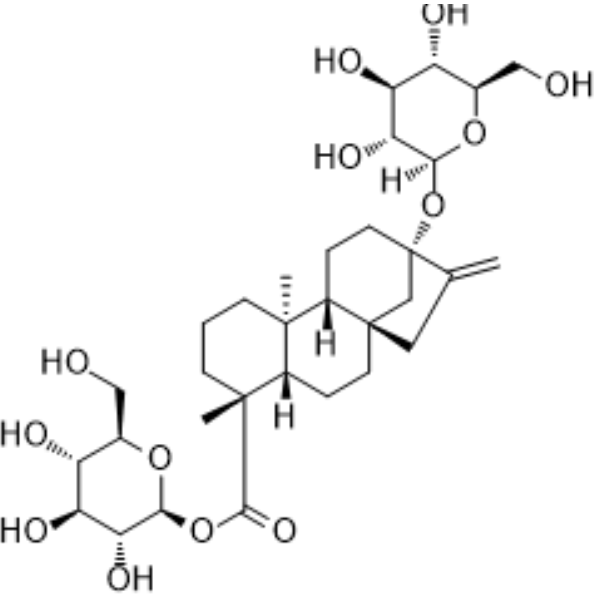
Rubusoside is a diterpene glycoside that is also a sweetener and solubilizer with anti-angiogenic, anti-cancer, anti-obesity, anti-allergic and anti-asthmatic effects. Rubusoside attenuates airway hyperresponsiveness and reduces inflammatory cells in bronchoalveolar lavage fluid (BALF), reducing OVA (HY-W250978)-induced airway inflammation. Rubusoside also prevents palmitic acid-induced lipotoxicity in pancreatic INS-1 cells, reduces the transport of human glucose transporters GLUT-1 and fructose GLUT-5, and inhibits NF-κB and α-amylase (α-amylase) .
loading...
    loading...
2
2 Cited Publications
Cat. No.: HY-13529
CAS No.: 1234703-40-2
Purity:  ≥98.0%
Synonyms: LY2608204; SY-004
Target:  

Glucokinase

Research Areas:  

Metabolic Disease

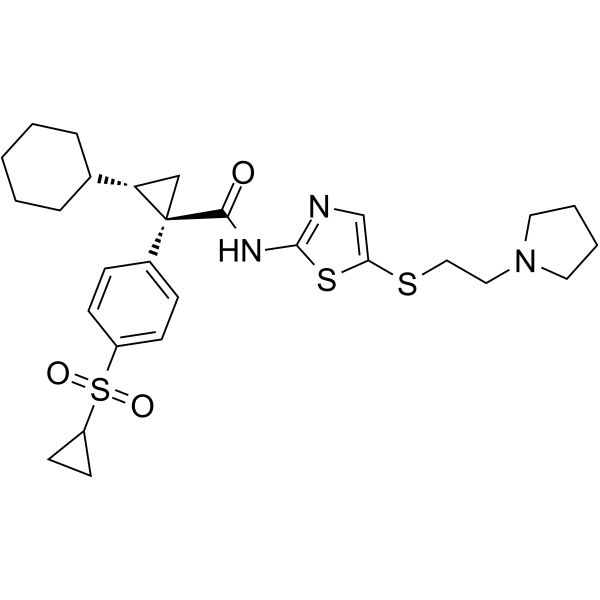
Globalagliatin (LY2608204) is an orally active glucokinase (GK) activator with an EC50 of 42 nM. Globalagliatin also stimulates glucose metabolism in rat insulinoma INS1-E cells with an EC50 of 579 nM. Globalagliatin targets both pancreatic β-cells and hepatocytes. Globalagliatin is promising for research of type 2 diabetes .
loading...
    loading...
2
2 Cited Publications
Cat. No.: HY-P10769
CAS No.: 2209854-03-3
Target:  

AMPK Apoptosis

Research Areas:  

Metabolic Disease

MOTS-c (mouse) is a mitochondrial-derived polypeptide that can be used to regulates pancreatic cell function. MOTS-c (mouse) reduces insulin secretion and expression in INS-1E cells, and enhances glucagon secretion and expression in αTC-1 cells. MOTS-c (mouse) decreases the apoptosis in INS-1E and αTC-1. MOTS-c (mouse) counteracts diet-induced obesity and insulin resistance through AMPK activation .
loading...
    loading...
Cat. No.: HY-173537
CAS No.: 154278-46-3
Synonyms: INS(1,2,4,5)P4 tetrasodium salt; 1,2,4,5-IP4 tetrasodium salt
Target:  

Calcium Channel

Research Areas:  

Neurological Disease

D-myo-Inositol-1,2,4,5-tetraphosphate (DL-Ins-(1,2,4,5)P4) tetrasodium is raracemic regioisomer of myo-inositol tetrakisphosphates (IP4s). D-myo-Inositol-1,2,4,5-tetraphosphate tetrasodium is an Ins(1,4,5)P3 receptor agonist with a Ki of 11 nM. D-myo-Inositol-1,2,4,5-tetraphosphate tetrasodium induces Ca 2+ mobilization with an EC50 value of 0.22 μM in CHO cells .
loading...
    loading...
Cat. No.: HY-145422
CAS No.: 2922507-65-9
Target:  

IRE1 Apoptosis

Research Areas:  

Others

KIRA9 is a potent IRE1 inhibitor (IC50=4.8 μM in INS-1 cells). KIRA9 is able to fully engage the ATP-binding site of IRE1α. KIRA9 can block ER-localized mRNA decay and apoptosis .
loading...
    loading...
Cat. No.: HY-175042
Synonyms: INS(1,3,4,5,6)P5 ammonium salt; 1,3,4,5,6-IP5 ammonium salt
Target:  

Akt

Research Areas:  

Cancer

D-myo-Inositol-1,3,4,5,6-pentaphosphate (ammonium salt) (Ins(1,3,4,5,6)P5 (ammonium salt)) is an isomer of inositol phosphate that acts as a small and soluble second messenger in the transmission of cellular signals. D-myo-Inositol-1,3,4,5,6-pentaphosphate (ammonium salt) can bind to the PH domain of Grp1 with a Kd of 590 nM. D-myo-Inositol-1,3,4,5,6-pentaphosphate (ammonium salt) can inhibit the phosphorylation and kinase activity of Akt/PKB, inducing apoptosis in ovarian, lung, and breast cancer cells. D-myo-Inositol-1,3,4,5,6-pentaphosphate (ammonium salt) exhibits antiangiogenic activity in vitro and blocks capillary tube formation of HUVEC. D-myo-Inositol-1,3,4,5,6-pentaphosphate (ammonium salt) exerts antitumor effects against cancer xenografts in nude mice .
loading...
    loading...
Cat. No.: HY-N0668R
CAS No.: 64849-39-4
Rubusoside (Standard) is the analytical standard of Rubusoside. This product is intended for research and analytical applications. Rubusoside is a diterpene glycoside that is also a sweetener and solubilizer with anti-angiogenic, anti-cancer, anti-obesity, anti-allergic and anti-asthmatic effects. Rubusoside attenuates airway hyperresponsiveness and reduces inflammatory cells in bronchoalveolar lavage fluid (BALF), reducing OVA (HY-W250978)-induced airway inflammation. Rubusoside also prevents palmitic acid-induced lipotoxicity in pancreatic INS-1 cells, reduces the transport of human glucose transporters GLUT-1 and fructose GLUT-5, and inhibits NF-κB and α-amylase (α-amylase) .
loading...
    loading...
Cat. No.: HY-N16465
CAS No.: 97233-06-2
Cinnamtannin D1 is an orally active polyphenolic compound with immunosuppressive activity. Cinnamtannin D1 regulates the balance of Th17/Treg cells by inhibiting AHR expression. Cinnamtannin D1 reduces apoptosis and ROS in INS-1 cells and primary cultured murine islets induced by Palmitic acid (PA) (HY-N0830). Cinnamtannin D1 reduces Th17 cell differentiation via downregulating p-STAT3/RORγt and promotes Treg cell differentiation via upregulating p-STAT5/Foxp3. Cinnamtannin D1 exerts excellent anti-arthritic efficacy in collagen-induced arthritis (CIA) model of mice. Cinnamtannin D1 can be used for the study of rheumatoid arthritis (RA) .
loading...
    loading...
Cat. No.: HY-164111
CAS No.: 1128096-58-1
Target:  

JAK

Research Areas:  

Neurological Disease

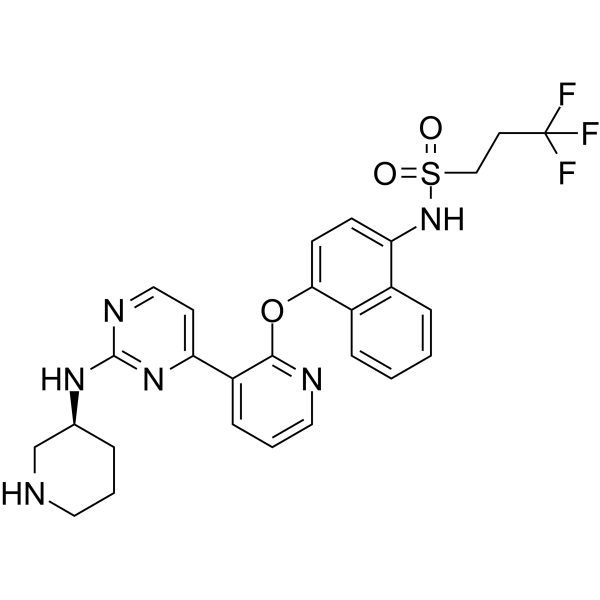
JNK-IN-17 (Compound 9J) is a selective and potent JNK inhibitor with IC50 values of 0.039, 0.079 μM for JNK1 and JNK3. JNK-IN-17 can inhibit c-Jun phosphorylation with an IC50 of 0.082 μM in Streptozotocin (HY-13753)-infuced INS-1 pancreatic islet β cells. JNK-IN-17 shows inhibition rate ≤ 33% on the four main P450 subtypes (2C9, 2D6, 3A4, 1A2) in human liver microsomes, indicating a relatively low risk of drug interactions. JNK-IN-17 can be used for researches of neurological and metabolic disease, such as Parkinson's disease .
loading...
    loading...
Cat. No.: HY-175068
Synonyms: INS(1,3,4,5,6)P5 sodium
Target:  

PI3K Akt Apoptosis

Research Areas:  

Cardiovascular Disease Cancer

D-myo-Inositol-1,3,4,5,6-pentaphosphate sodium (Ins(1,3,4,5,6)P5 sodium) is a small intracellular signaling molecule. D-myo-Inositol-1,3,4,5,6-pentaphosphate sodium inhibits the PI3K/Akt signaling pathway. D-myo-Inositol-1,3,4,5,6-pentaphosphate sodium inhibits Akt/PKB phosphorylation and kinase activity, inducing apoptosis in cancer cells. D-myo-Inositol-1,3,4,5,6-pentaphosphate sodium inhibits the formation of tubular structures in endothelial cells in an in vitro angiogenesis mouse model. D-myo-Inositol-1,3,4,5,6-pentaphosphate sodium can be used in research on ovarian cancer, lung cancer, breast cancer, and other cancers, as well as in cardiovascular and cerebrovascular diseases such as angiogenesis .
loading...
    loading...

