9 Results for "

KB/C3

" in MedChemExpress (MCE) Product Catalog:
Products (9)

9 Results for "KB/C3" in MCE Product Catalog:

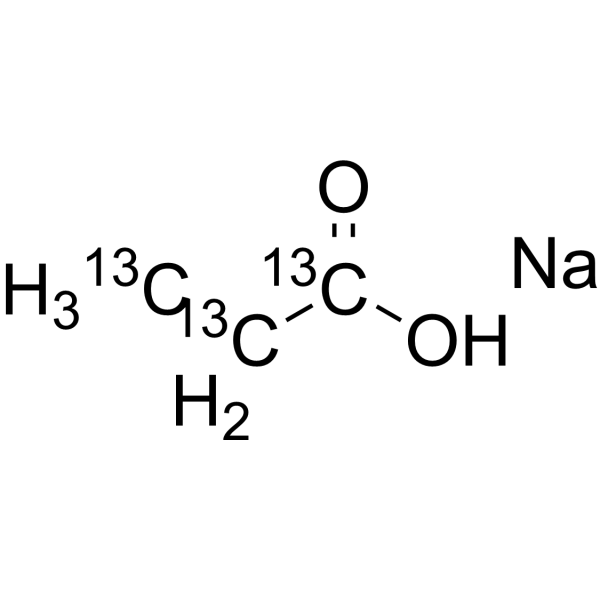
Cat. No.: HY-B1773AS3
CAS No.: 152571-51-2
Sodium propionate- 13C-3 is the 13C-labeled Propionate sodium (HY-B1773A). Sodium propionate is an orally active short-chain fatty acid. Sodium propionate can be produced by intestinal bacteria from the metabolism of dietary fiber. Sodium propionate increases PPAR-γ, inhibits NF-κB activation, and reduces COX-2 expression and NO production. Sodium propionate also induces Apoptosis and Autophagy. Sodium propionate reduces HSV-1-induced keratitis. Sodium propionate has anticancer effects against glioblastoma. Sodium propionate exhibits neuroprotective, antioxidant, and anti-inflammatory activities. Sodium propionate can be used in the research of spinal cord injury and Alzheimer's disease .
loading...
    loading...
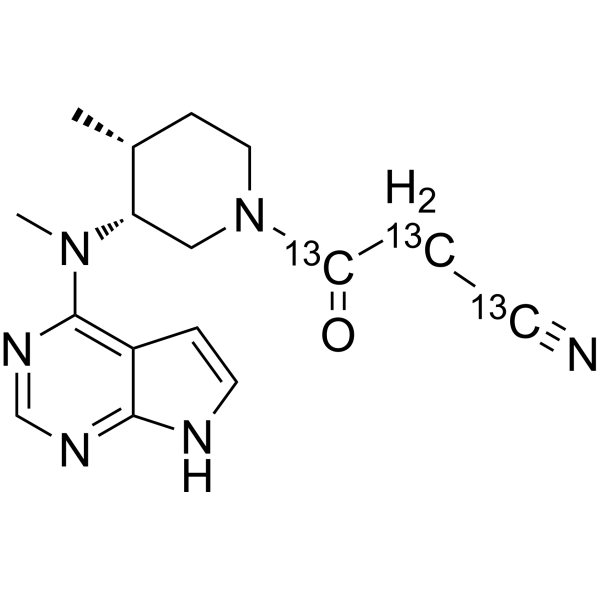
Cat. No.: HY-40354S
CAS No.: 2256762-71-5
Synonyms: Tasocitinib-13C3; CP-690550-13C3
Tofacitinib- 13C3 (Tasocitinib- 13C3; CP-690550- 13C3) is the 13C-labeled Tofacitinib (HY-40354). Tofacitinib (Tasocitinib) is an orally active, blood-brain barrier permeable selective inhibitor of JAK1/JAK3. Tofacitinib blocks the JAK-STAT/NF-κB signaling pathway, inhibits cytokine signal transduction, phosphorylation of STAT1/STAT5, and suppresses innate and adaptive immune responses. Tofacitinib can be used in research related to major depressive disorder, rheumatoid arthritis, pulmonary diseases, systemic lupus erythematosus, and immune-mediated liver injury .
loading...
    loading...
Cat. No.: HY-W130878
CAS No.: 1806-26-4
4-Octylphenol is a hormone disruptor that has gender-specific effects on male reproductive cells, significantly reducing the mitotic index and the number of spermatogonia. 4-Octylphenol can cause inflammatory damage to fish gills by activating the complement system through the C3a/C3aR axis and the C5a/C5aR1 axis, this leads to complement activation and causes immune suppression due to the imbalance between Th1/Th2 cells and regulatory T cells (Treg)/Th17 cells, as well as inflammatory damage via the Toll-like receptor 7 (Toll-like Receptor (TLR))/IκBα/NF-κB pathway .
loading...
    loading...
Cat. No.: HY-40354S1
Synonyms: Tasocitinib-13C3,15N; CP-690550-13C3,15N
Tofacitinib- 13C3, 15N (Tasocitinib- 13C3, 15N; CP-690550- 13C3, 15N) is the 15N, 13C-labeled Tofacitinib (HY-40354). Tofacitinib (Tasocitinib) is an orally active, blood-brain barrier permeable selective inhibitor of JAK1/JAK3. Tofacitinib blocks the JAK-STAT/NF-κB signaling pathway, inhibits cytokine signal transduction, phosphorylation of STAT1/STAT5, and suppresses innate and adaptive immune responses. Tofacitinib can be used in research related to major depressive disorder, rheumatoid arthritis, pulmonary diseases, systemic lupus erythematosus, and immune-mediated liver injury .
loading...
    loading...
Cat. No.: HY-D0205AS1
CAS No.: 1391068-19-1
Synonyms: Carbocysteine-13C3-1
Carbocisteine- 13C3-1 (Carbocysteine- 13C3-1) is 13C labeled Carbocisteine. Carbocisteine is an orally active mucolytic agent. Carbocisteine attenuates the phosphorylation of NF-κB p65 and ERK1/2. Carbocisteine modulates Nrf2/HO-1 and NFκB interplay. Carbocisteine inhibits Apoptosis. Carbocisteine is used in chronic obstructive pulmonary disease (COPD) research .
loading...
    loading...
Cat. No.: HY-N0001S2
Synonyms: (-)-Epicatechol-13C3; Epicatechin-13C3; epi-Catechin-13C3
(-)-Epicatechin- 13C3 ((-)-Epicatechol- 13C3) is 13C labeled (-)-Epicatechin. (-)-Epicatechin inhibits cyclooxygenase-1 (COX-1) with an IC50 of 3.2 μM. (-)-Epicatechin inhibits the IL-1β-induced expression of iNOS by blocking the nuclear localization of the p65 subunit of NF-κB.
loading...
    loading...
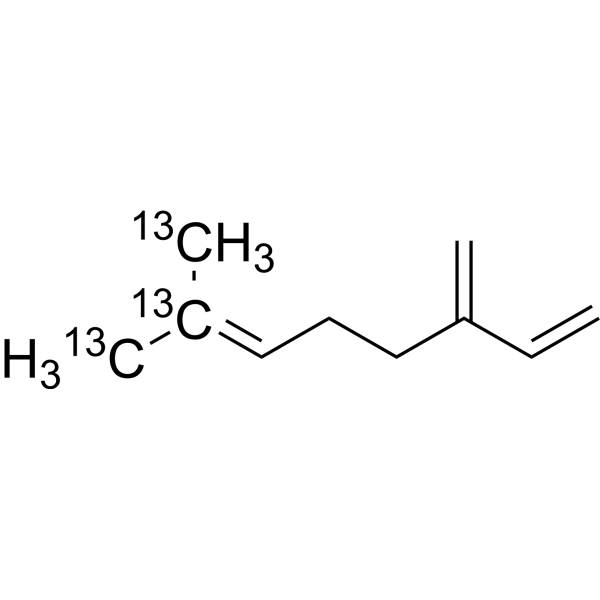
Cat. No.: HY-N0803S1
CAS No.: 3028870-47-2
Synonyms: β-Myrcene-13C3
Myrcene- 13C3 is 13C labeled Myrcene (HY-N0803). Myrcene (β-Myrcene) is a type of aromatic compound that inhibits TNFα and NF-κB activity. Myrcene has anti-invasive action, inhibits cell cycle, and leads to cancer cell apoptosis. Myrcene has strong blood protection effect, anti-inflammation, and anti-inflammatory activity .
loading...
    loading...
Cat. No.: HY-W778057
CAS No.: 1330195-40-8
Synonyms: Protocatechuic acid ethyl ester-13C3
Ethyl 3,4-Dihydroxybenzoate- 13C3 (Protocatechuic acid ethyl ester- 13C3) is the 13C-labeled Ethyl 3,4-dihydroxybenzoate (HY-W016409). Ethyl 3,4-dihydroxybenzoate (Protocatechuic acid ethyl ester) is an orally effective, blood-brain barrier-permeable, competitive prolyl hydroxylase (PHD) inhibitor that inhibits the hydroxylation modification of hypoxia-inducible factor (HIF) by PHD. Ethyl 3,4-dihydroxybenzoate stabilizes HIF-1α by inhibiting PHD, activates downstream pathways to induce autophagy and apoptosis of tumor cells, and regulates inflammatory responses, inhibits the NF-κB pathway, improves vascular permeability, and promotes osteoblast differentiation. Ethyl 3,4-dihydroxybenzoate has anti-tumor, anti-hypoxic injury, and bone metabolism regulation effects. It can also be used in the research of cardiovascular protection (such as reducing myocardial ischemic damage), bone tissue engineering (promoting osteogenesis/inhibiting osteoclast differentiation), and prevention and treatment of high-altitude cerebral edema .
loading...
    loading...
Cat. No.: HY-P5522AS
Synonyms: L-Ala-γ-D-Glu-meso-diaminopimelic acid-13C3,15N dihydrochloride
TriDAP- 13C3, 15N (L-Ala-γ-D-Glu-meso-diaminopimelic acid- 13C3, 15N) dihydrochloride is the 13C, 15N-labeled TriDAP dihydrochloride (HY-P5522A). TriDAP dihydrochloride (L-Ala-γ-D-Glu-meso-diaminopimelic acid dihydrochloride) is a NOD1 agonist with a Kd value of 34.5 μM. TriDAP dihydrochloride enhances the binding of NOD1-RICK, promotes RICK phosphorylation, and activates the NF-κB, TAK1, MEK/ERK, p38 and interferon response pathways. TriDAP dihydrochloride downregulates Runx2 via increasing ubiquitination and reduces trabecular bone parameters. TriDAP dihydrochloride decreases IκBα levels and increases p65 levels. TriDAP dihydrochloride induces the secretion of proinflammatory mediators IL-8 and prostaglandins, triggers tissue inflammation and innate immune activation, and inhibits SARS-CoV-2 replication in lung epithelial cells. TriDAP dihydrochloride increases the RANKL/OPG ratio in mice, reduces bone mass and enhances osteoclast activity, and inhibits new bone formation by decreasing the mineralization deposition rate in mice. TriDAP dihydrochloride can be used in research related to pulpitis, chronic ulcerative colitis, Crohn's disease and SARS-CoV-2 infection .
loading...
    loading...

