9 Results for "

LPI

" in MedChemExpress (MCE) Product Catalog:
Products (9)

9 Results for "LPI" in MCE Product Catalog:

Cat. No.: HY-112747
CAS No.: 97281-51-1
Synonyms: LPI; PE (soy)
Target:  

Phospholipase

Research Areas:  

Infection

Soy PE (LPI) is the most abundant phospholipid in prokaryotes and the second most abundant found in the membrane of mammalian, plant, and yeast cells, comprising approximately 25% of total mammalian phospholipids. In the brain, phosphatidylethanolamine comprises almost half of the total phospholipids. It is synthesized mainly through the cytidine diphosphate-ethanolamine and phosphatidylserine decarboxylation pathways, which occur in the endoplasmic reticulum (ER) and mitochondrial membranes, respectively. It is a precursor in the synthesis of phosphatidylcholine and arachidonoyl ethanolamide and is a source of ethanolamine used in various cellular functions. In E.coli, phosphatidylethanolamine deficiency prevents proper assembly of lactose permease, suggesting a role as a lipid chaperone. It is a cofactor in the propagation of prions in vitro and can convert recombinant mammalian proteins into infectious molecules even in the absence of RNA. This product contains phosphatidylethanolamine molecular species with variable fatty acyl chain lengths at the sn-1 and sn-2 positions .
loading...
    loading...
Cat. No.: HY-111083
CAS No.: 931695-79-3
Purity:  99.65%
Synonyms: CID23612552
Target:  

GPR55 PERK PKC ERK p38 MAPK

Research Areas:  

Metabolic Disease Cancer

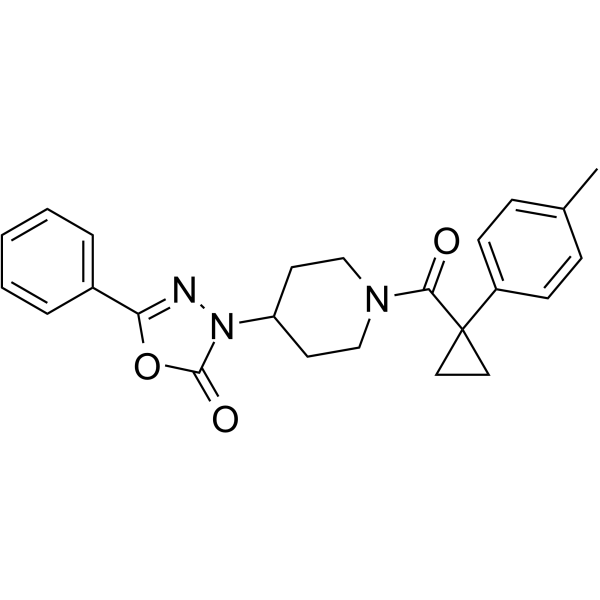
ML191 (CID23612552) is a GPR55 antagonist. ML191 inhibits ERK phosphorylation and PKC β II translocation downstream of GPR55 signaling. ML191 suppresses LPI-induced activation of ERK1/2 and p38 MAPK signaling, blocks the transcription of RANKL-induced osteoclastogenesis markers, and reduces the bone resorption activity of mature osteoclasts promoted by RANKL. ML191 can be used to investigate diseases associated with bone degradation caused by excessive osteoclast activation, such as osteoporosis and bone damage during the formation stage of bone metastases .
loading...
    loading...
Cat. No.: HY-W018004S
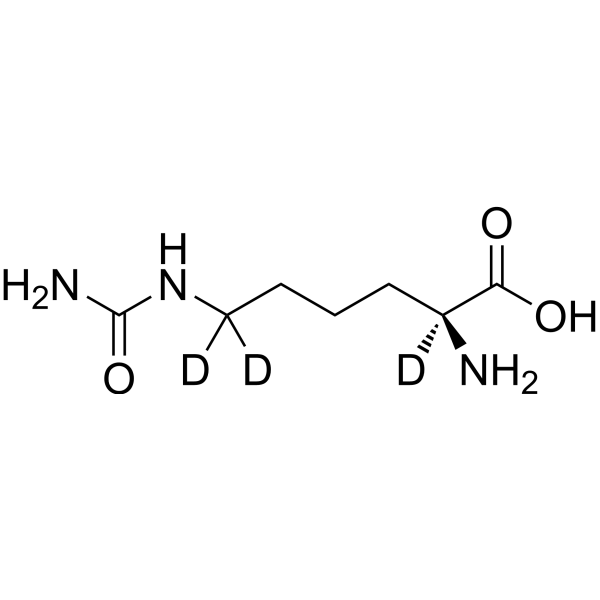
L-Homocitrulline-d3 is the deuterium labeled L-Homocitrulline. L-Homocitrulline is metabolized to homoarginine through homoargininosuccinate via the urea cycle pathway and its metabolic abnormality could lead to Lysinuric Protein Intolerance (LPI).
loading...
    loading...
Cat. No.: HY-W018004R
CAS No.: 1190-49-4
L-Homocitrulline is metabolized to homoarginine through homoargininosuccinate via the urea cycle pathway and its metabolic abnormality could lead to Lysinuric Protein Intolerance (LPI).
loading...
    loading...
Cat. No.: HY-RS13334
Research Areas:  

Others

SLC7A7 Human Pre-designed siRNA Set A contains three designed siRNAs for SLC7A7 gene (Human), as well as a negative control, a positive control, and a FAM-labeled negative control.

loading...
    loading...
Cat. No.: HY-189122
CAS No.: 2251130-98-8
Lpi-1 is an ATP-competitive LATS1/2 inhibitor with IC50 values of 4.4 nM and 1.3 nM, respectively. Lpi-1 blocks LATS-mediated YAP1 phosphorylation. Lpi-1 reversibly inhibits LATS1/2 in cells and in vivo, activating the YAP/TAZ signaling pathway. Lpi-1 can be used for research on acute liver injury and colitis .
loading...
    loading...
Cat. No.: HY-P88119
Synonyms: LAT2; LPI-PC1

Host:  

Mouse

Application:  

IHC-P, ICC/IF

Reactivity:  

Human, Mouse, Rat

loading...
    loading...
Cat. No.: HY-P88119A
Synonyms: LAT2; LPI-PC1

Host:  

Mouse

Application:  

IHC-P, ICC/IF

Reactivity:  

Human, Mouse, Rat

loading...
    loading...
Cat. No.: HY-111083R
CAS No.: 931695-79-3
Synonyms: CID23612552 (Standard)
Research Areas:  

Others

ML191 (Standard) is the analytical standard of ML191 (HY-111083). This product is intended for research and analytical applications. ML-191 is an antagonist of GPR55. It inhibits GPR55 signaling induced by lysophosphatidylinositol (EC50=1.076 µM in U2OS cells overexpressing GPR55). ML-191 inhibits LPI-induced phosphorylation of ERK1/2 (IC50=328 nM) and receptor-dependent translocation of PKCβII when used at a concentration of 30 µM .
loading...
    loading...

