4 Results for "

Podosphaera xanthii

" in MedChemExpress (MCE) Product Catalog:
Products (4)

4 Results for "Podosphaera xanthii" in MCE Product Catalog:

1
1 Cited Publications
Cat. No.: HY-N0358
CAS No.: 1182-34-9
Synonyms: 1,4-DCQA
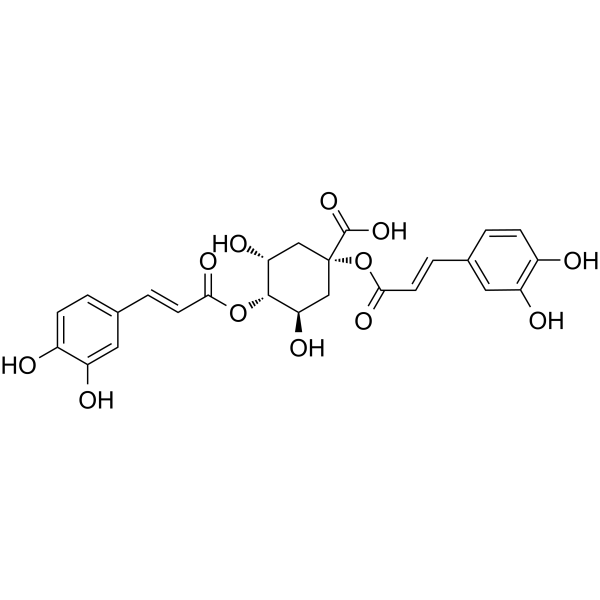
1,4-Dicaffeoylquinic acid (1,4-DCQA) is a phenylpropanoid compound that can be isolated from Xanthii fructus and an inhibitor of xanthine oxidase (IC50: 7.36 μM). 1,4-Dicaffeoylquinic acid has anti-inflammatory activity and can inhibit the production of TNF-α induced by LPS (HY-D1056) .
loading...
    loading...
Cat. No.: HY-171542
CAS No.: 2559404-67-8
Target:  

Fungal

Research Areas:  

Infection

CDA-IN-2 (Compound VS#2-3) is a chitin deacetylase (Chitin Deacetylase, CDA) inhibitor with antifungal activity. At a concentration of 100 μM, it can inhibit the CDA PxCDA1 and PxCDA2 of P. xanthii by 83.7% and 74.5% respectively. CDA-IN-2 can be applied to the research in the field of controlling agricultural fungal diseases, such as dealing with resistant powdery mildew and Botrytis cinerea .
loading...
    loading...
Cat. No.: HY-N0358R
CAS No.: 1182-34-9
Synonyms: 1,4-DCQA (Standard)
1,4-Dicaffeoylquinic acid (Standard) (1,4-DCQA (Standard)) is the analytical standard of 1,4-Dicaffeoylquinic acid (HY-N0358). This product is intended for research and analytical applications. 1,4-Dicaffeoylquinic acid (1,4-DCQA) is a phenylpropanoid compound that can be isolated from Xanthii fructus and an inhibitor of xanthine oxidase (IC50: 7.36 μM). 1,4-Dicaffeoylquinic acid has anti-inflammatory activity and can inhibit the production of TNF-α induced by LPS (HY-D1056) .
loading...
    loading...
Cat. No.: HY-171541
CAS No.: 354562-11-1
Target:  

Fungal

Research Areas:  

Infection

CDA-IN-1 (Compound vs#2-1) is an inhibitor of chitin deacetylase (CDA). CDA-IN-1 exhibits antifungal activity. It can inhibit fungal growth by suppressing the activity of fungal CDA, activating the plant immune response, and accumulating reactive oxygen species (ROS). At a concentration of 100 μM, CDA-IN-1 can achieve inhibition rates of 86.9% and 74.5% against PxCDA1 and PxCDA2 of P. xanthii, respectively. CDA-IN-1 can be applied to the research in the field of controlling plant fungal diseases, such as the research on diseases like cucurbit powdery mildew and tomato gray mold .
loading...
    loading...

