35 Results for "

Radionuclide therapy

" in MedChemExpress (MCE) Product Catalog:
Products (35)

35 Results for "Radionuclide therapy" in MCE Product Catalog:

1
1 Cited Publications
Cat. No.: HY-Y1091
CAS No.: 923-27-3
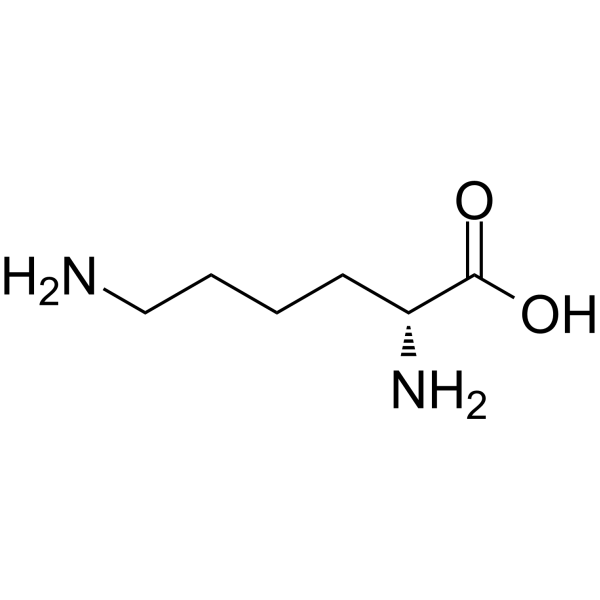
D-Lysine is the D-enantiomer of L-Lysine (HY-N0469). D-Lysine is metabolically inert and not utilized for protein synthesis by mammalian ribosomes. D-Lysine blocks renal uptake of 111In/ 90Y-Octreotide (HY-P0036)-based probes without inhibiting uptake by tumor/receptor tissues, and thus acts as a renoprotective agent in diagnostic imaging and peptide receptor radionuclide therapy (PRRT). D-Lysine specifically inhibits the early steps of non-enzymatic glycation by competing with glucose via its free amino group, theoretically, it can serve as a glycation competitor that "does not interfere with protein synthesis" under chronic hyperglycemia in diabetes. D-Lysine can be used in research related to cancer and diabetes .
loading...
    loading...
1
1 Cited Publications
Cat. No.: HY-Y1804
CAS No.: 7274-88-6
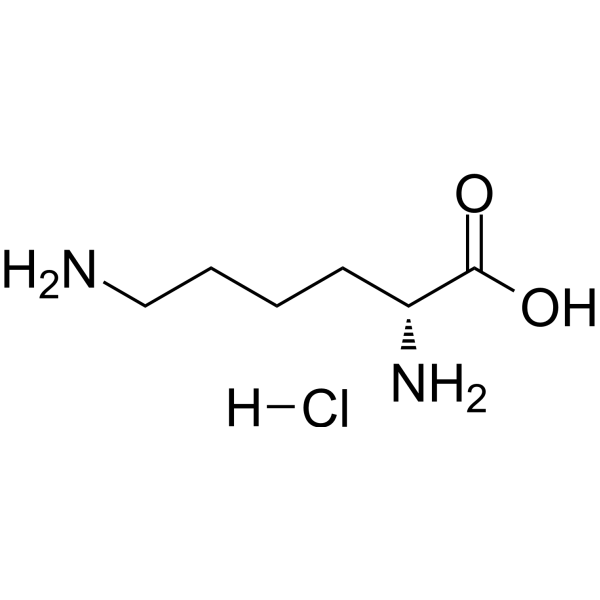
D-Lysine monohydrochloride is the D-enantiomer of L-Lysine (HY-N0469). D-Lysine monohydrochloride is metabolically inert and not utilized for protein synthesis by mammalian ribosomes. D-Lysine monohydrochloride blocks renal uptake of 111In/ 90Y-Octreotide (HY-P0036)-based probes without inhibiting uptake by tumor/receptor tissues, and thus acts as a renoprotective agent in diagnostic imaging and peptide receptor radionuclide therapy (PRRT). D-Lysine monohydrochloride specifically inhibits the early steps of non-enzymatic glycation by competing with glucose via its free amino group, theoretically, it can serve as a glycation competitor that "does not interfere with protein synthesis" under chronic hyperglycemia in diabetes. D-Lysine monohydrochloride can be used in research related to cancer and diabetes .
loading...
    loading...
Cat. No.: HY-100138
CAS No.: 173308-19-5
Purity:  ≥98.0%
Research Areas:  

Cancer

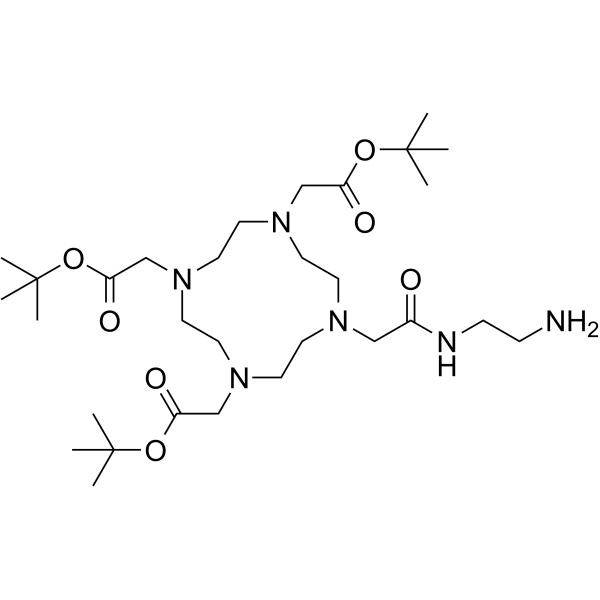
2-Aminoethyl-mono-amide-DOTA-tris(tBu ester) is a metal chelator precursor containing a DOTA macrocyclic structure. DOTA can form highly stable complexes with metal ions (such as 68Ga, 177Lu) through four nitrogen atoms and four carboxylic acid groups to mediate targeted delivery of radionuclides. The tert-butyl ester group (tBu ester) of 2-Aminoethyl-mono-amide-DOTA-tris(tBu ester) also protects the carboxylic acid group during synthesis, and forms a free carboxyl group after deprotection reaction for coupling with targeting molecules (such as antibodies, peptides). 2-Aminoethyl-mono-amide-DOTA-tris(tBu ester) may be combined with tumor pre-targeting systems through bioorthogonal reactions (such as reverse electron demand Diels-Alder reaction) to study radioactive imaging or therapy of tumor tissues, and is mainly used in tumor pre-targeting research in the field of nuclear medicine .
loading...
    loading...
Cat. No.: HY-139564
CAS No.: 1908409-18-6
Research Areas:  

Cancer

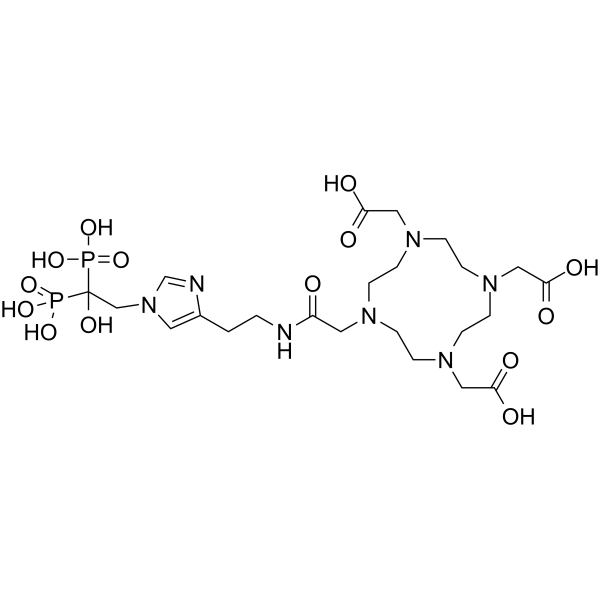
DOTA Zoledronate is a next-generation agent for bone targeted radionuclide therapy for diagnosing bone metastases .
loading...
    loading...
Cat. No.: HY-164574
CAS No.: 2565792-45-0
BCN-DOTA is a cyclooctyne-linked DOTA chelator. BCN-DOTA integrates BCN and DOTA, enabling conjugation with azide-functionalized groups via the click chemistry properties of BCN, while binding to metal ions through the coordination capacity of DOTA. BCN-DOTA can serve as a radionuclide-drug conjugate (RDC) to target specific biomolecules, cells or tissues after radiolabeling with zirconium-89. BCN-DOTA is applicable to research related to PET imaging and targeted therapy .
loading...
    loading...
Cat. No.: HY-173374
CAS No.: 3114056-16-2
Target:  

FAP Drug Derivative

Research Areas:  

Cancer

DOTAGA-FAP-2286-ALB is a derivative of Rofapitide tetraxetan (HY-147057). DOTAGA-FAP-2286-ALB is a selective fibroblast activation protein (FAP) inhibitor with an IC50 value of 67.5 nM. DOTAGA-FAP-2286-ALB enhances tumor retention via albumin interaction, prolonging blood circulation and improving radiometal complex stability (e.g., with 111In and 225Ac). DOTAGA-FAP-2286-ALB is promising for research of radionuclide therapy (TRT) of FAP-positive solid tumors .
loading...
    loading...
Cat. No.: HY-P10239
CAS No.: 302794-43-0
Tyr3-Octreotate is a ligand for somatostatin receptor subtype 2 (sst2), with an IC50 value of 1.3 nM against sst2 when labeled with [ 111In-DTPA], and an IC50 value of 1.6 nM against sst2 when labeled with [ 90Y-DOTA]. Radiolabeled Tyr3-Octreotate generates cell-associated radioactivity, and acts as both a tumor growth inhibitor and a tumor cytotoxic agent. When radiolabeled with 177Lu or 90Y, Tyr3-Octreotate serves as a peptide receptor radionuclide therapy (PRRT) analog. Tyr3-Octreotate can be used in studies related to pancreatic tumors .
loading...
    loading...
Cat. No.: HY-P10732
CAS No.: 909024-55-1
Research Areas:  

Cancer

DOTA-cyclo(RGDfK) is a radionuclide conjugate (RDC), which is capable of binding to a radionuclide. RDC has the ability to specifically target biomolecules and can be used in medical imaging or therapy .
loading...
    loading...
Cat. No.: HY-W873634
CAS No.: 1242003-07-1
Synonyms: TRAP-Pr
Research Areas:  

Cancer

TRAP-Pr is a radionuclide conjugate (RDC) that can bind to the radionuclide [68]Ga. RDCs have the ability to specifically target biomolecules and can be used in medical imaging or therapy. TRAP-Pr can be further functionalized with acetone and used in click chemistry CuAAC reactions to conjugate other labeled molecules.
loading...
    loading...
Cat. No.: HY-175744
CAS No.: 3077205-52-5
Target:  

PSMA

Research Areas:  

Cancer

PSMA-MAL-5 is a PSMA ligand. PSMA-MAL-5 covalently binds to Cys466 of PSMA. PSMA-MAL-5 labeled with 177Lu and 225Ac has high radiostability and tumor uptake. PSMA-MAL-5 also effectively inhibits tumor growth. PSMA-MAL-5 can be used for SPECT/CT imaging and radionuclide therapy of prostate cancer .
loading...
    loading...
Cat. No.: HY-158118
CAS No.: 2088426-96-2
Purity:  97.19%
Target:  

DNA-PK

Research Areas:  

Cancer

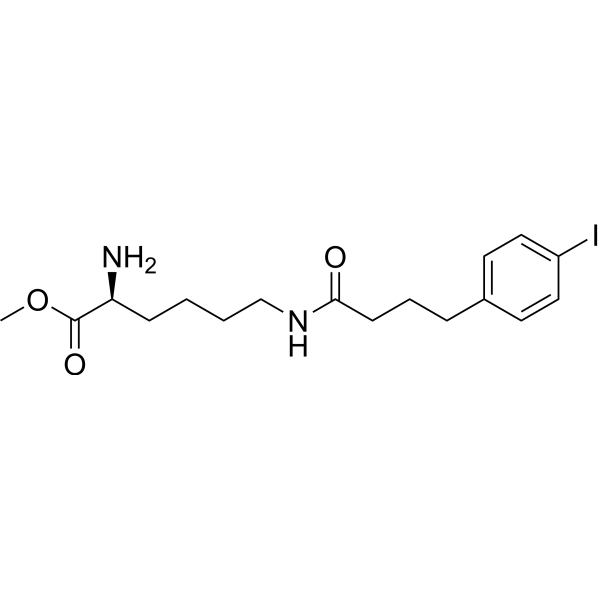
Lys(CO-C3-p-I-Ph)-OMe is a pharmacokinetic modifier (PK modifier) that can improve the PK properties of PSMA ligand molecules (such as Ac-PSMA-trillium). Lys(CO-C3-p-I-Ph)-OMe can increase the residence time of Ac-PSMA-trillium in plasma by increasing its binding capacity to albumin. Lys(CO-C3-p-I-Ph)-OMe also reduces salivary gland absorption of Ac-PSMA-trillium, potentially extending its half-life. Ac-PSMA-trillium is a suitable PSMA-targeting compound that has different biological applications after modification with different radioactive isotopes. If labeled with 111In, it can be used as DOTA chelating agent and imaging agent. Or labeled with 225Ac as a Macropa chelator for targeted radionuclide therapy (TRT) in the study of metastatic castration-resistant prostate cancer (mCRPC) .
loading...
    loading...
Cat. No.: HY-175685
CAS No.: 3020777-28-7
Target:  

FAP

Research Areas:  

Cancer

FAP-IN-7 (Compound 5b) is a FAPradionuclide therapy of cancers research .
loading...
    loading...
Cat. No.: HY-158125
CAS No.: 2149567-00-8
Purity:  97.35%
Target:  

PSMA

Research Areas:  

Cancer

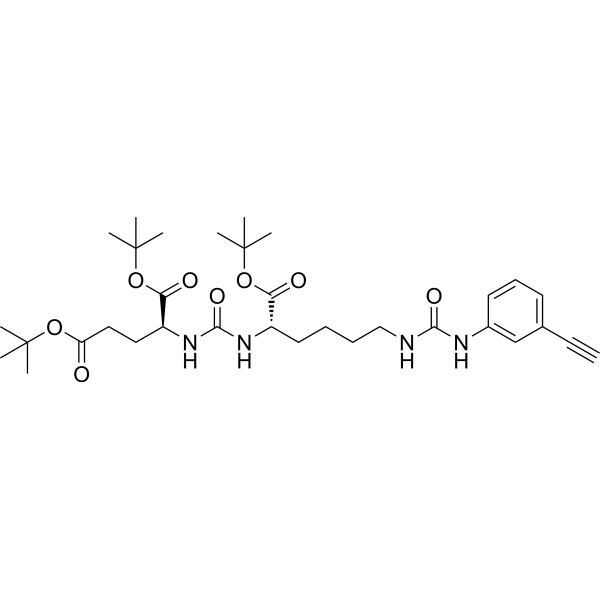
PSMA binder-2 is a ligand for PSMA and can be used to synthesize Ac-PSMA-trillium. Ac-PSMA-trillium is a suitable PSMA-targeting compound with improved PSMA binding properties and pharmacokinetic properties. PSMA ligands have different biological applications after being modified with different radioactive isotopes. If labeled with 111In, it can be used as DOTA chelating agent and imaging agent. Or labeled with 225Ac as a Macropa chelator for targeted radionuclide therapy (TRT) in the study of metastatic castration-resistant prostate cancer (mCRPC) .
loading...
    loading...
Cat. No.: HY-W035399S
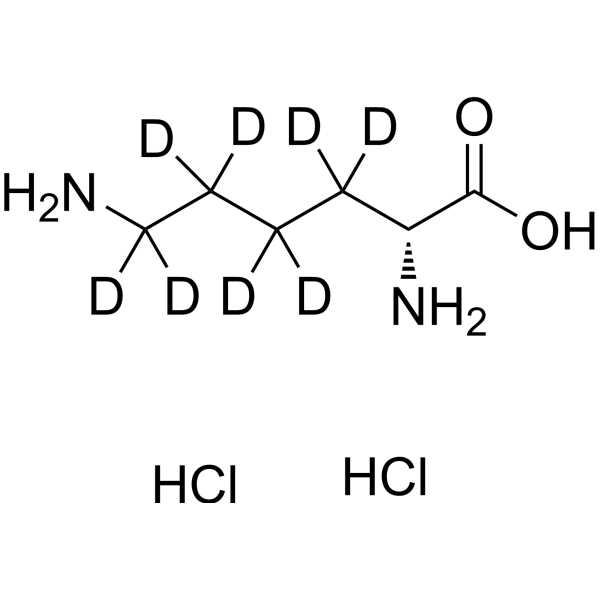
D-Lysine-d8 dihydrochloride is the d8-labeled D-Lysine (HY-Y1091). D-Lysine is the D-enantiomer of L-Lysine (HY-N0469). D-Lysine is metabolically inert and not utilized for protein synthesis by mammalian ribosomes. D-Lysine blocks renal uptake of 111In/ 90Y-Octreotide (HY-P0036)-based probes without inhibiting uptake by tumor/receptor tissues, and thus acts as a renoprotective agent in diagnostic imaging and peptide receptor radionuclide therapy (PRRT). D-Lysine specifically inhibits the early steps of non-enzymatic glycation by competing with glucose via its free amino group, theoretically, it can serve as a glycation competitor that "does not interfere with protein synthesis" under chronic hyperglycemia in diabetes. D-Lysine can be used in research related to cancer and diabetes .
loading...
    loading...
Cat. No.: HY-164653
CAS No.: 137076-50-7
Research Areas:  

Cancer

DOTAEt is a radionuclide conjugate (RDC), which is capable of binding to a radionuclide. RDC has the ability to specifically target biomolecules and can be used in medical imaging or therapy .
loading...
    loading...
Cat. No.: HY-164590
CAS No.: 2256055-98-6
Research Areas:  

Cancer

BCN-NODAGA is a radionuclide conjugate (RDC), which is capable of binding to a radionuclide. RDC has the ability to specifically target biomolecules and can be used in medical imaging or therapy .
loading...
    loading...
Cat. No.: HY-P10730
CAS No.: 213187-44-1
Research Areas:  

Cancer

DOTA-Lanreotide is a radionuclide conjugate (RDC), which is capable of binding to a radionuclide. RDC has the ability to specifically target biomolecules and can be used in medical imaging or therapy .
loading...
    loading...
Cat. No.: HY-164594
Research Areas:  

Cancer

TA-DOTA-GA is a radionuclide conjugate (RDC), which is capable of binding to a radionuclide. RDC has the ability to specifically target biomolecules and can be used in medical imaging or therapy .
loading...
    loading...
Cat. No.: HY-W087187G
CAS No.: 1375475-53-8
DOTAGA-anhydride (GMP) is DOTAGA-anhydride (HY-W087187) produced by using GMP guidelines. GMP small molecules works appropriately as an auxiliary reagent for cell therapy manufacture. DOTAGA-anhydride is a DOTA-based metal chelator that can bind to radionuclides and is used to prepare radionuclide drug conjugates (RDCs). DOTAGA-anhydride has been successfully used for labeling antibodies (e.g., Trastuzumab (HY-P9907)). DOTAGA-anhydride can be used for the synthesis of a bimodal tag for Single-photon emission computed tomography (SPECT) or PET/optical imaging .
loading...
    loading...
Cat. No.: HY-164589
CAS No.: 1397275-76-1
Research Areas:  

Cancer

NOPO is a radionuclide conjugate (RDC), which is capable of binding to a radionuclide. RDC has the ability to specifically target biomolecules and can be used in medical imaging or therapy .
loading...
    loading...

