16 Results for "

S1 site

" in MedChemExpress (MCE) Product Catalog:
Products (16)

16 Results for "S1 site" in MCE Product Catalog:

  • Categories Recommended:
    More
14
14 Publications Verification
Cat. No.: HY-13447A
CAS No.: 2248666-66-0
Purity:  99.80%
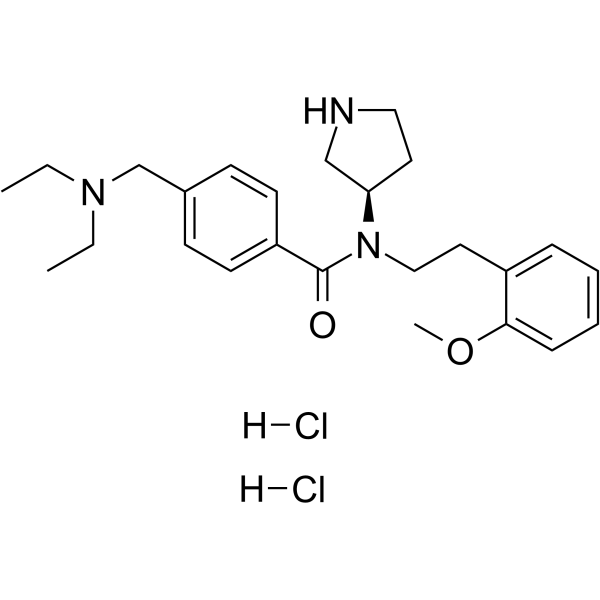
PF429242 dihydrochloride is a reversible and competitive SREBP site 1 protease (S1P) inhibitor with an IC50 of 175 nM .
loading...
    loading...
14
14 Publications Verification
Cat. No.: HY-13447
CAS No.: 947303-87-9
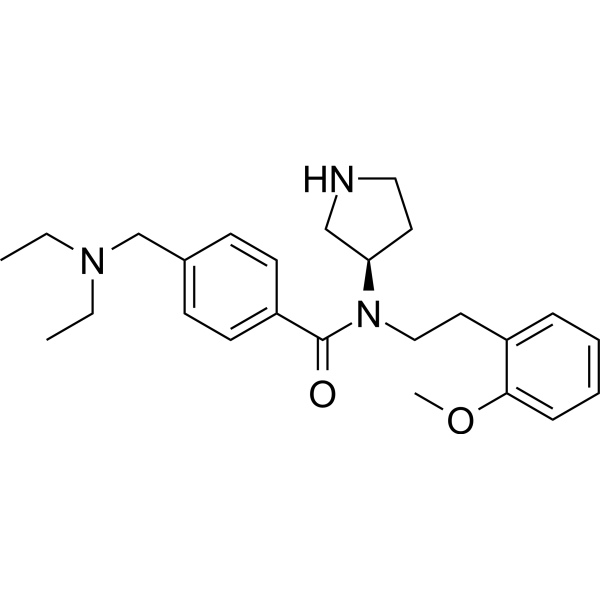
PF429242 is a reversible and competitive SREBP site 1 protease (S1P) inhibitor with an IC50 of 175 nM .
loading...
    loading...
1
1 Cited Publications
Cat. No.: HY-132830
CAS No.: 1933514-13-6
Purity:  99.58%
Synonyms: KVD900
Target:  

Kallikrein

Research Areas:  

Cardiovascular Disease

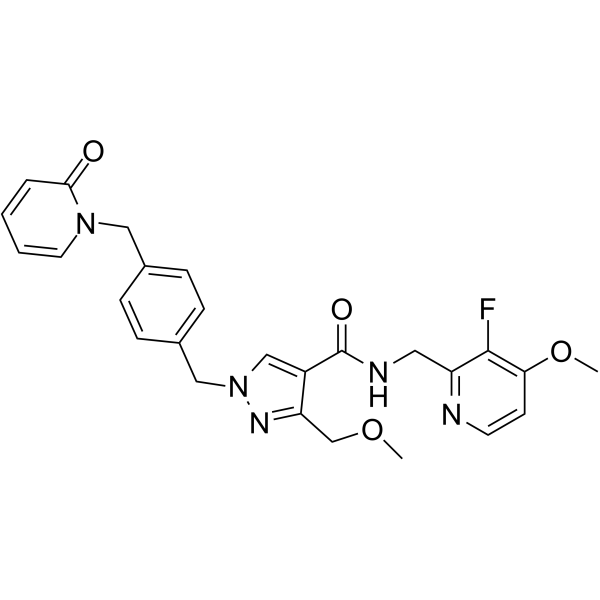
Sebetralstat (KVD900) is an orally active and selective plasma kallikrein inhibitor, with an IC50 of 6.0 nM and a Ki of 3.0 nM against the human target. Sebetralstat binds to the active site of plasma kallikrein, inducing a conformational flip of Trp215 to form a U-shaped conformation; its P1 group interacts with the S1 pocket through hydrophobic interactions and displacement of high-energy water molecules, independent of the Asp189 ionic bond. Sebetralstat inhibits plasma kallikrein-kinin system activation in whole plasma, rapidly relieves laryngeal and abdominal attack symptoms of hereditary angioedema (HAE-C1INH), and reduces attack severity. Sebetralstat can be used in research related to hereditary angioedema (HAE) .
loading...
    loading...
1
1 Cited Publications
Cat. No.: HY-N6680
CAS No.: 23152-29-6
Synonyms: Virginiamycin S
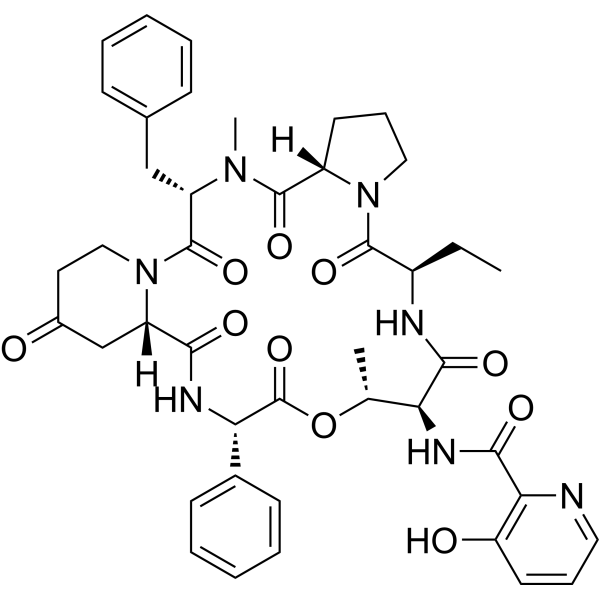
Virginiamycin S1 (Virginiamycin S) is a streptogramin class B antibiotic. Virginiamycin S1 binds to the bacterial 50S ribosome, occupies the region near the P-site, induces tRNA misreading/stalling, inhibits peptide chain elongation, and exhibits synergistic activity against Gram-positive bacteria when used in combination with Virginiamycin M1 (HY-N6686). Virginiamycin S1 can be used in the research of Gram-positive bacterial infections .
loading...
    loading...
1
1 Cited Publications
Cat. No.: HY-129115
CAS No.: 897613-29-5
Research Areas:  

Inflammation/Immunology

S1QEL1.1 is a cell-permeable selective site IQ electron leak inhibitor and mitochondrial complex I site IQ superoxide/hydrogen peroxide production inhibitor (IC50 of 70.3 nM for IQr; IC50 of 64.0 nM for IQf), exerting cytoprotective effects by inhibiting site IQ-dependent ROS production during reverse and forward electron transport without affecting oxidative phosphorylation and normal electron transport. S1QEL1.1 can be used for research on ischemia-reperfusion injury .
loading...
    loading...
Cat. No.: HY-168534
CAS No.: 2929223-35-6
Target:  

SF3B1 Apoptosis FOXA

Research Areas:  

Cancer

WX-02-23 is a small-molecule probe that stereoselectively and site-specifically binds to C258 of FOXA1 and C1111 of SF3B1. WX-02-23 remodels FOXA1's chromatin binding and pioneer activity in a DNA-dependent manner, disrupts spliceosome assembly, and enhances the thermal stability of SF3B1. WX-02-23 inhibits tumor cell proliferation and induces apoptosis. WX-02-23 can be used for research on cancers such as prostate cancer .
loading...
    loading...
Cat. No.: HY-P11212
CAS No.: 1193634-36-4
Target:  

Fluorescent Dye

Research Areas:  

Metabolic Disease Cancer

Ac-RHKK(Ac)-AMC (Compound S1) is a fluorescent substrate for SITR6, that is based on p53 sequence. Ac-RHKK(Ac)-AMC mimics H3K56 deacetylation site and significantly increases the deacetylation signal with low signal-to-background ratio. Ac-RHKK(Ac)-AMC can be used for ageing and cancers research .
loading...
    loading...
Cat. No.: HY-P11406
CAS No.: 259176-76-6
Target:  

Fluorescent Dye

Research Areas:  

Others

Ac-RSLK-AMC is a fluorogenic substrate, can be used to measure the enzymatic activities of site-1 protease (S1P) .
loading...
    loading...
Cat. No.: HY-168591
Target:  

Cathepsin

Research Areas:  

Cancer

CTSC-IN-1 (B22) is a CTSC inhibitor. CTSC-IN-1 inhibits CTSC activity by binding to S2 pocket and S1 site. CTSC-IN-1 can be used in the study inflammatory bowel disease .
loading...
    loading...
Cat. No.: HY-187650
CAS No.: 2507890-46-0
Target:  

Serotonin Transporter

Research Areas:  

Neurological Disease

LuAF60097 is a serotonin transporter (SERT) ligand. LuAF60097 binds to the extracellular vestibule (S2 site) of SERT with high affinity and to the central binding site (S1) with lower affinity, triggering conformational changes that exert combined competitive and non-competitive inhibitory effects on serotonin reuptake. LuAF60097 is applicable to research related to depression and anxiety disorders .
loading...
    loading...
Cat. No.: HY-P10855
CAS No.: 3027437-21-1
Target:  

SARS-CoV

Research Areas:  

Infection

S1b3inL1 is a SARS-CoV-2 spike protein macrocyclic peptide inhibitor. S1b3inL1 can bind the conserved site of spike protein with high affinity and inhibit the infection of various SARS-CoV-2 variant strains. S1b3inL1 has antiviral activity .
loading...
    loading...
Cat. No.: HY-189418
CAS No.: 2778223-60-0
Target:  

SARS-CoV Virus Protease

Research Areas:  

Infection

HL-3-68 is a SARS-CoV-2 main protease (MPro) inhibitor (IC50 = 0.29 μM; Ki = 0.89 μM; Kd = 0.75 μM). HL-3-68 stabilizes the primary binding site of MPro, locks the S1 and S2 subsites, and reduces loop flexibility. HL-3-68 is used for COVID-19 research .
loading...
    loading...
Cat. No.: HY-L925
9,269 compounds

Cysteine proteases (CPs), a key enzyme family regulating physiological metabolism and mediating pathological processes (such as abnormal bone resorption, tumour invasion, and pathogen infection), represent a core therapeutic target for developing specific inhibitors in disease intervention. Currently reported CP inhibitors primarily achieve their inhibitory function by precisely binding to CP active pockets (e.g., S1-S4 non-primed regions or S1'-S2' primed regions) and forming covalent/non-covalent interactions with the active site cysteine residues, providing clear structural references for the development of novel inhibitors.

This compound library, designed based on the core strategy of "similarity-based known active structures", contains over 200 cysteine protease inhibitors. Leveraging AI-driven molecular screening technology, it retains the critical pharmacological and shape features of reported CP inhibitors, serving as a specialized tool for efficiently discovering novel cysteine protease inhibitors.

Cat. No.: HY-173334
hMAO-B-IN-11 (Compound 12) is a selective and reversible inhibitor of human monoamine oxidase B (hMAO-B) with an IC50 of 0.11 µM. hMAO-B-IN-11 acts through competitive binding to the hMAO-B active site, preventing oxidative deamination of monoamines and reducing hydrogen peroxide production. hMAO-B-IN-11 also inhibits pro-inflammatory mediators (NO, TNF-α, IL-1β) in activated microglia, hMAO-B-IN-11 is promising for research of neurodegenerative diseases like Parkinson’s and Alzheimer’s .
loading...
    loading...
Cat. No.: HY-132830A
CAS No.: 2163789-76-0
Synonyms: KVD900 hydrochloride
Target:  

Kallikrein

Research Areas:  

Cardiovascular Disease

Sebetralstat hydrochloride (KVD900 hydrochloride) is an orally active and selective plasma kallikrein inhibitor, with an IC50 of 6.0 nM and a Ki of 3.0 nM against the human target. Sebetralstat hydrochloride binds to the active site of plasma kallikrein, inducing a conformational flip of Trp215 to form a U-shaped conformation; its P1 group interacts with the S1 pocket through hydrophobic interactions and displacement of high-energy water molecules, independent of the Asp189 ionic bond. Sebetralstat hydrochloride inhibits plasma kallikrein-kinin system activation in whole plasma, rapidly relieves laryngeal and abdominal attack symptoms of hereditary angioedema (HAE-C1INH), and reduces attack severity. Sebetralstat hydrochloride can be used in research related to hereditary angioedema (HAE) .
loading...
    loading...
Cat. No.: HY-121501
CAS No.: 121024-51-9
Target:  

Endogenous Metabolite

Research Areas:  

Others

Tyrostatin is a peptide inhibitor isolated from Kitasatospora sp. 55. It has a Ki value of 6 nM against serine carboxyl protease (PSCP) from Pseudomonas sp. 101, a Ki value of 2.1 nM against carboxyl protease (XSCP) from Xanthomonas sp. T-22, and a Ki value of 2.6 nM against carboxyl protease (PCP) from Pseudomonas sp. 101. Tyrostatin forms a reversible covalent hemiacetal bond with Ser287 at the active site of PSCP, where Tyr at the P1 position and Leu at the P2 position occupy the S1-S4 subsites of the enzyme. Tyrostatin inhibits the activity of XSCP, specifically blocks the autocatalytic maturation process of PCP precursor under acidic conditions, and also inhibits the protease activity of mature and recombinant PCP in a dose-dependent manner. Tyrostatin does not inhibit KSCP or alcohol-resistant protease J-4, and can serve as a tool for identifying the catalytic residues of PCP .
loading...
    loading...
  • 1

