16 Results for "

UPS cells

" in MedChemExpress (MCE) Product Catalog:
Products (16)

16 Results for "UPS cells" in MCE Product Catalog:

Cat. No.: HY-147941
CAS No.: 2772613-37-1
Purity:  95.29%
Target:  

PROTACs EGFR

Research Areas:  

Inflammation/Immunology Cancer

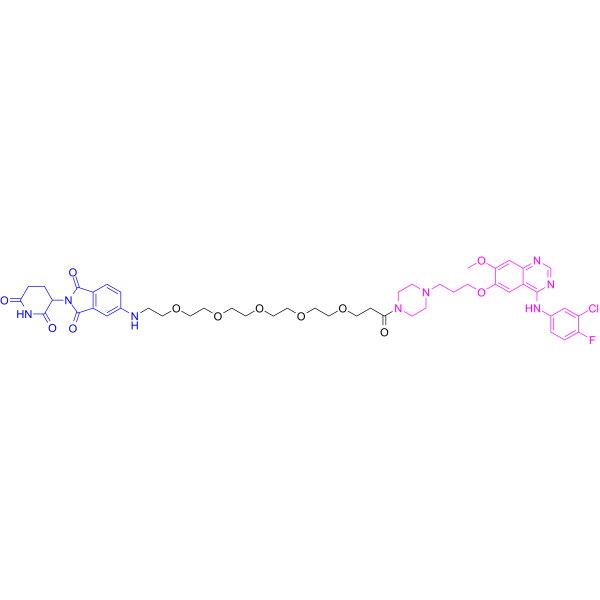
MS9427 is a potent PROTAC EGFR degrader with Kds of 7.1 nM and 4.3 nM for EGFR WT and EGFR L858R, respectively. MS9427 selectively degrades the mutant but not the WT EGFR through both the ubiquitin/proteasome system (UPS) and autophagy/lysosome pathways. MS9427 potently inhibits the proliferation of NSCLC cells. MS9427 can be used for researching anticancer .
loading...
    loading...
Cat. No.: HY-147942
CAS No.: 2772612-96-9
Purity:  98.95%
Target:  

PROTACs EGFR

Research Areas:  

Cancer

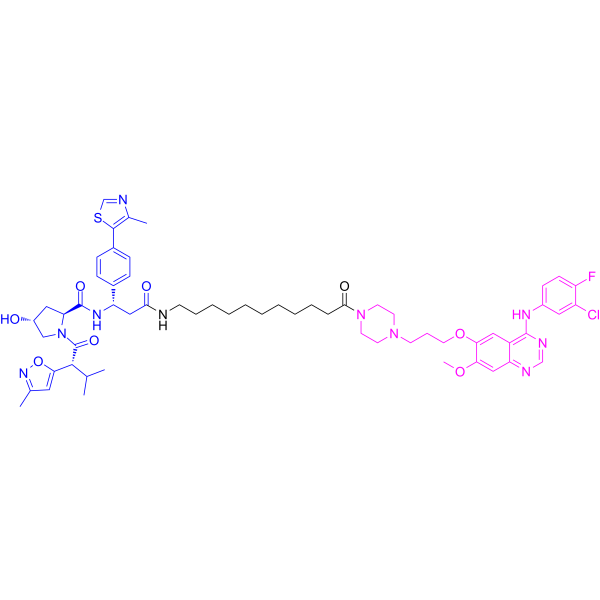
MS9449 is a potent PROTAC EGFR degrader, with Kd values of 17 nM and 10 nM for wild-type EGFR and mutant EGFR L858R, respectively, and a DC50 of 7.1 nM for EGFR Del19. MS9449 effectively induces the degradation of mutant EGFR through the ubiquitin-proteasome system (UPS) and the autophagy-lysosome pathway. MS9449 exhibits anticancer activity against non-small cell lung cancer. MS9449 can be applied in related research on non-small cell lung cancer .
loading...
    loading...
Cat. No.: HY-179243
CAS No.: 3033746-21-0
Target:  

PROTACs STAT MDM-2/p53

Research Areas:  

Cancer

S3D5 is a highly efficient and selective PROTAC degrader targeting STAT3 (KD = 4.35 μM). S3D5 induces degradation of STAT3 in HepG2 cells without significant effects on other STAT proteins. S3D5 exhibits good anti-hepatocellular carcinoma cell proliferation activity, which can be explained by activating the p53 pathway. S3D5 degradation of the STAT3 protein is mediated by the ubiquitin–proteasome system (UPS). S3D5 can be used for the study of hepatocellular carcinoma .
loading...
    loading...
Cat. No.: HY-170574
CAS No.: 3093767-34-8
Research Areas:  

Cancer

CQ627 is a molecular glue degrader of right open reading frame kinase 2 (RIOK2). CQ627 inhibits the ATPase activity of RIOK2 in MOLT-4 cells with an IC50 of 98 nM. By recruiting the E3 ubiquitin ligase RNF126, CQ627 promotes RIOK2 ubiquitination and induces its degradation via the ubiquitin-proteasome system (UPS), while inhibiting RIOK2-dependent mTOR/AKT signaling, suppressing cancer cell proliferation, and inducing G2/M cell cycle arrest and apoptosis. CQ627 can be used in studies related to RIOK2-targeted protein degradation and leukemia .
loading...
    loading...
Cat. No.: HY-179433
Research Areas:  

Cancer

PROTAC AR Degrader-12 is a highly efficient PROTAC targeting AR coactivator binding site (AR-CBS). PROTAC AR Degrader-12 induces AR degradation in a ubiquitin proteasome system (UPS) pathway-dependent manner. PROTAC AR Degrader-12 inhibits tumor cell growth by affecting DNA replication and cell division PROTAC AR Degrader-12 could not only effectively degrade AR, but also potently inhibit the proliferation of MCF-7 and multiple mutant or resistant BC cells. PROTAC AR Degrader-12 effectively blocked estrogen receptor α (ERα) signaling through a dual mechanism involving ERα protein downregulation and suppression of its transcriptional activity. PROTAC AR Degrader-12 significantly inhibits the mRNA expression of FOXA1, GREB1, SRC, and PELP1. PROTAC AR Degrader-12 can be used for the study of breast cancer .
loading...
    loading...
Cat. No.: HY-147941A
Purity:  99.01%
Target:  

PROTACs EGFR

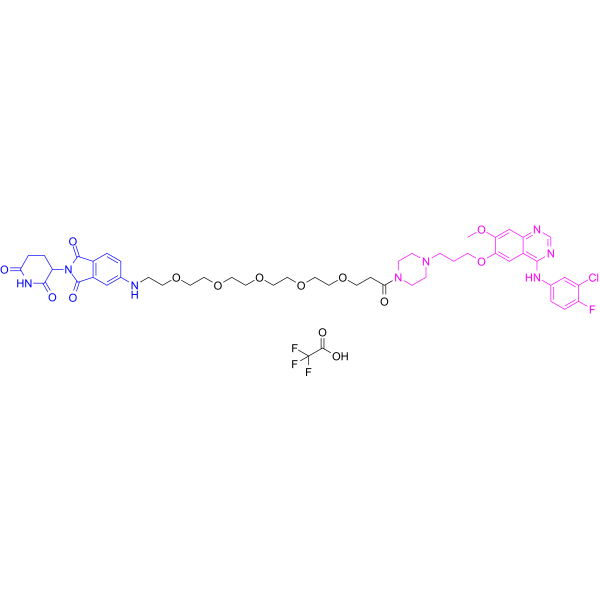
MS9427 TFA is a potent PROTAC EGFR degrader with Kds of 7.1 nM and 4.3 nM for EGFR WT and EGFR L858R, respectively. MS9427 TFA selectively degrades the mutant but not the WT EGFR through both the ubiquitin/proteasome system (UPS) and autophagy/lysosome pathways. MS9427 TFA potently inhibits the proliferation of NSCLC cells. MS9427 TFA can be used for researching anticancer .
loading...
    loading...
Cat. No.: HY-178176
Research Areas:  

Cancer

PROTAC CB1R Degrader-1 is a potent and selective CB1R PROTAC degrader that exploits the ubiquitin-proteasome system (UPS) achieving a DC50 of 3.37 μM in MCF-7 cells and showing no impact on CB2R. PROTAC CB1R Degrader-1 reduces CB1R-associated downstream signaling (p-AKT, p-ERK, BCL2, and MCM5), thereby inhibiting breast cancer cell proliferation and inducing apoptosis. PROTAC CB1R Degrader-1 can be used for breast cancer research .
loading...
    loading...
Cat. No.: HY-175849
Research Areas:  

Cancer

ALK degrader 1 is a potent, hydrophobic tag (HyT)-based degrader that induces ubiquitin-proteasome system (UPS)-dependent EML4-ALK degradation (DC50 = 0.13 μM). ALK degrader 1 demonstrates potent ALK degradation and antiproliferative effects in ALK-dependent cell lines, while showing minimal cytotoxicity in ALK fusion-negative cells. ALK degrader 1 triggers cell cycle arrest at the G0/G1 phase and stimulates apoptosis. ALK degrader 1 not only facilitates efficient degradation of the ALK protein but also disrupts key downstream effectors, including the STAT3 signaling axis. ALK degrader 1 mediates robust EML4-ALK degradation in vivo. ALK degrader 1 can be used for ALK-related diseases research .
loading...
    loading...
Cat. No.: HY-N10332
CAS No.: 138039-33-5
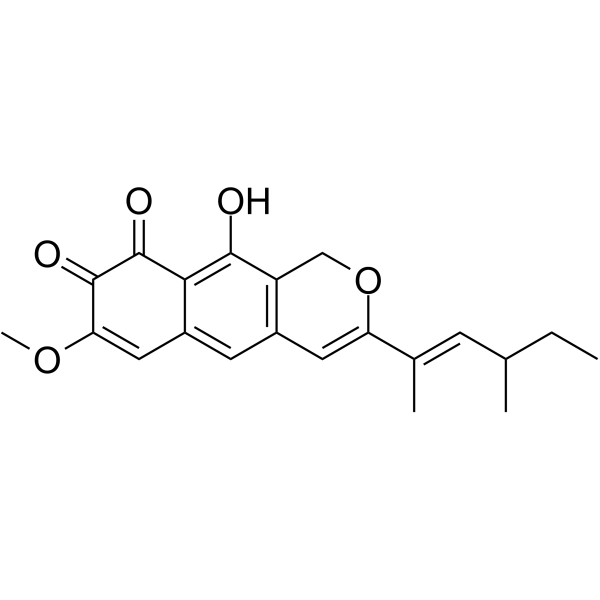
Leptosphaerodione, isolated from Remotididymella sp. Fungus, is a potent ubiquitin-proteasome system (UPS) inhibitor. Leptosphaerodione exhibits cytotoxicity in HeLa cells with IC50 value of 3.2 μM. Anti-tumor agent .
loading...
    loading...
Cat. No.: HY-161930
PROTAC GPX4 degrader-3 is a glutathione peroxidase 4 (GPX4) PROTAC degrader with a DC50 of 0.019 μM in HT1080 cells. PROTAC GPX4 degrader-3 degrades GPX4 primarily via the ubiquitin-proteasome system (UPS) in a dose- and time-dependent manner. PROTAC GPX4 degrader-3 induces lipid peroxidation (LPO) and ROS accumulation, thereby triggering ferroptosis (ferroptosis). PROTAC GPX4 degrader-3 exhibits in vitro anti-tumor activity against cancer cells. PROTAC GPX4 degrader-3 can be used in the research of fibrosarcoma, triple-negative breast cancer, and renal cell carcinoma .
loading...
    loading...
Cat. No.: HY-180909
TMU454 is an ASGPR-targeting GalNAc-PROTAC BRD4 degrader conjugate. TMU454 undergoes ASGPR-mediated endocytosis and CTSB cleavage to release MZ1, which selectively degrades BRD4 in ASGPR-positive hepatocellular carcinoma cells via the VHL/UPS/proteasome pathway. TMU454 inhibits cancer cell proliferation and colony formation, and suppresses tumor growth in vivo. TMU454 can be used for research related to hepatocellular carcinoma .
loading...
    loading...
Cat. No.: HY-183555
Research Areas:  

Cancer

MS108 is a selective VHL-based eleven-nineteen leukemia protein (ENL) PROTAC degrader with DC50 of 0.6 nM. MS108 recruits VHL E3 ligase to induce ENL degradation in a VHL- and ubiquitin-proteasome system (UPS)-dependent manner. MS108 degrades the ENL paralog AF9, which shares a highly conserved YEATS domain with ENL. MS108 suppresses proliferation of cancer cells .
loading...
    loading...
Cat. No.: HY-210438
Research Areas:  

Cancer

L013 is an orally active and selective NRF2 PROTAC degrader. L013 directly binds to the NRF2 protein and promotes NRF2 ubiquitination and UPS-related degradation through a Cullin-dependent, CRBN-related process. L013 inhibits RNA polymerase II transcriptional elongation and downregulates NFE2L2 transcript levels. L013 selectively reduces NRF2 protein/mRNA and inhibits proliferation/colony formation in esophageal squamous cell carcinoma cells with NRF2 hyperactivation. L013 inhibits tumor growth in the KYSE150 esophageal squamous cell carcinoma xenograft mouse model and reduces intratumoral NRF2 and Ki-67 protein levels. L013 can be used for research on esophageal squamous cell carcinoma and lung squamous cell carcinoma .
loading...
    loading...
Cat. No.: HY-187534
Research Areas:  

Cancer

VEGFR2 AUTOTAC-1 is a VEGFR2 AUTOTAC degrader. VEGFR2 AUTOTAC-1 recruits p62, activates the autophagy-lysosome pathway through the p62-LC3 axis cascade, forms a ternary complex with VEGFR2 and p62, and drives UPS-independent post-translational degradation of VEGFR2. VEGFR2 AUTOTAC-1 induces G1 phase arrest and endogenous apoptosis in cells via the mitochondrial and caspase apoptotic pathways, thereby inhibiting cancer cell proliferation, migration and malignant phenotypes; meanwhile, it inhibits endothelial cell tube formation, migration and endothelial-mesenchymal transition by regulating E-cadherin and MMP2. VEGFR2 AUTOTAC-1 is applicable to research related to triple-negative breast cancer.(Pink: VEGFR2 target protein ligand (HY-187558); Blue: p62 ligand (HY-W014292); Black: Linker)
loading...
    loading...
Cat. No.: HY-180261
CAS No.: 3107761-81-6
Target:  

PROTACs mTOR PI3K Apoptosis

Research Areas:  

Cancer

GP262 is a PI3K/mTOR PROTAC degrader targeting PI3Kγ, PI3Kα and mTOR with DC50 values of 42.23 nM, 227.4 nM and 45.4 nM, respectively in MDA-MB-231 cells. GP262 induces degradation of p110α and p110γ with a DC50 of 227.4 and 42.23 nM. GP262 efficient modulates the PI3K/AKT/mTOR pathway, achieving degradation through the ubiquitin-proteasome system (UPS). GP262 also exhibits robust antiproliferative activity and induces apoptosis in vitro. GP262 exhibits tumor growth suppression capability and biosafety profile. GP262 can be used for leukemia and triple-negative breast cancer (TNBC) .
loading...
    loading...
Cat. No.: HY-187390
BRD4 RIMTAC-1 is a BRD4 PROTAC degrader based on the RIPK1-mediated targeted chimera (RIMTAC) technology. It hijacks the endogenous RIPK1-VHL complex via the RIPK1 inhibitor moiety to indirectly recruit the VHL E3 ligase, forming a BRD4-Compound 10-RIPK1-VHL quaternary complex, and degrades BRD4 through the ubiquitin-proteasome system (UPS). BRD4 RIMTAC-1 exhibits selectivity over other BET proteins, induces concentration- and time-dependent, reversible post-translational degradation of BRD4 without altering the target mRNA level. BRD4 RIMTAC-1 potently induces endogenous BRD4 degradation in RAW264.7 and HEK-293T cells, with DC50 values of 179.1 nM and 54.12 nM, respectively. BRD4 RIMTAC-1 can be used for the research of cancer and inflammation-related diseases .
loading...
    loading...
  • 1

