44 Results for "

VHL binding

" in MedChemExpress (MCE) Product Catalog:
Products (44)

44 Results for "VHL binding" in MCE Product Catalog:

1
1 Cited Publications
Cat. No.: HY-148771
CAS No.: 2488296-74-6
Purity:  99.79%
Synonyms: PROTAC AR-V7 degrader-2
Research Areas:  

Cancer

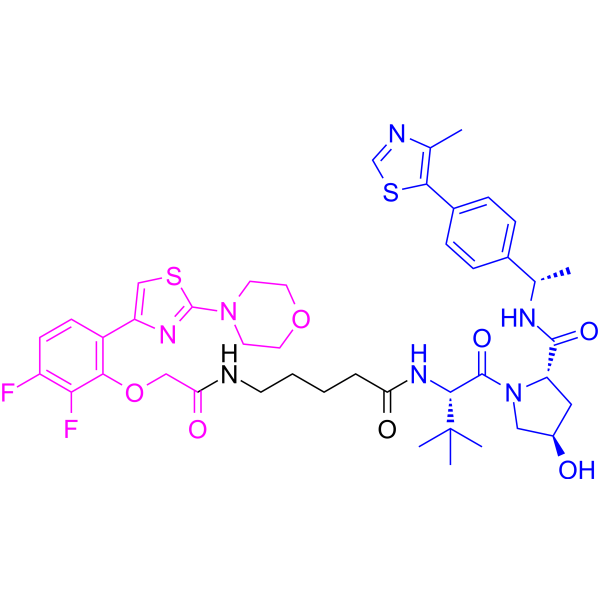
MTX-23 is a PROTAC degrader targeting androgen receptor splice variant 7 (AR-V7) and full-length androgen receptor (AR-FL), with DC50 values of 0.37 μM and 2 μM, respectively. MTX-23 binds to the DNA-binding domains of AR-V7 and AR-FL, recruits the VHL E3 ubiquitin ligase (E3 ubiquitin ligase) and induces their degradation. MTX-23 reduces the proliferation of prostate cancer cells, promotes their apoptosis (apoptosis), and also inhibits tumor growth in mouse models. MTX-23 can be used for the research of prostate cancer .
loading...
    loading...
1
1 Cited Publications
Cat. No.: HY-130714
CAS No.: 2305936-56-3
Purity:  99.41%
Target:  

PROTACs

Research Areas:  

Cancer

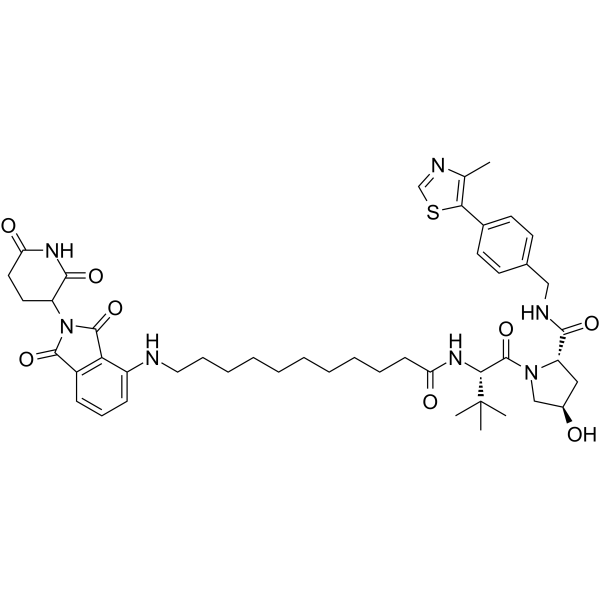
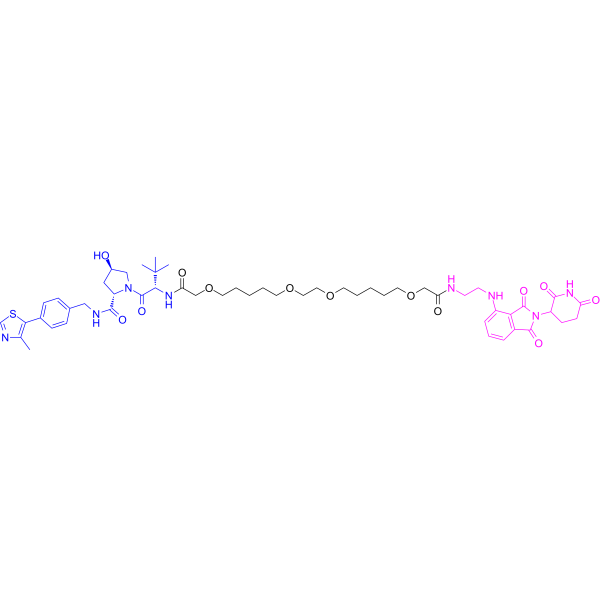
TD-165 is a PROTAC-based cereblon (CRBN) degrader. TD-165 comprises a cereblon (CRBN) ligand binding group, a linker and an von Hippel-Landau (VHL) binding group .
loading...
    loading...
Cat. No.: HY-156730
CAS No.: 2502186-79-8
Purity:  96.17%
Target:  

Molecular Glues STAT

Research Areas:  

Cancer

KT-333 is a molecular glues that degrades STAT3 protein. KT-333 mediates the selective degradation of STAT3 through the ubiquitin-proteasome system by binding to STAT3 protein and E3 ubiquitin ligase von Hippel-Lindau protein (VHL). KT-333 has strong selectivity for STAT3 protein degradation and good antitumor activity. KT-333 can be used in the study of hematologic malignancies such as large granular lymphocytic leukemia (LGL-L), peripheral T-cell lymphoma (PTCL), and cutaneous T-cell lymphoma (CTCL) .
loading...
    loading...
Cat. No.: HY-129180
CAS No.: 2229974-73-4
Purity:  98.62%
Target:  

PROTACs CDK

Research Areas:  

Cancer

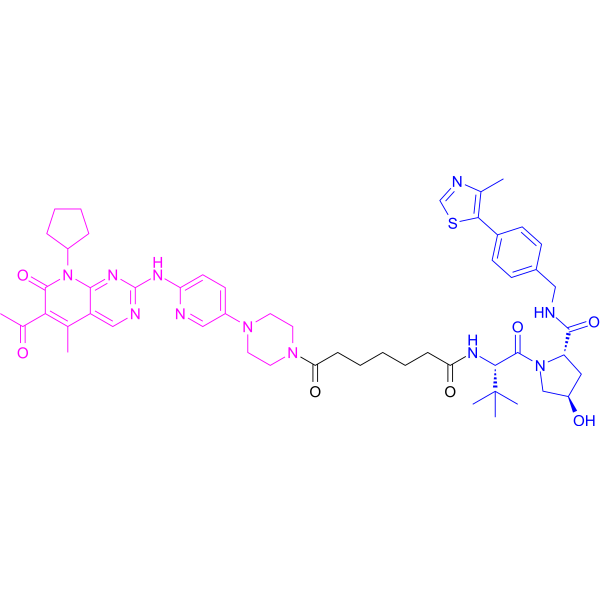
XY028-133 is a selective CDK4/6 PROTAC degrader. XY028-133 targets and ubiquitinates CDK4/6 for degradation by binding to the VHL E3 ubiquitin ligase. XY028-133 can be used for research related to melanoma .
loading...
    loading...
Cat. No.: HY-130845A
CAS No.: 1818885-55-0
Purity:  99.53%
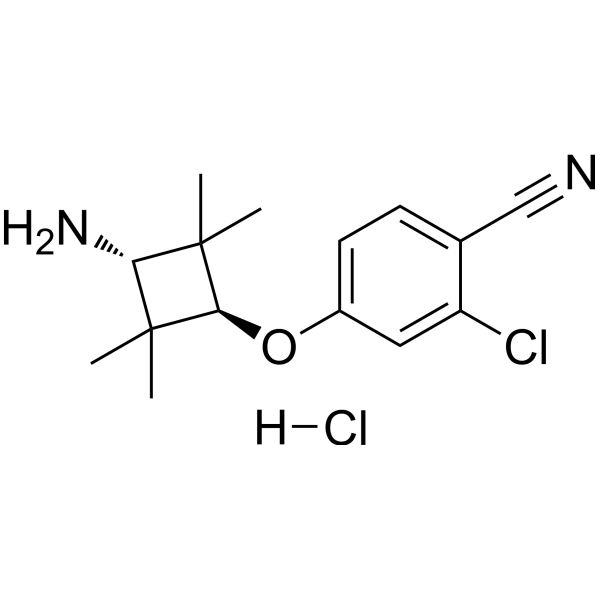
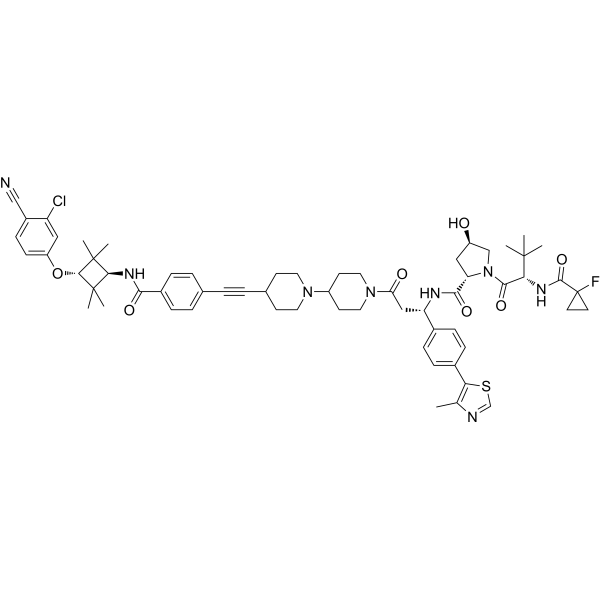
AR antagonist 1 (compound 29) hydrochloride is a potent androgen receptor (AR) antagonist and binds to E3 ligase ligands with weak binding affinities to VHL protein in the synthesis of PROTAC ARD-266 (HY-133020) .
loading...
    loading...
Cat. No.: HY-P5908F
Target:  

Inhibitory Antibodies

Research Areas:  

Others

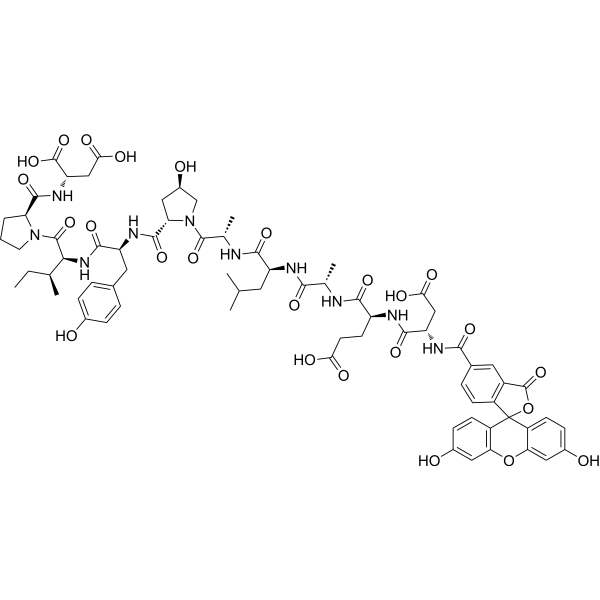
FAM-DEALA-Hyp-YIPD is a fluorescent HIF-1α peptide, with the Kd of 180-560 nM. FAM-DEALA-Hyp-YIPD can be used to assess VHL binding in Fluorescence Polarization (FP) displacement assay, and evaluate the effect of VHL binding on degradation activity .
loading...
    loading...
Cat. No.: HY-158684
CAS No.: 3049076-98-1
Purity:  99.86%
Research Areas:  

Cancer

YX-02-030 is a VHL-dependent MDM2 PROTAC degrader with a Kd of 35 nM. YX-02-030 recruits the VHL E3 ligase to form a ternary complex, leading to ubiquitination and proteasome-mediated degradation of MDM2. YX-02-030 inhibits MDM2-p53 and VHL-HIF1α binding with IC50 values of 63 and 1350 nM. YX-02-030 activates TAp73, upregulates p53 family target genes and induces apoptosis. YX-02-030 demonstrates on-target efficacy in TNBC xenograft-bearing mice, extending survival without normal cell toxicity .
loading...
    loading...
Cat. No.: HY-114402
CAS No.: 2316837-10-0
Purity:  99.61%
Research Areas:  

Cancer

ARD-69 is a PROTAC degrader based on the E3 ubiquitin ligase VHL and targeting the androgen receptor, which can induce androgen receptor (AR) protein degradation in AR-positive prostate cancer cells. ARD-69 inhibits AR-regulated gene expression, binds to the AR ligand binding domain at one end and binds to VHL at the other end, prompting AR to be recruited to the E3 ubiquitin ligase complex, triggering proteasome degradation, thereby inhibiting AR signaling pathways and downstream gene expression (such as PSA, TMPRSS2). ARD-69 can be used to study of castration-resistant prostate cancer (mCRPC) .
loading...
    loading...
Cat. No.: HY-162362
CAS No.: 3060730-06-2
Research Areas:  

Cancer

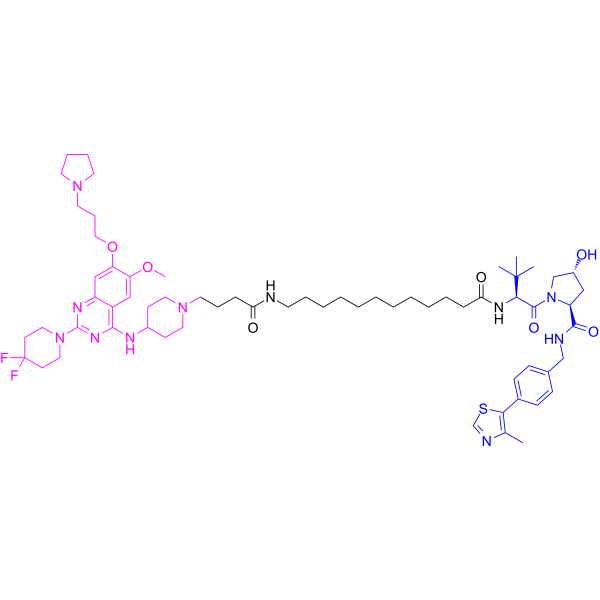
MS8709 is a PROTAC degrader that induces the degradation of G9a (EHMT2)/GLP (EHMT1) by recruiting VHL. MS8709 induces G9a/GLP protein degradation via a mechanism that simultaneously depends on G9a/GLP target protein binding, VHL recruitment, and the ubiquitin-proteasome system (UPS), while the mRNA levels of G9a and GLP do not show significant changes, indicating that the effect occurs primarily at the protein level rather than the transcriptional level. MS8709 retains the inhibitory effect on G9a/GLP methyltransferase activity and reduces H3K9me2 levels, thereby simultaneously affecting the catalytic and non-catalytic functions of G9a/GLP. MS8709 can be used for studies related to G9a/GLP biology, prostate cancer, lung cancer, and other relevant fields .
loading...
    loading...
Cat. No.: HY-128845
CAS No.: 2358775-70-7
Purity:  99.84%
Target:  

PROTACs E1/E2/E3 Enzyme

Research Areas:  

Cancer

PROTAC CRBN Degrader-1 (Compound 14a) is a VHL-CRBN heterodimerization PROTAC degrader that achieves a selective degradation of CRBN by binding two E3 ubiquitin ligases (VHL and CRBN) to each other .
loading...
    loading...
Cat. No.: HY-145703
CAS No.: 2740582-16-3
Purity:  99.76%
Target:  

PROTACs Drug Isomer

Research Areas:  

Others

SHP2-D26 isomer-1 (Compound 26) is an isomer of SHP2-D26 (HY-145162). SHP2-D26 is the first highly potent SHP2 PROTAC degrader. The induction of SHP2 degradation by SHP2-D26 requires binding to VHL-1 and SHP2 proteins, and is dependent on ubiquitin-like modification and the proteasome. SHP2-D26 can be used in the research of esophageal cancer and acute myeloid leukemia .
loading...
    loading...
Cat. No.: HY-170824
CAS No.: 3033586-31-8
Target:  

PROTACs SWI/SNF Complex

Research Areas:  

Cancer

SMD-3236 is a SMARCA2 PROTAC degrader with a DC50 of 0.5 nM, a Dmax of 98%, and an IC50 of 42.2 nM against human SMARCA2. SMD-3236 induces proteasome- and ubiquitin-like modification-dependent degradation of SMARCA2 protein by binding to SMARCA2 and VHL-1. SMD-3236 inhibits the growth of SMARCA4-deficient cancer cells. SMD-3236 induces significant and persistent depletion of SMARCA2 in tumor tissues. SMD-3236 suppresses tumor growth in SMARCA4-deficient human cancer xenograft models. SMD-3236 can be used in research related to SMARCA4-deficient cancers such as melanoma, non-small cell lung cancer, and acute myeloid leukemia .
loading...
    loading...
Cat. No.: HY-144304
CAS No.: 3031336-58-7
Purity:  95.61%
Target:  

PROTACs EGFR

Research Areas:  

Cancer

PROTAC EGFR degrader 2 is an EGFR-targeting PROTAC and antitumor agent. PROTAC EGFR degrader 2 induces degradation of EGFR protein via the ubiquitin-proteasome system, requiring binding to both EGFR and the VHL E3 ubiquitin ligase. PROTAC EGFR degrader 2 exerts antitumor efficacy following EGFR degradation. PROTAC EGFR degrader 2 is released from the NTR-responsive caged-PROTAC 17-1 upon activation by nitroreductase in hypoxic tumor tissues. PROTAC EGFR degrader 2 can be used for the research of non-small cell lung cancer .
loading...
    loading...
Cat. No.: HY-143883
CAS No.: 2376137-41-4
Target:  

PROTACs Akt

Research Areas:  

Cancer

MS143 is a VHL-recruiting AKT protein PROTAC degrader with a DC50 of 46 nM in PC3 prostate cancer cells. MS143 preferentially binds to AKT1 and AKT3, with weaker binding activity towards AKT2. MS143 degrades AKT and blocks the phosphorylation of downstream signaling molecules in the PI3K/AKT/mTOR pathway. MS143 inhibits cancer cell growth and xenograft tumor growth. MS143 can be used for research on prostate cancer, triple-negative breast cancer, and breast cancer .
loading...
    loading...
Cat. No.: HY-175252
Research Areas:  

Cancer

PROTAC EGFR degrader 14 is a EGFR PROTAC degrader, with a DC50 of 2.9 nM against EGFR L858R/T790M/C797S. PROTAC EGFR degrader 14 forms a stable ternary complex by bridging the ATP-binding pocket of the target protein EGFR with VHL E3 ubiquitin ligase, induces efficient and specific degradation of EGFR mutants via the ubiquitin-proteasome system, and ultimately induces cell cycle arrest and apoptosis. PROTAC EGFR degrader 14 can be used in studies related to non-small cell lung cancer carrying the EGFR C797S drug-resistant mutation .
loading...
    loading...
Cat. No.: HY-150803
CAS No.: 2010986-87-3
Purity:  99.93%
Target:  

Ligands for E3 Ligase

Research Areas:  

Cancer

VHL Ligand 14 (Compound 11) is a VHL ligand for design of PROTAC estrogen receptor α (ERα) degraders, with a binding affinity IC50 of 196 nM .
loading...
    loading...
Cat. No.: HY-175358
Target:  

PROTACs Deubiquitinase

Research Areas:  

Cancer

PROTAC USP7 Degrader-1 is a VHL-recruiting PROTAC and USP7 degrader with binding activity to both USP7 and the VHL E3 ubiquitin ligase. PROTAC USP7 Degrader-1 recruits the VHL E3 ligase to mediate the ubiquitination and subsequent proteolytic degradation of USP7 .
loading...
    loading...
Cat. No.: HY-172767
Target:  

PROTACs STAT Apoptosis

Research Areas:  

Cancer

STAT3-D11-PROTAC-VHL (Compound D11-PROTAC) is a PROTAC degrader targeting Signal Transducer and Activator of Transcription 3 (STAT3). STAT3-D11-PROTAC-VHL exhibits anti-tumor activity with IC50 values of 1335 nM and 1973 nM against HeLa and MCF-7 cells, respectively. STAT3-D11-PROTAC-VHL binds to the DNA-binding domain of STAT3 and recruits the E3 ligase VHL to form a ternary complex, leading to the ubiquitination of STAT3 and subsequent degradation by the proteasome. STAT3-D11-PROTAC-VHL also inhibits tumor cell growth, induces cell cycle arrest and apoptosis, and suppresses tumor immune evasion .
loading...
    loading...
Cat. No.: HY-100947A
CAS No.: 2097381-86-5
cis VH-298 is the cis form of VH-298 (HY-100947). cis VH-298 results in a significant loss of binding specificity of hydroxylated HIF-1a peptides to VHL in vitro .
loading...
    loading...
Cat. No.: HY-156730A
CAS No.: 2839758-34-6
Target:  

Molecular Glues STAT

Research Areas:  

Cancer

KT-333 ammonium (Compound A) is a molecular glues that degrades STAT3 protein. KT-333 ammonium mediates the selective degradation of STAT3 through the ubiquitin-proteasome system by binding to STAT3 protein and E3 ubiquitin ligase von Hippel-Lindau protein (VHL). KT-333 ammonium has strong selectivity for STAT3 protein degradation and good antitumor activity. KT-333 ammonium can be used in the study of hematologic malignancies such as large granular lymphocytic leukemia (LGL-L), peripheral T-cell lymphoma (PTCL), and cutaneous T-cell lymphoma (CTCL) .
loading...
    loading...

