6 Results for "

castrated rat

" in MedChemExpress (MCE) Product Catalog:
Products (6)

6 Results for "castrated rat" in MCE Product Catalog:

1
1 Cited Publications
Cat. No.: HY-19337
CAS No.: 1297537-33-7
Synonyms: BAY 1896953; ORM-15341
Target:  

Androgen Receptor

Research Areas:  

Cancer

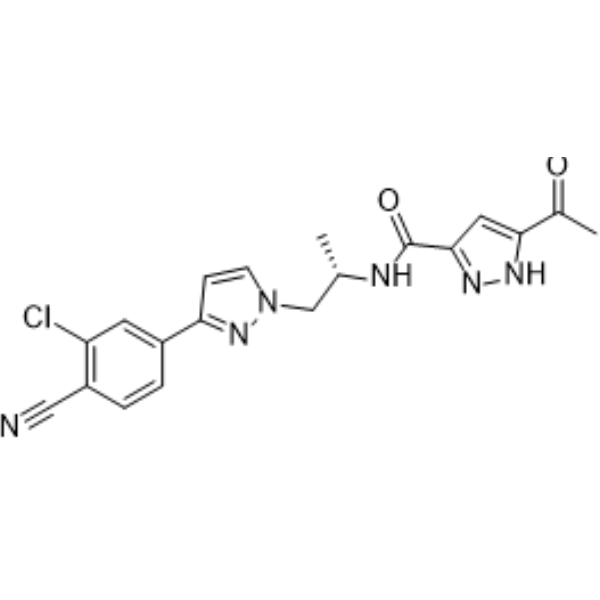
Ketodarolutamide (ORM-15341) is a potent, high-affinity nonsteroidal competitive full antagonist of androgen receptor (AR). Ketodarolutamide displays a Ki value of 8 nM for rat wild-type AR and an IC50 value of 38 nM in AR-HEK293 cells . Ketodarolutamide inhibits testosterone-induced nuclear translocation of the AR and antagonizes both overexpressed and mutant ARs . Ketodarolutamide specifically suppresses the proliferation of AR-dependent prostate cancer cells and exhibits antitumor activity in models of castration-resistant prostate cancer (CRPC) . Ketodarolutamide is suitable for the mechanistic and therapeutic research of prostate cancer .
loading...
    loading...
Cat. No.: HY-114246
CAS No.: 1351185-54-0
Synonyms: ONC1-13B
Research Areas:  

Cancer

Varilutamide (ONC1-13B) is an orally active androgen receptor (AR) inhibitor. Varilutamide shows a rat AR IC50 of 7.9 μM, inhibits DHT-stimulated PSA expression and prostate cancer cell proliferation, suppresses tumor growth and PSA expression and weakly induces lower CYP3A activity. Varilutamide can be used for the research of castration-resistant prostate cancer and prostate cancer .
loading...
    loading...
Cat. No.: HY-182421
CAS No.: 925924-27-2
Target:  

Kisspeptin Receptor

Research Areas:  

Endocrinology Cancer

GPR54 antagonist‑1 is a GPR54 antagonist with IC50 values of 3.6 nM and 15 nM against human and rat GPR54, respectively. GPR54 antagonist‑1 shows blood‑brain barrier penetration. GPR54 antagonist‑1 blocks the function of human and rat GPR54 receptors. GPR54 antagonist‑1 suppresses plasma luteinizing hormone levels in castrated male rats. GPR54 antagonist‑1 can be used for the study of prostate cancer and endometriosis .
loading...
    loading...
Cat. No.: HY-19337S1
Synonyms: BAY 1896953-d6; ORM-15341-d6
Ketodarolutamide-d6 (BAY 1896953-d6) is the deuterium labeled Ketodarolutamide (HY-19337). Ketodarolutamide (ORM-15341) is a potent, high-affinity nonsteroidal competitive full antagonist of androgen receptor (AR). Ketodarolutamide displays a Ki value of 8 nM for rat wild-type AR and an IC50 value of 38 nM in AR-HEK293 cells . Ketodarolutamide inhibits testosterone-induced nuclear translocation of the AR and antagonizes both overexpressed and mutant ARs . Ketodarolutamide specifically suppresses the proliferation of AR-dependent prostate cancer cells and exhibits antitumor activity in models of castration-resistant prostate cancer (CRPC) . Ketodarolutamide is suitable for the mechanistic and therapeutic research of prostate cancer .
loading...
    loading...
Cat. No.: HY-19337S
CAS No.: 2484757-41-5
Synonyms: BAY 1896953-d3; ORM-15341-d3
Ketodarolutamide-d3 (BAY 1896953-d3) is the deuterium labeled Ketodarolutamide (HY-19337). Ketodarolutamide (ORM-15341) is a potent, high-affinity nonsteroidal competitive full antagonist of androgen receptor (AR). Ketodarolutamide displays a Ki value of 8 nM for rat wild-type AR and an IC50 value of 38 nM in AR-HEK293 cells . Ketodarolutamide inhibits testosterone-induced nuclear translocation of the AR and antagonizes both overexpressed and mutant ARs . Ketodarolutamide specifically suppresses the proliferation of AR-dependent prostate cancer cells and exhibits antitumor activity in models of castration-resistant prostate cancer (CRPC) . Ketodarolutamide is suitable for the mechanistic and therapeutic research of prostate cancer .
loading...
    loading...
Cat. No.: HY-187614
CAS No.: 1597-68-8
Target:  

Cytochrome P450

Research Areas:  

Endocrinology

6α-Fluorotestosterone is a non-aromatizable aromatase inhibitor, with IC50 values of 115 nM and 580 nM against human and rat aromatase, respectively. 6α-Fluorotestosterone binds to the substrate site of human aromatase P450arom with a Ki of 150 nM, but is not aromatized into estrogen. In vivo, 6α-Fluorotestosterone maintains sexual behavior in castrated male rats (with an effect comparable to that of testosterone), induces defeminization of sexual development, and inhibits nuclear translocation of hypothalamic estrogen receptors; its pro-mating effect is blocked by the aromatase inhibitors ATD and Fadrozole (HY-14247A). Combined with Progesterone (HY-N0437), 6α-Fluorotestosterone induces lordosis behavior in ovariectomized female rats. 6α-Fluorotestosterone can be used in studies related to anovulatory infertility and sexual behavior regulation .
loading...
    loading...

