8 Results for "

cell detachment

" in MedChemExpress (MCE) Product Catalog:
Products (8)

8 Results for "cell detachment" in MCE Product Catalog:

Cat. No.: HY-P1189
CAS No.: 154303-05-6
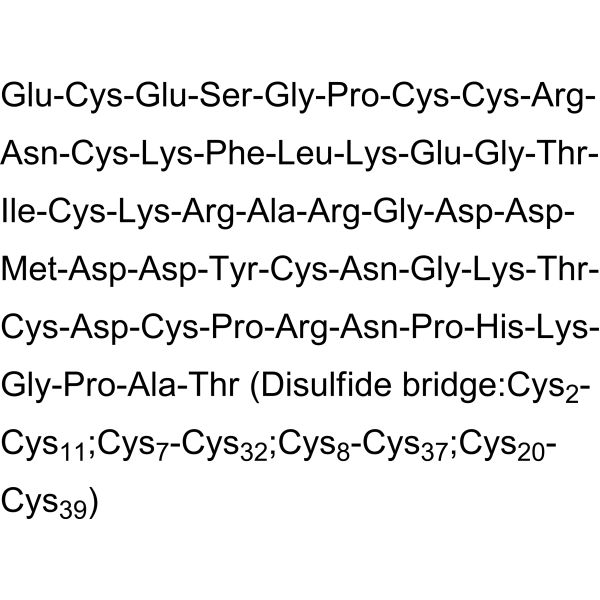
Echistatin is a naturally derived RGD-containing snake venom peptide. Echistatin exhibits an IC50 of 0.6 nM against mouse αvβ3 integrin, and acts as an antagonist against αvβ3, αIIbβ3, α5β1 integrins, pp125 FAK and paxillin. Echistatin reduces the phosphorylation of pp125 FAK and paxillin, inhibits the autophosphorylation and kinase activity of pp125 FAK, and weakens its binding to pp60src and paxillin. Echistatin disrupts the actin cytoskeleton and focal adhesions, induces melanoma cell detachment from fibronectin, and regulates cell adhesion and motility. Echistatin inhibits osteoclast maturation and migration, bone resorption, platelet aggregation, bone loss, as well as adhesion and metastasis of Lewis lung cancer cells; it also increases the number of osteoclasts and bone coverage area in mice with secondary hyperparathyroidism. Echistatin can be used in research related to melanoma, lung cancer and secondary hyperparathyroidism .
loading...
    loading...
Cat. No.: HY-P1189A
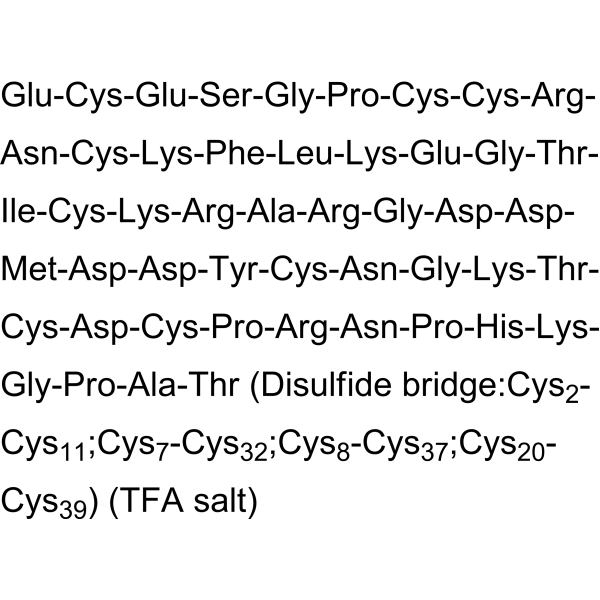
Echistatin TFA is a naturally derived RGD-containing snake venom peptide. Echistatin TFA exhibits an IC50 of 0.6 nM against mouse αvβ3 integrin, and acts as an antagonist against αvβ3, αIIbβ3, α5β1 integrins, pp125 FAK and paxillin. Echistatin TFA reduces the phosphorylation of pp125 FAK and paxillin, inhibits the autophosphorylation and kinase activity of pp125 FAK, and weakens its binding to pp60src and paxillin. Echistatin TFA disrupts the actin cytoskeleton and focal adhesions, induces melanoma cell detachment from fibronectin, and regulates cell adhesion and motility. Echistatin TFA inhibits osteoclast maturation and migration, bone resorption, platelet aggregation, bone loss, as well as adhesion and metastasis of Lewis lung cancer cells; it also increases the number of osteoclasts and bone coverage area in mice with secondary hyperparathyroidism. Echistatin TFA can be used in research related to melanoma, lung cancer and secondary hyperparathyroidism .
loading...
    loading...
Cat. No.: HY-121683
CAS No.: 22644-96-8
Synonyms: 16:1 Aldehyde; trans-2-Hexadecenal
Research Areas:  

Cancer

(E)-2-Hexadecenal (trans-2-Hexadecenal) is an MLK3 activator that induces cytoskeletal remodeling, leading to cell rounding, detachment, and ultimately apoptosis in human and mouse cells. (E)-2-Hexadecenal activates the MLK3 signaling pathway, phosphorylating MKK4/7 and JNK, subsequently activating downstream targets of JNK, such as c-Jun phosphorylation, cytochrome c release, Bax activation, Bid cleavage, and Bim translocation to mitochondria. (E)-2-Hexadecenal has potential applications in research related to sphingolipid signaling pathways .
loading...
    loading...
Cat. No.: HY-N21831
CAS No.: 489-21-4
Sarkomycin is a glutathione-targeting cytotoxic agent and antibacterial agent. Sarkomycin forms an addition product with glutathione, thereby reducing intracellular glutathione levels. Sarkomycin can induce cytoplasmic vacuolation, mitochondrial damage, cytoplasmic deformation, metaphase arrest, chromosomal abnormalities, nuclear degeneration, and nuclear fragmentation; it also modulates amino acid metabolism. Sarkomycin also inhibits anaerobic fermentation in affected cells in mice and inhibits cell growth in tissue culture, leading to the disappearance of mitotic cells, cell degeneration, and cell detachment from the glass surface. Sarkomycin can be used in research related to Yoshida ascites tumor, Ehrlich ascites tumor, Ehrlich carcinoma, and Yoshida rat sarcoma .
loading...
    loading...
Cat. No.: HY-187719
CAS No.: 318262-42-9
Target:  

Proton Pump Apoptosis

Research Areas:  

Cancer

NIK-12192 is an orally active inhibitor of vacuolar H +-ATPase. NIK-12192 reduces intracellular pH, decreases lysosomal volume and acidity, and alters the intracellular localization of V-ATPase by inhibiting proton pumps . NIK-12192 induces αvβ5 integrin polarization, cytoskeletal disruption, cell detachment, anoikis-mediated delayed apoptosis and necrosis, a delayed reduction in mitochondrial membrane potential, and lysosomal/phagosomal accumulation. NIK-12192 inhibits tumor cell migration, invasion, and three-dimensional spheroid growth, and enhances the activity of Topotecan (HY-13768). NIK-12192 suppresses spontaneous lung metastasis in vivo. NIK-12192 is used in research related to colon cancer, ovarian cancer, lung cancer, breast cancer, renal cancer, prostate cancer, acute myeloid leukemia, and melanoma .
loading...
    loading...
Cat. No.: HY-184626
Thiol-modified magnetite nanoparticles are prepared via high-temperature pyrolysis and surface-modified with thiol functional groups. Magnetite is widely used in magnetic resonance imaging, magnetic separation, targeted drug delivery, tumor hyperthermia, cell labeling and separation, as a contrast agent, and in retinal detachment repair surgery due to its stable properties, good biocompatibility, high strength, and lack of toxicity. It is also used as a catalyst carrier, microwave absorbing material, and magnetic recording material. Xianfeng has developed numerous derivatives of magnetite, including oleic acid-modified magnetite, magnetite with different PEG ends, DMSA-modified magnetite, polylysine-modified magnetite, carboxylated dextran-modified magnetite nanoparticles, streptavidin-modified magnetite particles, thiol-modified magnetite magnetic nanoparticles, and polyethyleneimine (PEI)-modified magnetic magnetite nanoparticles, among others.
loading...
    loading...
Cat. No.: HY-184620
Ferric oxide (Fe3O4) is widely used in magnetic resonance imaging (MRI), magnetic separation, targeted drug delivery, tumor hyperthermia, cell labeling and separation, and as a contrast agent and enhancement agent in retinal detachment repair surgery due to its stable material properties, good biocompatibility, high strength, and lack of toxic side effects. It is also used as a catalyst carrier, microwave absorbing material, and magnetic recording material. Xianfeng has developed numerous derivatives of ferric oxide, including oleic acid-modified ferric oxide, PEG-terminated ferric oxide, DMSA-modified ferric oxide, polylysine-modified ferric oxide, carboxylated dextran-modified ferric oxide nanoparticles, streptavidin-modified ferric oxide particles, thiol-modified ferric oxide magnetic nanoparticles, and polyethyleneimine (PEI)-modified magnetic ferric oxide nanoparticles, among others. This wide range of modifications provides numerous options for subsequent experiments.
loading...
    loading...
Cat. No.: HY-K3047

MCE Versene Solution is a gentle, enzyme-free, ready-to-use cell dissociation solution containing 0.02% (w/v) tetrasodium EDTA (EDTA-Na₄, 0.48 mM) in calcium- and magnesium-free D-PBS. This product is phenol red-free, animal component-free, and chemically defined.

loading...
    loading...

