
22 Results for "

cleavable complex

" in MedChemExpress (MCE) Product Catalog:
Products (22)

22 Results for "cleavable complex" in MCE Product Catalog:

3
3 Cited Publications
Cat. No.: HY-13721
CAS No.: 81267-65-4
Purity:  99.89%
Synonyms: Idronoxil; Dehydroequol; Haginin E
Research Areas:  

Cancer

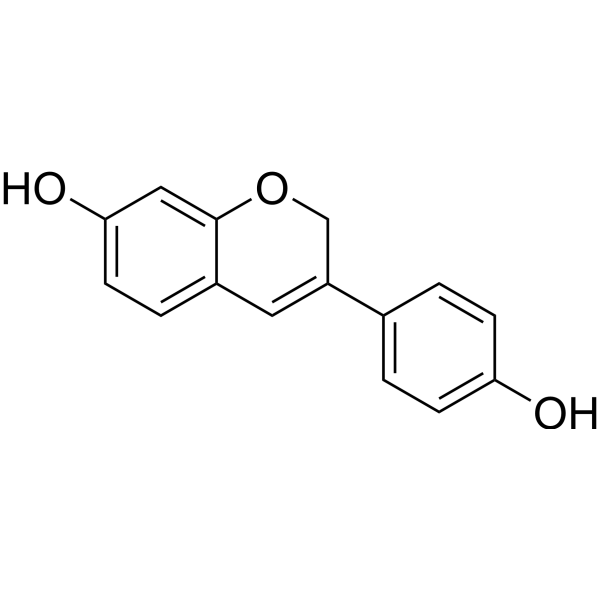
Phenoxodiol (Idronoxil), a synthetic analog of Genestein, activates the mitochondrial caspase system, inhibits XIAP (an apoptosis inhibitor), and sensitizes the cancer cells to Fas-mediated apoptosis. Phenoxodiol also inhibits DNA topoisomerase II by stabilizing the cleavable complex. Phenoxodiol induces cell cycle arrest in the G1/S phase of the cell cycle and upregulates p21 WAF1 via a p53 independent manner .
loading...
    loading...
Cat. No.: HY-123740
CAS No.: 1351828-03-9
Purity:  99.00%
Synonyms: DSSO
Research Areas:  

Others

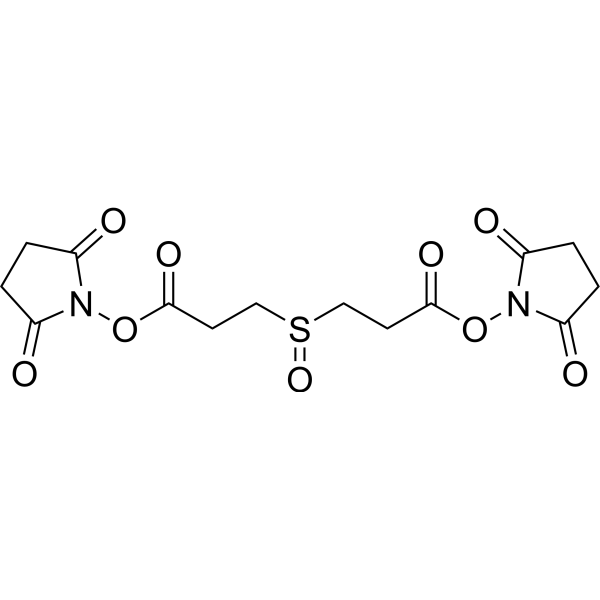
Disuccinimidyl sulfoxide (DSSO) is a sulfoxide-containing crosslinker targeting amino groups that can be cleaved by MS, and it is suitable for model peptides, proteins, and multisubunit protein complexes. Disuccinimidyl sulfoxide contains two symmetric collision-induced dissociation (CID)-cleavable sites, enabling the identification of DSSO-crosslinked peptides based on different fragmentation patterns .
loading...
    loading...
Cat. No.: HY-13631J
CAS No.: 2938875-39-7
Purity:  99.94%
Synonyms: (1R,9R)-DX8951f
Research Areas:  

Cancer

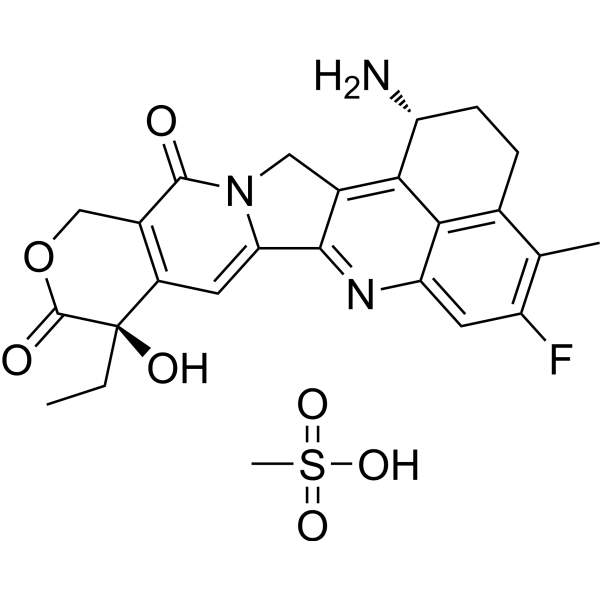
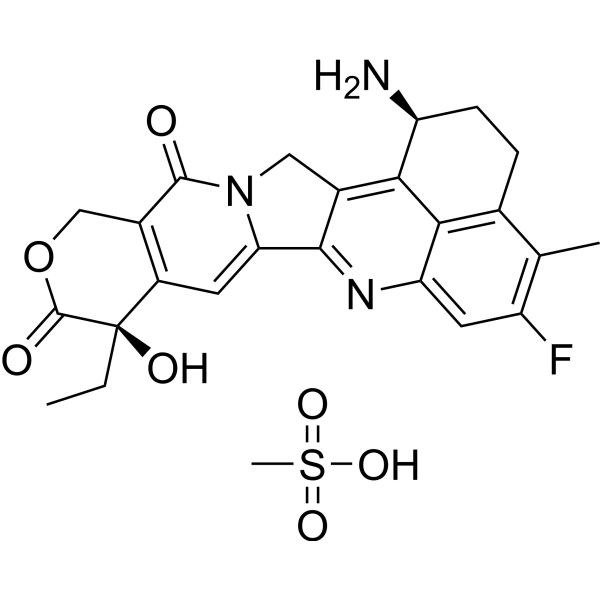
(1R,9R)-Exatecan mesylate ((1R,9R)-DX8951f) is a non-prodrug camptothecin derivative and a potent topoisomerase I inhibitor (IC50=0.975 μg/mL in mice and 0.82 μg/mL in humans). (1R,9R)-Exatecan mesylate blocks enzyme activity and induces apoptosis by stabilizing the enzyme-DNA cleavable complex. (1R,9R)-Exatecan mesylate not only effectively inhibits the proliferation of various malignant tumor cells and tumor growth, but also circumvents P-glycoprotein-mediated multidrug resistance. (1R,9R)-Exatecan mesylate is widely used in preclinical studies of multiple cancers including pancreatic cancer, lung cancer, breast cancer, and leukemia . The low-activity isomer of (1R,9R)-Exatecan mesylate is (1S,9R)-Exatecan mesylate (HY-13631I).
loading...
    loading...
Cat. No.: HY-158799
Research Areas:  

Others

Poly(ADP-ribose) Polymer/pADPr is a complex polymer of repeating ADP-ribose units, which is synthesized using poly(ADP-ribose) polymerase (PARP) in the presence of NAD +, cleaved from PARP, and subsequently purified .
loading...
    loading...
Cat. No.: HY-E70133
CAS No.: 37278-88-9
Synonyms: Endo F2
Target:  

Endonuclease

Research Areas:  

Metabolic Disease

Endo-β-N-acetylglucosaminidase F2 (Endo F2), a highly specific endoglycosidase, cleaves within the chitobiose core of asparagine-linked complex biantennary and high mannose oligosaccharides from glycoproteins and glycopeptides. Endo F2 cleaves biantennary glycans at a rate approximately 20 times greater than high mannose glycans. The activity of Endo F2 is identical on biantennary structures with and without core fucosylation. Endo F2 is not active on hybrid or tri- and tetra-antennary oligosaccharides .
loading...
    loading...
Cat. No.: HY-13631I
CAS No.: 2938875-54-6
Purity:  98.48%
Synonyms: (1S,9R)-DX8951f
Research Areas:  

Cancer

(1S,9R)-Exatecan mesylate ((1S,9R)-DX8951f) is a non-prodrug camptothecin derivative and a topoisomerase I inhibitor (IC50=0.975 μg/mL in mice and 0.82 μg/mL in humans). (1S,9R)-Exatecan mesylate blocks enzyme activity and induces apoptosis by stabilizing the enzyme-DNA cleavable complex. (1S,9R)-Exatecan mesylate not only effectively inhibits the proliferation of various malignant tumor cells and tumor growth, but also circumvents P-glycoprotein-mediated multidrug resistance. (1S,9R)-Exatecan mesylate is widely used in preclinical studies of various cancers such as pancreatic cancer, lung cancer, breast cancer, and leukemia .
The chiral isomer of (1S,9R)-Exatecan mesylate is (1R,9R)-Exatecan mesylate (HY-13631J).
loading...
    loading...
Cat. No.: HY-E70573
Research Areas:  

Others

Endo SH is a fusion protein of Endo S (from Streptococcus pyogenes) and Endo H (from Streptomyces plicatus), expressed in Escherichia coli. Endo SH can cleave the chitobiose core structure of high mannose, complex and some hybrid oligosaccharides in N-glycoproteins, remove N-linked high mannose in glycoproteins, and can completely replace Endo S and Endo H.
loading...
    loading...
Cat. No.: HY-163944
CAS No.: 3081311-94-3
LL-K12-18 is a CDK12 kinase inhibitor and a dual-site molecular glue. LL-K12-18 inhibits human CDK12 with an IC50 value of 283.9 nM, and selectively degrades cyclin K via the ubiquitin-proteasome system by stabilizing the CDK12-DDB1 complex. LL-K12-18 downregulates DNA damage response genes, reduces the phosphorylation level of CTD Ser2 in RNA polymerase II, and modulates biomarkers such as ATM, RAD51, γ-H2AX and cleaved PARP, thereby effectively inducing apoptosis and inhibiting proliferation of breast cancer cells. LL-K12-18 exhibits high target selectivity and serves as a research tool for studies on triple-negative breast cancer .
loading...
    loading...
Cat. No.: HY-E70574
Research Areas:  

Others

Trypsin/Lys-C complex protease (MS grade) combines Trypsin and Lys-C, two recombinant proteases, to achieve efficient peptide bond hydrolysis. Trypsin specifically cleaves the C-terminal peptide bonds of arginine (R) and lysine (K), while Lys-C specifically cleaves the C-terminal peptide bonds of lysine (K). This combination overcomes issues such as the slower digestion rate of lysine and arginine by rTrypsin, PTM changes on lysine, or hydrophobic C-termini (such as proline) that can lead to missed cleavage. Trypsin/Lys-C complex protease (MS grade) can be used to process complex protein samples that are difficult to enzymatically digest. Trypsin/Lys-C complex protease (MS grade) can be used for protein characterization, single-cell proteomics and large cohort proteomics studies.
loading...
    loading...
Cat. No.: HY-P2816
CAS No.: 37278-89-0
Research Areas:  

Others

Xylanase is an enzyme targeting 1,4-β-D-xylan that randomly cleaves the β-1,4 backbone of xylan, a complex polysaccharide in plant cell walls. Xylanase finds applications in the food, feed and industrial sectors, including pulp and paper processing, baking, animal feed improvement, and biotransformation of waste .
loading...
    loading...
Cat. No.: HY-148369
CAS No.: 3094177-94-0
Purity:  99.68%
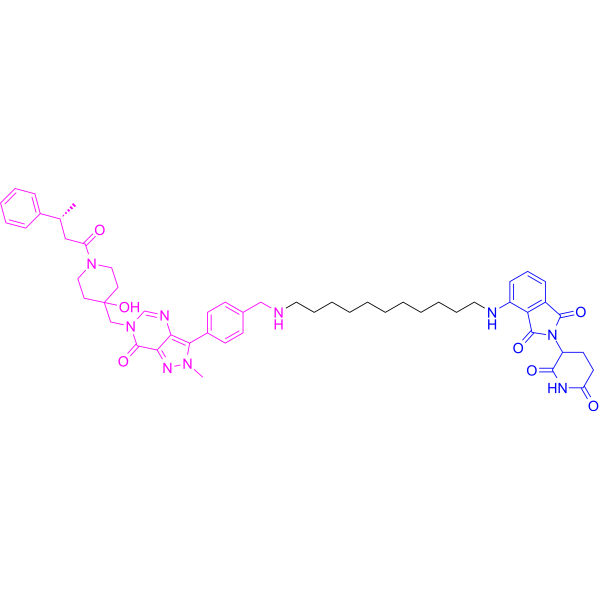
U7D-1 is a USP7 PROTAC degrader that induces selective proteasomal degradation of USP7. U7D-1 destabilizes and downregulates the expression of variant PRC1 complex subunits PCGF1, RING1A and PCGF6, and also slightly reduces the protein level of KDM2B. U7D-1 decreases cell viability, arrests neuroblastoma cells at the G0/G1 cell cycle phase, and downregulates the expression of target genes of PAX3::FOXO1 in FP-RMS cells. U7D-1 increases the level of cleaved PARP in FP-RMS cells, induces cell apoptosis, and upregulates the expression of muscle differentiation markers MYH1 and MYF5. U7D-1 inhibits the growth and proliferation of p53 wild-type and mutant cancer cells, and regulates the apoptosis pathway and E2F pathway. U7D-1 is applicable to studies on neuroblastoma, fusion-positive rhabdomyosarcoma, p53-mutant cancers and cancer-related research .
loading...
    loading...
Cat. No.: HY-178510
Research Areas:  

Cancer

JQ1-S (GlcNAc) Cq is a sugar-modified BRD4 PROTAC degrader with a DC50 of 2.1 μM. JQ1-S (GlcNAc) Cq inhibits the formation of the ternary complex between CRBN and BRD4 (BD1/BD2). JQ1-S (GlcNAc) Cq serves as a substrate for O-GlcNAcase, which cleaves its O-GlcNAc domain to restore binding ability with CRBN, thereby forming a BRD4-containing ternary complex and triggering ubiquitination and proteasomal degradation of BRD4. JQ1-S (GlcNAc) Cq is applicable for cancer research .
loading...
    loading...
Cat. No.: HY-155807
CAS No.: 2668267-47-6
Target:  

STAT JAK Apoptosis

Research Areas:  

Cancer

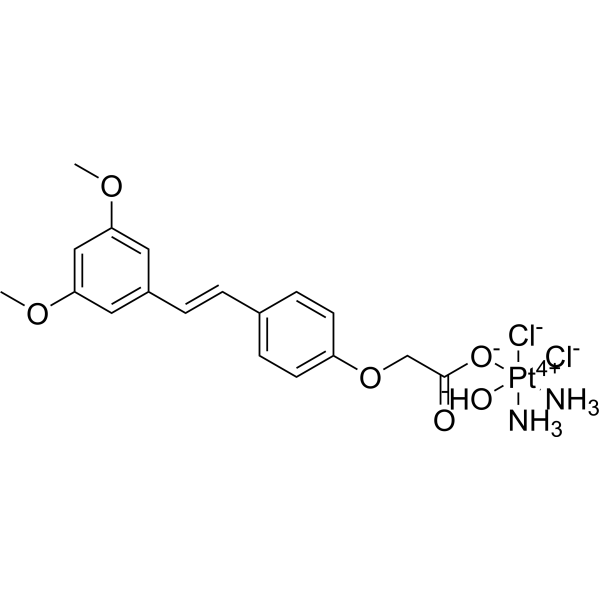
DPP is a Platinum(IV) complex, bearing pterostilbene-derived axial ligand. DPP inhibit the JAK2-STAT3 pathway in breast cancer (BC) cells with antiproliferative activity, and activates caspase-3 and cleaved poly ADP-ribose polymerase to induces apoptosis. DPP promotes the maturation and antigen presentation of dendritic cells, and exhibits in vivo safety .
loading...
    loading...
Cat. No.: HY-P990753
CAS No.: 2763342-87-4
Synonyms: CAN-106

Target:  

Complement System

Research Areas:  

Inflammation/Immunology

Omoprubart is an anti-C5 complement recombinant humanized monoclonal antibody. Omolubat can prevent C5 from cleaving into C5a and C5b, thereby inhibiting the formation and activation of the C5b-dependent membrane attack complex (MAC) on the surface of susceptible cells, leading to cell lysis (destruction). Omoprubart can be used for the study of paroxysmal nocturnal hemoglobinuria (PNH).
loading...
    loading...
Cat. No.: HY-E70390
Synonyms: masp-2, c1 esterase, c1-esterase
Target:  

Wnt

C1s Enzyme is a subunit of the complement C1 complex, which activates the complement as a serine protease. C1s Enzyme cleaves LRP5 and LRP6, and thus activates the Wnt/β-Catenin signaling pathway. C1s Enzyme promotes the macrophage M2 polarization and inhibits M1 polarization. C1s Enzyme enhances efferocytosis, exhibits anti-inflammatory activity .
loading...
    loading...
Cat. No.: HY-13721R
CAS No.: 81267-65-4
Synonyms: Idronoxil (Standard); Dehydroequol (Standard); Haginin E (Standard)
Research Areas:  

Cancer

Phenoxodiol (Standard) is the analytical standard of Phenoxodiol. This product is intended for research and analytical applications. Phenoxodiol (Idronoxil), a synthetic analog of Genestein, activates the mitochondrial caspase system, inhibits XIAP (an apoptosis inhibitor), and sensitizes the cancer cells to Fas-mediated apoptosis. Phenoxodiol also inhibits DNA topoisomerase II by stabilizing the cleavable complex. Phenoxodiol induces cell cycle arrest in the G1/S phase of the cell cycle and upregulates p21WAF1 via a p53 independent manner .
loading...
    loading...
Cat. No.: HY-155808
CAS No.: 2668267-41-0
Target:  

STAT JAK Apoptosis COX

Research Areas:  

Cancer

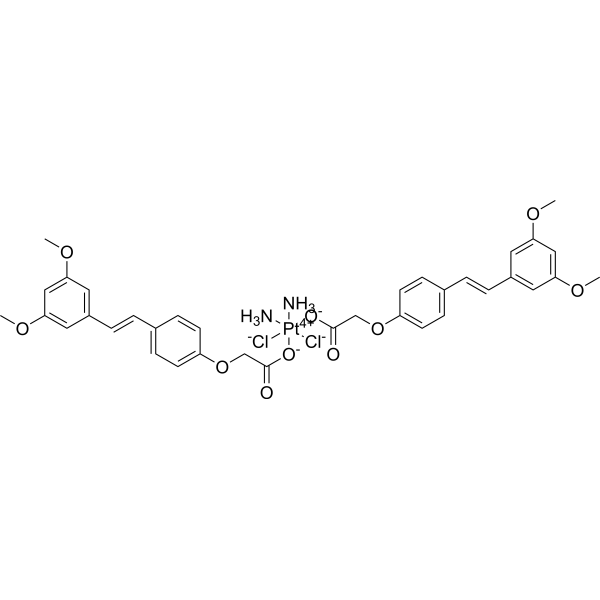
STAT3-IN-18 (compound SPP) is a platinum (IV) complex with an axial ligand derived from sandalwood. STAT3-IN-18 inhibits the JAK2-STAT3 pathway in breast cancer (BC) cells, with anti-proliferative activity. STAT3-IN-18 activates caspase-3 and increases cleaved polyADP-ribose polymerase to induce apoptosis. STAT3-IN-18 promotes maturation and antigen presentation of dendritic cells and demonstrates safety in vivo.
loading...
    loading...
Cat. No.: HY-N2062
CAS No.: 86639-62-5
Target:  

Topoisomerase

Research Areas:  

Cancer

10-Nitrocamptothecin is a topoisomerase I inhibitor with an IC50 of 0.64 μM. 10-Nitrocamptothecin interferes with the formation of cleavable complexes, thereby inhibiting the activity of Topoisomerase I. 10-Nitrocamptothecin is applicable for cancer research .
loading...
    loading...
Cat. No.: HY-176859
Target:  

Apoptosis

Research Areas:  

Cancer

[Ru(dpp)(bpy)(mtmp)](PF6)2 (Compound 5) is a trisheteroleptic ruthenium complex. [Ru(dpp)(bpy)(mtmp)](PF6)2 has a light-activated anticancer activity. [Ru(dpp)(bpy)(mtmp)](PF6)2 can selectively cleave off upon green light irradiation, thereby releasing a phototoxic ruthenium-based photoproduct that binds to nuclear DNA, induces DNA damage and apoptosis in cancer cells. [Ru(dpp)(bpy)(mtmp)](PF6)2 can be used for phototherapy of cancers like conjunctival melanoma research .
loading...
    loading...
Cat. No.: HY-D3436
Target:  

Fluorescent Dye

Research Areas:  

Cancer

Pt-Luc is a bioluminescent probe used for real-time, non-invasive monitoring of Pt (IV) prodrug reduction in living cells and animal models. The detection mechanism of Pt-Luc relies on the intracellular reduction mediated by active cysteine residues in proteins. Pt-Luc can penetrate the membrane of living cells; after entering cells, active cysteine thiolates in high-molecular-weight protein components reduce the Pt (IV) complex, thereby cleaving the caged aminoluciferin substrate. The released free aminoluciferin is then oxidized by luciferase in the presence of ATP to generate a bioluminescent signal, whose intensity is directly correlated with the reduction degree of Pt (IV) .
loading...
    loading...

