9 Results for "

coupling partner

" in MedChemExpress (MCE) Product Catalog:
Products (9)

9 Results for "coupling partner" in MCE Product Catalog:

1
1 Cited Publications
Cat. No.: HY-D2171A
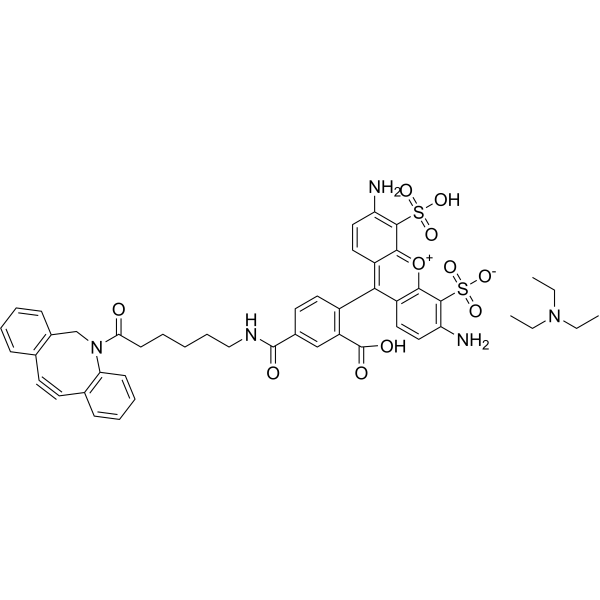
AF488 DBCO ditriethylamineis a fluorescent dye and also a click chemistry reagent that can label azide-containing biomolecules. AF488 DBCO ditriethylaminemediates the coupling reaction with azide-modified 2'-OMe RNA oligonucleotides. DBCO is a bioorthogonal partner of azides and enables covalent coupling without copper (Ex/Em = 470/520 nm) .
loading...
    loading...
1
1 Cited Publications
Cat. No.: HY-D2171
AF488 DBCO is a fluorescent dye and also a click chemistry reagent that can label azide-containing biomolecules. AF488 DBCO mediates the coupling reaction with azide-modified 2'-OMe RNA oligonucleotides. DBCO is a bioorthogonal partner of azides and enables covalent coupling without copper (Ex/Em = 470/520 nm) .
loading...
    loading...
Cat. No.: HY-D1314
CAS No.: 1386385-76-7
Synonyms: 6-FAM azide
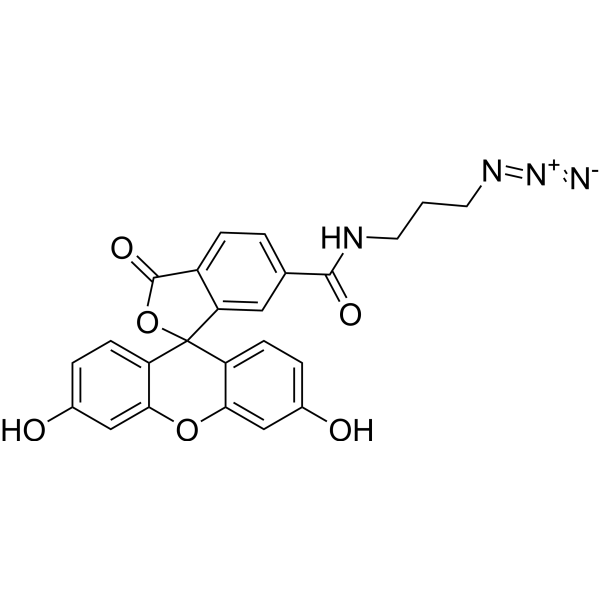
FAM azide, 6-isomer (6-FAM azide) is a 6-carboxyfluorescein derivative with an azide functional group and coupling partner in copper-catalyzed azide-alkyne cycloaddition. FAM azide, 6-isomer participates in synthesis of fluorescently tagged disparlure enantiomers for pheromone-binding protein binding assays. FAM azide, 6-isomer is widely used for labeling oligonucleotides (Ex/Em = 493/517 nm) .
loading...
    loading...
Cat. No.: HY-170704
CAS No.: 1480940-53-1
Target:  

Liposome

Research Areas:  

Metabolic Disease Cancer

DSPE-PEG2000-TCO is a click chemistry coupling partner. DSPE-PEG2000-TCO undergoes a reverse electron-demand Diels-Alder click reaction to form a covalent linkage with tetrazine-modified Cetuximab (HY-P9905). DSPE-PEG2000-TCO maintains the stability of lipid nanoparticles (LNPs) and has high mRNA encapsulation efficiency, which supports cellular uptake and mRNA transfection. DSPE-PEG2000-TCO is used to prepare EGFR-targeted and APN-targeted mRNA-loaded LNPs, mediating receptor-dependent endocytosis, mRNA delivery, and intestinal epithelial transcytosis .
loading...
    loading...
Cat. No.: HY-32748
CAS No.: 41404-58-4
Research Areas:  

Others

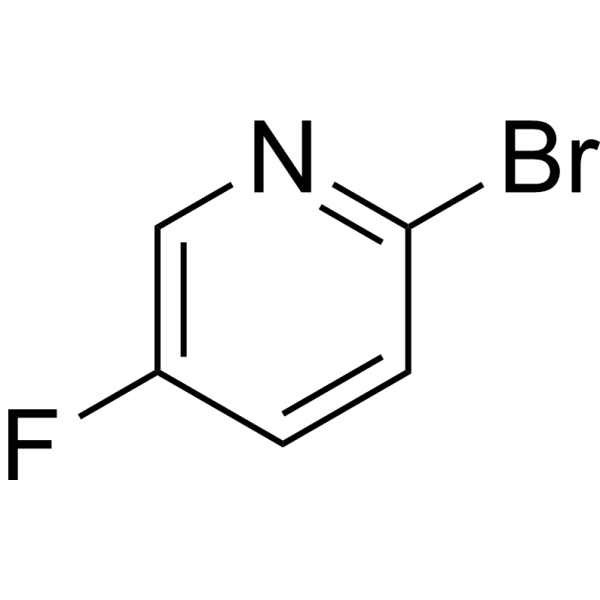
2-Bromo-5-fluoropyridine acts as a bromofluoropyridine starting material and an azaaryl halide coupling partner. 2-Bromo-5-fluoropyridine participates in an oxygen-promoted, ligand-free Pd (OAc)2-catalyzed Suzuki reaction, reacting with arylboronic acids to produce 5-fluoro-2-aryl-substituted pyridine derivatives. 2-Bromo-5-fluoropyridine can be used to synthesize 5-fluoro-2-(4-(methylsulfonyl) phenyl) pyridine, an intermediate of the GPR119 agonist GSK1292263A .
loading...
    loading...
Cat. No.: HY-32927
CAS No.: 150255-96-2
Research Areas:  

Others

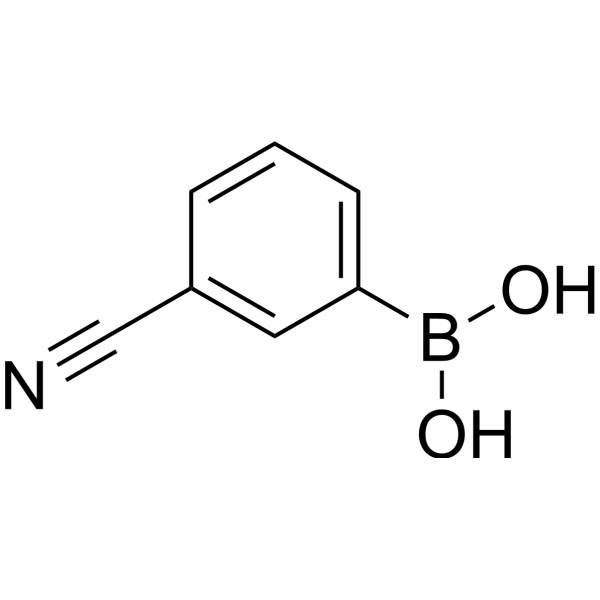
3-Cyanophenylboronic acid is an arylboronic acid-based boronic acid reagent that serves as a coupling partner in Suzuki-Miyaura cross-coupling reactions. 3-Cyanophenylboronic acid participates in reactions to synthesize 4'-propoxybiphenyl-3-carbonitrile .
loading...
    loading...
Cat. No.: HY-W001194
CAS No.: 5908-62-3
Synonyms: 1,1-Dioxoisothiazolidine
Research Areas:  

Others

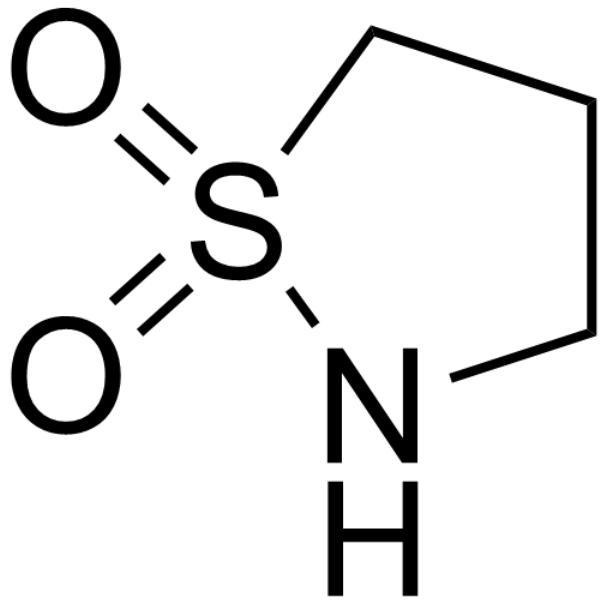
1,3-Propanesultam (1,1-Dioxoisothiazolidine) is a cyclic sulfonamide monomer. Polymerization of 1,3-Propanesultam under base catalysis produces high-molecular-weight polypropanesulfonamide, while polymerization under acid catalysis yields low-molecular-weight polypropanesulfonamide. 1,3-Propanesultam serves as a coupling partner in copper-catalyzed C-N cross-coupling reactions for the synthesis of 3-aminopyrazole phenylacetamide analogs. 1,3-Propanesultam is applicable to research related to organic synthesis .
loading...
    loading...
Cat. No.: HY-W000873
CAS No.: 146631-00-7
Target:  

Drug Intermediate

Research Areas:  

Metabolic Disease

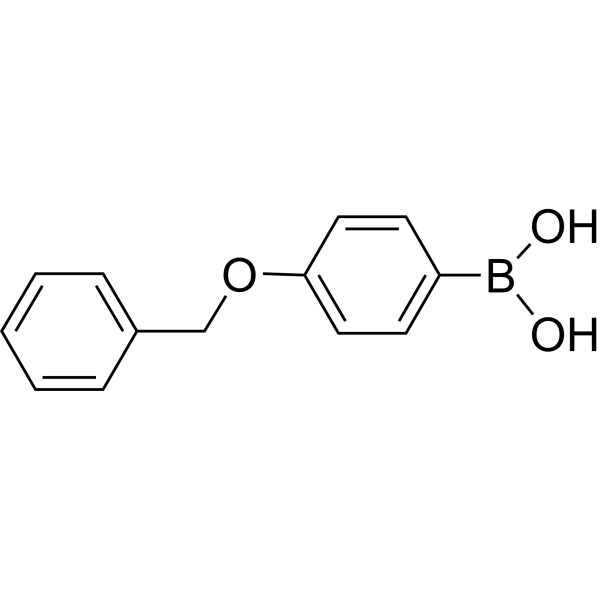
4-Benzyloxyphenylboronic acid is an arylboronic acid reagent that generates Monobenzone (HY-30272), a compound that inhibits melanin production in the skin, via electrochemical deboronation hydroxylation. 4-Benzyloxyphenylboronic acid serves as a coupling partner in Pd (0)-catalyzed Suzuki-Miyaura cross-coupling reactions for the synthesis of bent-core liquid crystals and liquid crystalline amphiphiles. 4-Benzyloxyphenylboronic acid is used in the study of hyperpigmentation .
loading...
    loading...
Cat. No.: HY-L257
190 compounds

Linkers, as key structural units in PROTAC molecules that connect the two functional ends, not only determine the overall molecular conformation and spatial compatibility but also directly influence the stability of the ternary complex, as well as cellular permeability and degradation efficiency. In recent years, with the widespread application of click chemistry in medicinal chemistry, the incorporation of bioorthogonal reactive groups such as azides (-N3) into PROTAC linker design has become an emerging research focus, providing an important tool for modular assembly and rapid structural optimization.

The MCE Azide PROTAC Linker Library contains 190 linkers specifically designed for targeted protein degradation molecule design and optimization. These linkers serve as efficient “click handles,” enabling rapid and highly selective covalent coupling with alkyne reaction partners, thereby facilitating modular assembly and structural diversification of PROTAC molecules. In drug development, this design not only improves the efficiency of molecular construction but also significantly accelerates the screening and optimization of lead compounds. Meanwhile, by tuning linker properties such as length, flexibility, and polarity, the ability to form ternary complexes and degradation activity can be optimized.

