5 Results for "

electrically excitable cells

" in MedChemExpress (MCE) Product Catalog:
Products (5)

5 Results for "electrically excitable cells" in MCE Product Catalog:

1
1 Cited Publications
Cat. No.: HY-D0127
CAS No.: 62796-23-0
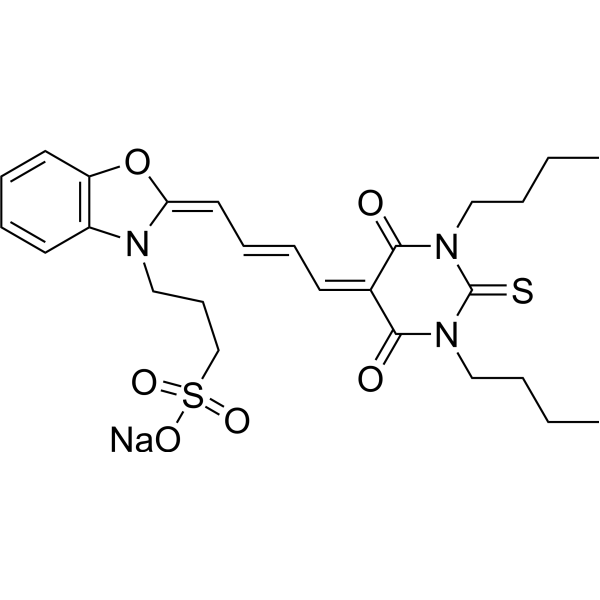
Merocyanin 540 is a fluorescent membrane probe that selectively stains the membranes of a wide variety of electrically excitable cells, but not those of nonexcitable cells (Ex/Em: 540/580 nm) .
loading...
    loading...
Cat. No.: HY-A0236
CAS No.: 37640-71-4
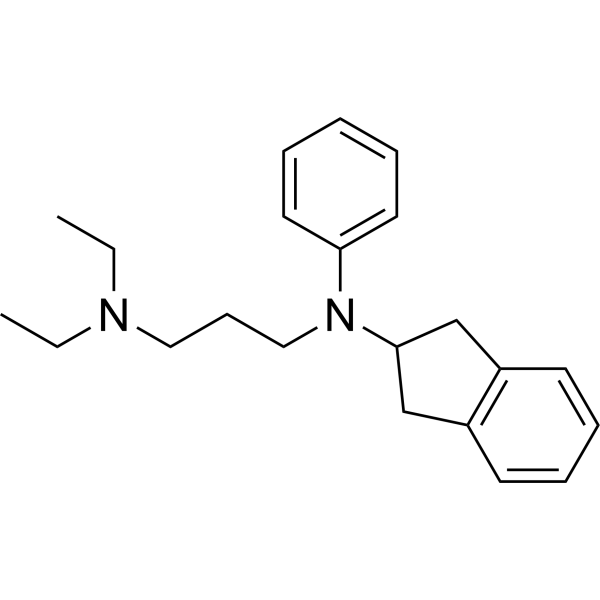
Aprindine is an Ib-class anti-arrhythmic agent. Aprindine mainly exerts its effect by blocking sodium channels (INa), thereby reducing the excitability and conduction velocity of cardiac muscle cells. Aprindine significantly inhibits delayed potassium currents, which helps to prolong the atrial effective refractory period (AERP) and inhibit the occurrence of atrial fibrillation. Aprindine can also regulate intracellular calcium ion concentration by inhibiting Na +/Ca 2+ exchange current (INCX), thereby further stabilizing cardiac electrical activity. Aprindine can be used for the study of atrial fibrillation (AF) and ventricular arrhythmias .
loading...
    loading...
Cat. No.: HY-A0236A
CAS No.: 33237-74-0
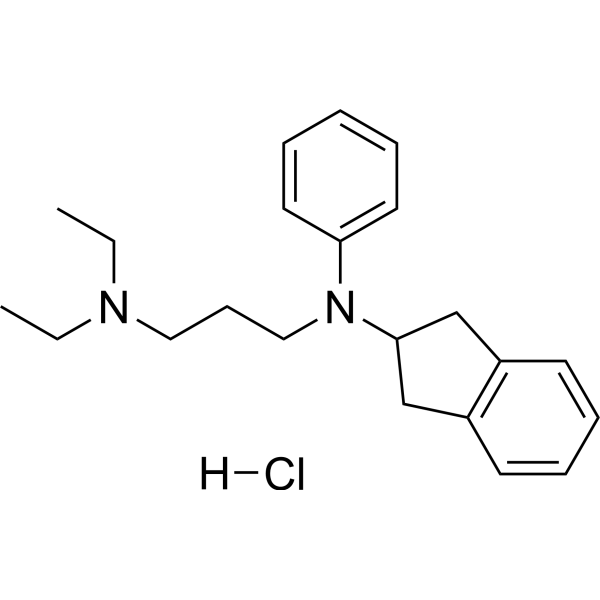
Aprindine hydrochloride is an Ib-class anti-arrhythmic agent. Aprindine hydrochloride mainly exerts its effect by blocking sodium channels (INa), thereby reducing the excitability and conduction velocity of cardiac muscle cells. Aprindine hydrochloride significantly inhibits delayed potassium currents, which helps to prolong the atrial effective refractory period (AERP) and inhibit the occurrence of atrial fibrillation. Aprindine hydrochloride can also regulate intracellular calcium ion concentration by inhibiting Na +/Ca 2+ exchange current (INCX), thereby further stabilizing cardiac electrical activity. Aprindine hydrochloride can be used for the study of atrial fibrillation (AF) and ventricular arrhythmias .
loading...
    loading...
Cat. No.: HY-A0236AR
CAS No.: 33237-74-0
Aprindine hydrochloride (Standard) is the analytical reference standard of Aprindine hydrochloride (HY-A0236A). This product is used for research and analytical applications. Aprindine hydrochloride is an Ib-class anti-arrhythmic agent. Aprindine hydrochloride mainly exerts its effect by blocking sodium channels (INa), thereby reducing the excitability and conduction velocity of cardiac muscle cells. Aprindine hydrochloride significantly inhibits delayed potassium currents, which helps to prolong the atrial effective refractory period (AERP) and inhibit the occurrence of atrial fibrillation. Aprindine hydrochloride can also regulate intracellular calcium ion concentration by inhibiting Na +/Ca 2+ exchange current (INCX), thereby further stabilizing cardiac electrical activity. Aprindine hydrochloride can be used for the study of atrial fibrillation (AF) and ventricular arrhythmias.
loading...
    loading...
Cat. No.: HY-D3146
CAS No.: 1418017-91-0
Target:  

Fluorescent Dye

Research Areas:  

Others

Di-4-AN (F) EPPTEA is a voltage-sensitive dye used for membrane potential imaging and optical recording of electrical activity in excitable cells and tissues. Its detection mechanism is based on electrochromism (also known as the molecular Stark effect). The single-photon excitation/emission wavelengths measured in ethanol solution are Ex/Em = 444/610 nm, and it can be excited via 1064 nm two-photon excitation in optical recording applications. Di-4-AN (F) EPPTEA can be used to record backpropagating action potentials in individual dendritic spines of brain cortical slices, map subcellular action potential characteristics of single cardiomyocytes, and perform real-time recording of multicellular action potentials in cerebellar slices .
loading...
    loading...

