11 Results for "

enzyme-activated

" in MedChemExpress (MCE) Product Catalog:
Products (11)

11 Results for "enzyme-activated" in MCE Product Catalog:

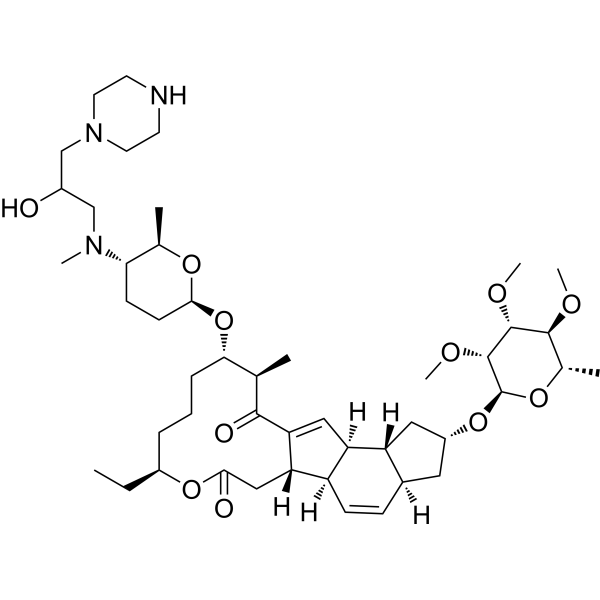
Cat. No.: HY-156112
CAS No.: 2055494-50-1
Purity:  99.78%
Target:  

Ser/Thr Protease

Research Areas:  

Cancer

LM2I is a derivative of Spinosyn A (SPA). LM2I is argininosuccinate synthase (ASS1) enzyme activator, and tumor inhibitor that directly interact with ASS1. LM2I has significant antiproliferative activity in seven colorectal cancer cell-lines and xenograft tumors of colorectal cancer. LM2I inhibits colorectal cancer cell growth via the EGFR pathway .
loading...
    loading...
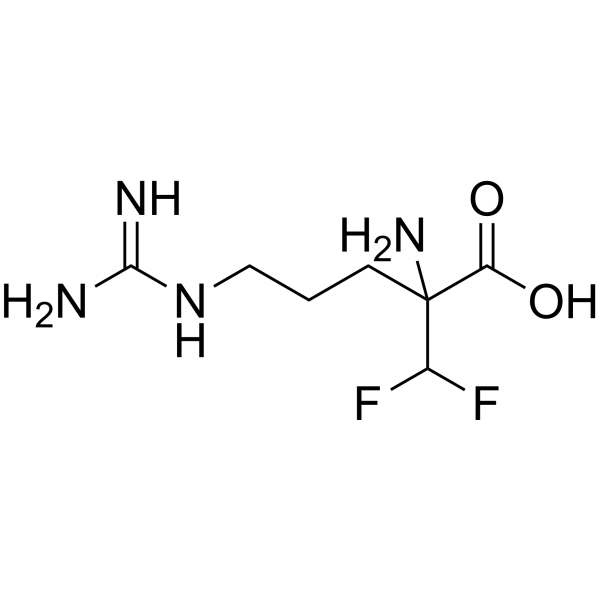
Cat. No.: HY-134161
CAS No.: 69955-43-7
Purity:  ≥95.0%
Target:  

Inhibitory Antibodies

Research Areas:  

Metabolic Disease

DL-α-(Difluoromethyl)arginine is an potent, enzyme-activated and irreversible arginine decarboxylases inhibitor. DL-α-(Difluoromethyl)arginine blocks the arginine decarboxylase activity of E.coli and Pseudomonas aeruginosa in vivo .
loading...
    loading...
Cat. No.: HY-W010989
CAS No.: 72957-37-0
Gly-His-Lys acetate is a natural, circulating regulatory and antimicrobial tripeptide derived from extracellular matrix proteins. Gly-His-Lys acetate binds Cu 2+ to support copper enzyme activation, antioxidant processes, cellular bioenergetics, and the synthesis of elastin, collagen and catecholamines. Gly-His-Lys acetate regulates cell growth, differentiation and tissue repair, and exerts regenerative, anxiolytic, anti-inflammatory, analgesic and immunosuppressive activities. Gly-His-Lys acetate induces liver degenerative changes. Gly-His-Lys acetate can be used for the research of infections, anxiety, pain-related behaviors and immune-associated liver diseases .
loading...
    loading...
Cat. No.: HY-D2379
CAS No.: 1629965-68-9
Target:  

Fluorescent Dye

Research Areas:  

Others

HMRG is a fluorescent dye, which serves as the fluorescent active product generated by enzyme-activated fluorescent probes targeting proteases and glycosidases. Its detection mechanism relies on the intramolecular spirocyclization equilibrium: HMRG itself exists in an open non-spirocyclic structure under physiological pH, which maintains a conjugated π system and produces strong fluorescence; whereas its probe precursors (such as Leu-HMRG, Ac-GlyPro-HMRG and βGal-HMRG) exist in a closed spirocyclic form and show no fluorescence due to the disruption of the π-conjugated system; when the target enzyme cleaves the substrate fragment linked to the probe precursor, the closed spirocyclic structure converts to the open structure of HMRG, restoring the conjugated system and generating a strong fluorescent signal. Its detection wavelength is Ex/Em = 501/524 nm .
loading...
    loading...
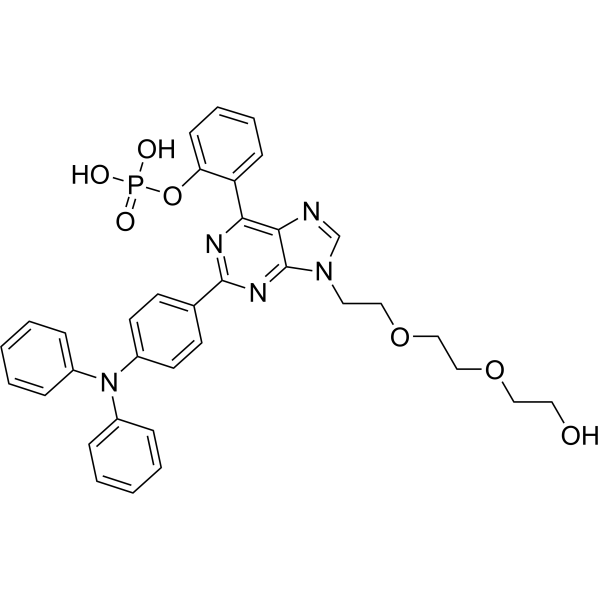
Cat. No.: HY-163346
Research Areas:  

Metabolic Disease

TPEG-P is an enzyme-activated intramolecular hydrogen bond (IMHB) enhanced probe, developed for ALP detection in cells and mice models of DILI .
loading...
    loading...
Cat. No.: HY-D2379A
CAS No.: 7449-51-6
Target:  

Fluorescent Dye

Research Areas:  

Others

closed-HMRG is an HMRG (HY-D2379) with a closed spiro-ring structure. HMRG is a fluorescent dye, which serves as the fluorescent active product generated by enzyme-activated fluorescent probes targeting proteases and glycosidases. Its detection mechanism relies on the intramolecular spirocyclization equilibrium: HMRG itself exists in an open non-spirocyclic structure under physiological pH, which maintains a conjugated π system and produces strong fluorescence; whereas its probe precursors (such as Leu-HMRG, Ac-GlyPro-HMRG and βGal-HMRG) exist in a closed spirocyclic form and show no fluorescence due to the disruption of the π-conjugated system; when the target enzyme cleaves the substrate fragment linked to the probe precursor, the closed spirocyclic structure converts to the open structure of HMRG, restoring the conjugated system and generating a strong fluorescent signal. Its detection wavelength is Ex/Em = 501/524 nm .
loading...
    loading...
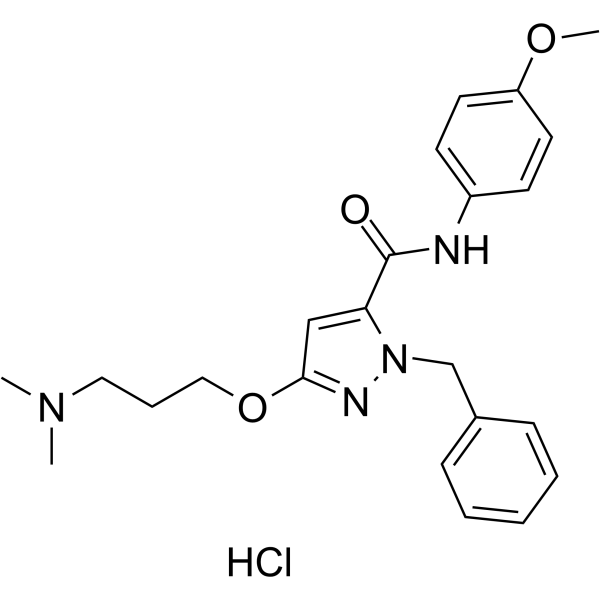
Cat. No.: HY-107546
CAS No.: 1215548-30-3
Purity:  99.47%
Target:  

Guanylate Cyclase

Research Areas:  

Cardiovascular Disease

CFM 1571 hydrochloride is the stimulator of the nitric oxide receptor, soluble guanylate cyclase (sGC) with an EC50 and IC50 of 5.49 μM and 2.84 μM, respectively. Soluble guanylate cyclase (sGC) is a key signal-transduction enzyme activated by nitric oxide (NO). CFM 1571 hydrochloride has the potential for the research of cardiovascular and other diseases .
loading...
    loading...
Cat. No.: HY-149545
CAS No.: 214038-32-1
Synonyms: 1,3-Dipalmitoyl-2-docosahexaenoyl glycerol
1,3-Palmitin-2-docosahexaenoin (1,3-Dipalmitoyl-2-docosahexaenoyl glycerol) is the isomer of triacylglycerol (TAG), in which docosahexaenoic acid (DHA) is located at the β position (sn-2) of the glycerol backbone. 1,3-Palmitin-2-docosahexaenoin inhibits fatty acid synthase and cholesterol metabolism enzymes, activates carnitine palmitoyltransferase (CPT) in liver mitochondria and promotes β-oxidation of fatty acids. 1,3-Palmitin-2-docosahexaenoin exhibits lipid metabolism regulating activity .
loading...
    loading...
Cat. No.: HY-187733
CAS No.: 77016-85-4
Research Areas:  

Cancer

Plomestane is an orally active second-generation steroidal aromatase inhibitor that, as an enzyme-activated pseudosubstrate, is converted via NADPH-dependent catalysis into a reactive intermediate, which covalently binds to aromatase to produce irreversible inhibition, thereby persistently suppressing peripheral aromatase activity. Plomestane can be used for the study of hormone-dependent breast cancer .
loading...
    loading...
Cat. No.: HY-107546R
CAS No.: 1215548-30-3
CFM 1571 hydrochloride (Standard) is the analytical standard of CFM 1571 (hydrochloride) (HY-107546). This product is intended for research and analytical applications. CFM 1571 hydrochloride is the stimulator of the nitric oxide receptor, soluble guanylate cyclase (sGC) with an EC50 and IC50 of 5.49 μM and 2.84 μM, respectively. Soluble guanylate cyclase (sGC) is a key signal-transduction enzyme activated by nitric oxide (NO). CFM 1571 hydrochloride has the potential for the research of cardiovascular and other diseases .
loading...
    loading...
Cat. No.: HY-187371
Research Areas:  

Cancer

DA29 is a human caseinolytic protease P (hClpP) activator, with an EC50 of 0.85 μM and a Kd of 185 nM. DA29 binds to the hydrophobic allosteric pocket of this enzyme, activates its proteolytic function, and displaces hClpX from the hClpXP complex. DA29 induces mitochondrial dysfunction and ROS accumulation. DA29 exerts cytotoxic effects on cancer cells and organoids. DA29 can be used in the research of diffuse intrinsic pontine glioma .
loading...
    loading...
  • 1

