4 Results for "

fragmented ions

" in MedChemExpress (MCE) Product Catalog:
Products (4)

4 Results for "fragmented ions" in MCE Product Catalog:

Cat. No.: HY-32876
CAS No.: 16133-25-8
Research Areas:  

Others

Pyridine-3-sulfonyl chloride is a sulfonyl chlorination derivatization reagent for steroidal estrogens. Pyridine-3-sulfonyl chloride reacts with estrogens to form pyridine-3-sulfonyl derivatives, which generate abundant analyte-specific fragment ions upon collision-induced dissociation. Pyridine-3-sulfonyl chloride facilitates quantitative LC-ESI-MS/MS analysis of estrogens in serum and water matrices .
loading...
    loading...
Cat. No.: HY-P2516
CAS No.: 330456-25-2
Target:  

Tau Protein

Research Areas:  

Neurological Disease

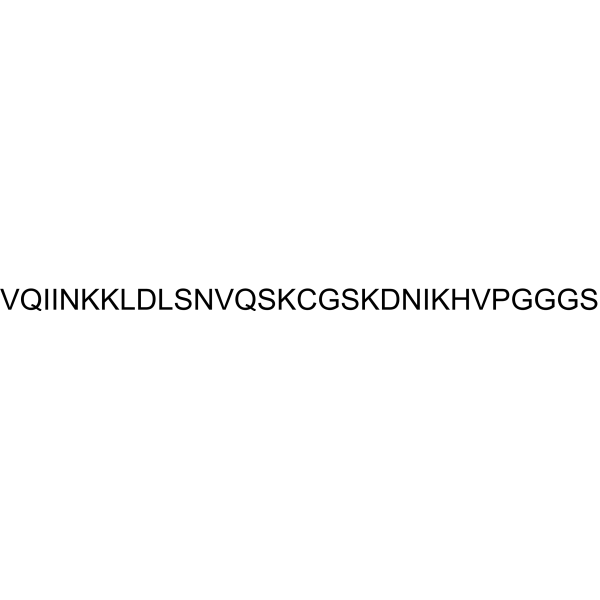
Tau Peptide (275-305) (Repeat 2 domain) is the Alzheimer's Tau fragment R2, corresponding to the second repeat unit of the microtubule-binding domain, which is believed to be pivotal to the biochemical properties of full tau protein. Tau Peptide (275-305) specifically coordinates with group IIB metal ions (Zn²⁺, Cd²⁺, Hg²⁺), which can induce their conformational changes and significantly promote their pathological accumulation. Tau Peptide (275-305) can be used to study the role of heavy metals in neurodegenerative diseases .
loading...
    loading...
Cat. No.: HY-120522
CAS No.: 125989-12-0
Synonyms: Cyclo(Gln-Trp-Phe-Gly-Leu-Met)
Target:  

Neurokinin Receptor

Research Areas:  

Others

L-659877 (Cyclo(Gln-Trp-Phe-Gly-Leu-Met)) is a compound used to study the chemical properties of peptide fragments in collision-induced dissociation. A series of experiments were conducted to study the structural changes of b-fragment ions of different lengths in collision-induced dissociation.
loading...
    loading...
Cat. No.: HY-185721
CAS No.: 25191-14-4
Synonyms: Polyguanylic acid
Target:  

DNA/RNA Synthesis

Research Areas:  

Others

Poly (G) (Polyguanylic acid) is a high-molecular-weight synthetic ribopolynucleotide. In the presence of Na + or K + ions, Poly (G) undergoes time-dependent structural modification, gradually self-assembling from a single strand into large G-quadruplex aggregates. Poly (G) undergoes cooperative secondary structure dissociation under alkaline conditions, but its secondary structure can withstand high temperatures up to 100°C and is resistant to snake venom diesterase at low Na + concentrations. Poly (G) forms stable 1:1 complexes with polycytidylic acid or poly 5-bromocytidylic acid, but does not bind to polyinosinic acid or polyadenylic acid. Poly (G) can be applied to studies on the interactions between drugs and G-rich DNA fragments in electrochemical biosensors .
loading...
    loading...

