
15 Results for "

genomic RNA

" in MedChemExpress (MCE) Product Catalog:
Products (15)

15 Results for "genomic RNA" in MCE Product Catalog:

45
45 Publications Verification
Cat. No.: HY-K0511A

MCE RT Master Mix for qPCR II is a convenient, ready-to-use formulation for reverse transcription and can eliminate genomic DNA (gDNA) contaminations in RNA samples. With updated reverse transcriptase, this kit can synthesize cDNA more rapidly, more specifically. The 100 rxns is defined as the base specification. All larger sizes correspond to incremental volumes of this base.

loading...
    loading...
2
2 Cited Publications
Cat. No.: HY-124614
CAS No.: 2133017-36-2
Purity:  98.36%
Target:  

HBV

Research Areas:  

Infection

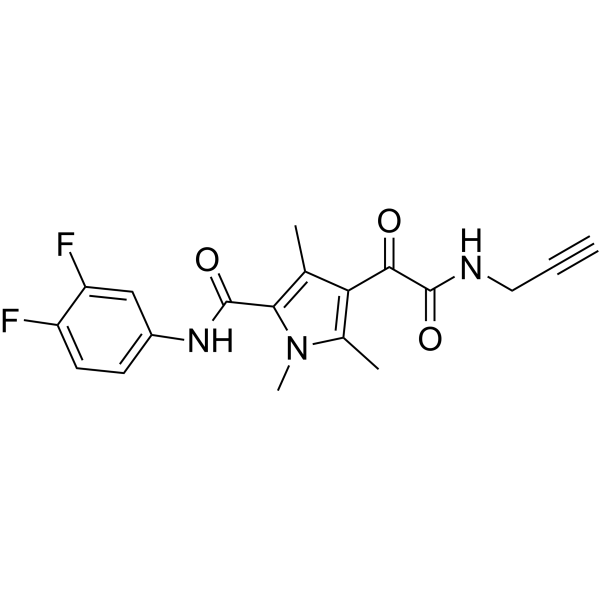
GLP-26 is a HBV capsid assembly modulators (CAM), inhibits HBV DNA replication in Hep AD38 system (IC50=3 nM), and reduces cccDNA by >90% at 1 μM. GLP-26 disrupts the encapsidation of pre-genomic RNA, causes nucleocapsid disassembly and reduces cccDNA pools . GLP-26 is a click chemistry reagent, it contains an Alkyne group and can undergo copper-catalyzed azide-alkyne cycloaddition (CuAAc) with molecules containing Azide groups.
loading...
    loading...
1
1 Cited Publications
Cat. No.: HY-19743
CAS No.: 928659-17-0
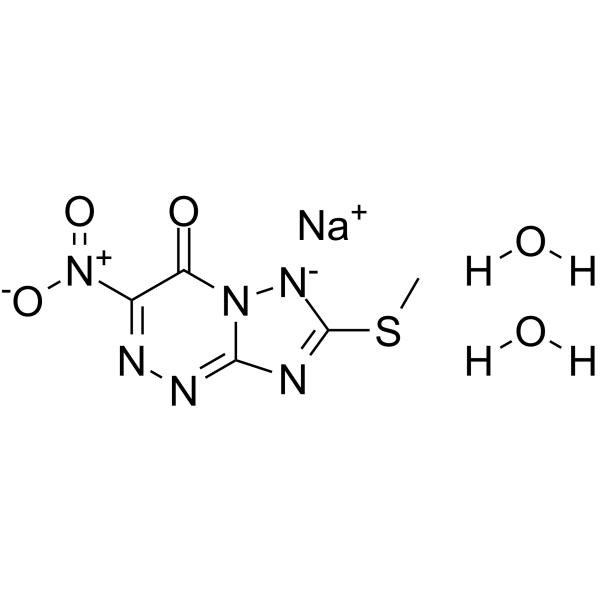
Triazavirin is a nucleoside analogue of nucleic acid and an antiviral agent. Triazavirin works by inhibiting the synthesis of viral RNA and DNA and replication of genomic fragments. Triazavirin is also an effective protective agent on the transmission stage of influenza .
loading...
    loading...
1
1 Cited Publications
Cat. No.: HY-12928
CAS No.: 1613465-33-0
Purity:  99.09%
Target:  

DNA/RNA Synthesis

Research Areas:  

Infection

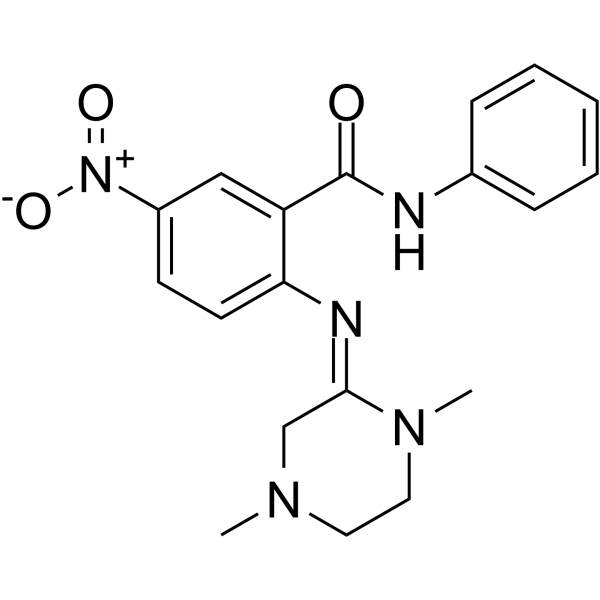
ML336 is a Venezuelan equine encephalitis virus (VEEV) inhibitor with moderate passive blood-brain barrier permeability. ML336 inhibits viral RNA synthesis, virus-induced cytopathic effects and viral replication, reduces viral titers, and blocks the synthesis of VEEV genomic, subgenomic and template RNAs. ML336 can be used in studies related to VEEV infection .
loading...
    loading...
Cat. No.: HY-119499
CAS No.: 85-31-4
Purity:  98.23%
Synonyms: 6-Mercaptoguanosine
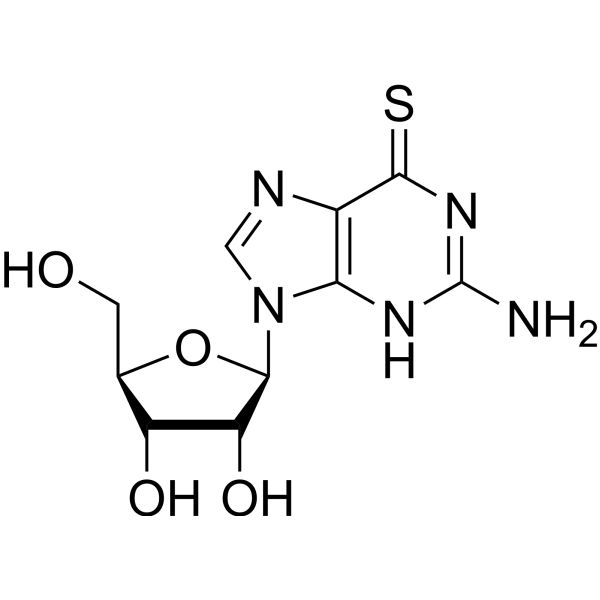
6-Thioguanosine (6-Mercaptoguanosine) is a ribonucleoside (nucleotide) metabolite of Azathioprine (HY-B0256). 6-Thioguanosine forms TGTP, which binds to Rac1 GTPase in an inhibitory manner, and is incorporated into newly synthesized RNA, mRNA, large/small RNA, and genomic DNA, with mRNA being the most abundant. 6-Thioguanosine inhibits the methylation of adjacent cytosines at methylated CpG sites, enhances the methylation of contralateral cytosines at unmethylated CpG sites, and inhibits the synthesis of poly (A)-containing RNA. 6-Thioguanosine does not inhibit general protein synthesis, does not cause depolymerization of polyribosomes, does not affect cytoplasmic/nuclear RNA synthesis, and does not affect RNA lacking poly (A) in the cytoplasm. 6-Thioguanosine can be used in research on acute lymphoblastic leukemia .
loading...
    loading...
Cat. No.: HY-156892
CAS No.: 342884-62-2
Target:  

Dengue Virus

Research Areas:  

Infection

SDM25N is a Dengue virus (DENV) inhibitor with an EC50 of 1.9 µM. SDM25N inhibits DENV in a cell type-specific manner. SDM25N restricts genomic RNA replication by targeting the viral NS4B protein. SDM25N can be used for DENV infection research .
loading...
    loading...
Cat. No.: HY-107745
CAS No.: 342884-71-3
Research Areas:  

Infection Neurological Disease

SDM25N hydrochloride, a δ-opioid receptor antagonist, is a potent DENV inhibitor. SDM25N hydrochloride targets the viral NS4B protein and restricts genomic RNA replication .
loading...
    loading...
Cat. No.: HY-114956
CAS No.: 300669-68-5
Target:  

HBV

Research Areas:  

Infection

AT-61 is a non nucleoside HBV replication inhibitor. AT-61 prevents the capsid formation of pre genomic RNA, resulting in the production of empty capsids. AT-61 has the activity of drug-resistant mutant strains. AT-61 can be used for research on hepatitis B virus infection .
loading...
    loading...
Cat. No.: HY-P10836
CAS No.: 869011-94-9
Target:  

Dengue Virus

Research Areas:  

Infection

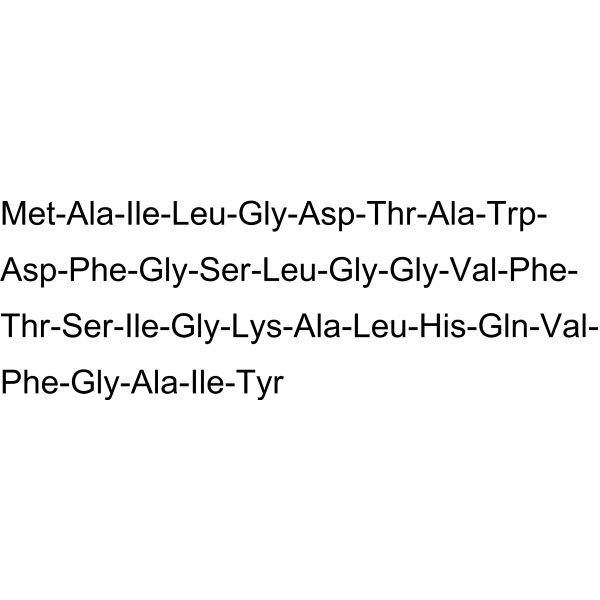
DN59 is a 33 amino acid peptide that mimics the dengue virus type 2 E stem region. DN59 inhibits all four serotypes of dengue virus (IC50: 2-5 μM) as well as other flaviviruses. N59 causes the release of genomic RNA by interacting directly with viral particles. DN59 has antiviral activity .
loading...
    loading...
Cat. No.: HY-119499R
CAS No.: 85-31-4
Synonyms: 6-Mercaptoguanosine (Standard)
6-Thioguanosine (Standard) (6-Mercaptoguanosine (Standard)) is the analytical standard of 6-Thioguanosine (HY-119499). This product is intended for research and analytical applications. 6-Thioguanosine (6-Mercaptoguanosine) is a ribonucleoside (nucleotide) metabolite of Azathioprine (HY-B0256). 6-Thioguanosine forms TGTP, which binds to Rac1 GTPase in an inhibitory manner, and is incorporated into newly synthesized RNA, mRNA, large/small RNA, and genomic DNA, with mRNA being the most abundant. 6-Thioguanosine inhibits the methylation of adjacent cytosines at methylated CpG sites, enhances the methylation of contralateral cytosines at unmethylated CpG sites, and inhibits the synthesis of poly (A)-containing RNA. 6-Thioguanosine does not inhibit general protein synthesis, does not cause depolymerization of polyribosomes, does not affect cytoplasmic/nuclear RNA synthesis, and does not affect RNA lacking poly (A) in the cytoplasm. 6-Thioguanosine can be used in research on acute lymphoblastic leukemia .
loading...
    loading...
Cat. No.: HY-N16775
CAS No.: 206876-12-2
Gylongiposide I is a selective inhibitor against the enterovirus EV71 with an EC50 of 1.53 μM. Gylongiposide I exerts antiviral activity by reducing viral protein VP1 expression and viral genomic RNA levels. Gylongiposide I can be used in the development of anti-EV71 drugs related to hand, foot and mouth disease .
loading...
    loading...
Cat. No.: HY-K0511

MCE RT Master Mix for qPCR (gDNA digester plus) is a convenient, ready-to-use formulation for reverse transcription and can eliminate genomic DNA (gDNA) contaminations in RNA samples. The cDNA product can be directly applied as a template in a standard PCR and real time quantitative PCR (qPCR). The 100 rxns is defined as the base specification. All larger sizes correspond to incremental volumes of this base.

loading...
    loading...
Cat. No.: HY-K0002

MCE Bacterial Protein Extraction Reagent integrates both lysozyme and nuclease activities and is specifically formulated for E. coli lysis. It efficiently disrupts the peptidoglycan layer under mild conditions to rapidly release intracellular proteins. Simultaneously, the incorporated nucleases degrade genomic DNA/RNA, significantly reducing lysate viscosity and minimizing nucleic-acid interference, thereby preserving the native conformation and functional integrity of target proteins to the greatest extent.

loading...
    loading...
Cat. No.: HY-136972A
CAS No.: 19360-72-6
Synonyms: Biflavanone GB-1a
GB-1a (Biflavanone GB-1a) is a biflavanone HIV-1 reverse transcriptase inhibitor (IC50=236 μM), with an EC50 of 38.0 μM for HIV-1 replication. GB-1a can block the conversion of HIV-1 genomic RNA to DNA and can be used in research related to AIDS (HIV-1 infection). GB-1a can be naturally extracted from the heartwood of Garcinia multiflora Champ .
loading...
    loading...
Cat. No.: HY-D3416
Synonyms: TAMRA-2,4-dinitroaniline
Target:  

Fluorescent Dye

Research Areas:  

Others

TMR-DN (TAMRA-2,4-dinitroaniline) is a fluorescent probe for RNA imaging that consists of a covalently coupled fluorophore (5-carboxy tetramethylrhodamine (TMR)) and quencher (dinitroaniline (DN)). The Kd value of TMR-DN with SRB-2 is 35 nM, and its Kd value with RhoBAST is approximately 30 nM. TMR-DN has a contact quenching function and forms a non-fluorescent intramolecular ground-state dimer in the free state; the excitation/emission wavelengths of the free probe are Ex/Em = 557/579 nm, those of the complex formed by binding to SRB-2 are Ex/Em = 561/587 nm, and those of the probe bound to the DNB aptamer are Ex/Em = 555/582 nm. TMR-DN reduces non-specific binding to genomic nucleic acids via negatively charged carboxyl-functionalized aromatic rings. Fluorescence dequenching occurs when TMR-DN specifically binds to SRB-2, RhoBAST or the DNB aptamer, among which the binding of RhoBAST requires Mg 2+ for proper folding .
loading...
    loading...
  • 1

