
12 Results for "

hyperemia

" in MedChemExpress (MCE) Product Catalog:
Products (12)

12 Results for "hyperemia" in MCE Product Catalog:

Cat. No.: HY-132596A
CAS No.: 1848239-71-3
Purity:  96.85%
Synonyms: SYL1001 sodium
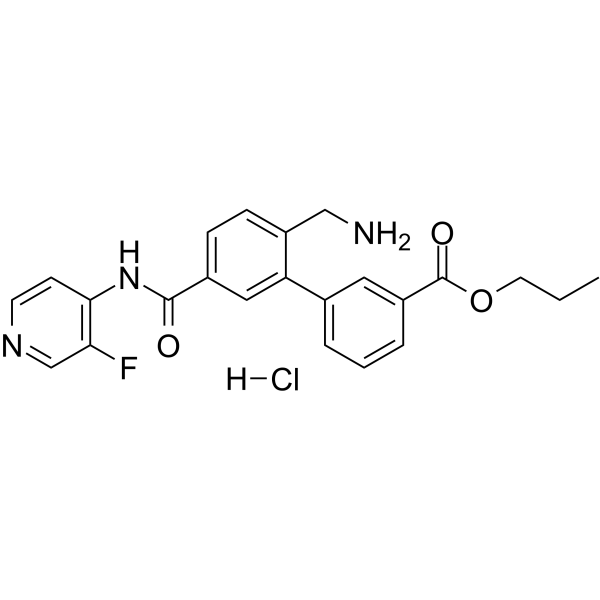
Tivanisiran sodium (SYL1001 sodium) is a small interfering RNA (siRNA) targeting TRPV1 . Tivanisiran sodium induces the degradation of TRPV1 mRNA, thereby inhibiting protein synthesis. Tivanisiran sodium alleviates ocular discomfort and pain, and improves ocular hyperemia and tear quality. Tivanisiran sodium is applicable to research related to dry eye disease .
loading...
    loading...
Cat. No.: HY-109191
CAS No.: 1333400-14-8
Purity:  99.91%
Synonyms: PHP-201; AMA0076
Target:  

ROCK

Research Areas:  

Others

Sovesudil (PHP-201) is a potent, ATP-competitive, locally acting Rho kinase (ROCK) inhibitor with IC50s of 3.7 and 2.3 nM for ROCK-I and ROCK-II, respectively. Sovesudil lowers intraocular pressure (IOP) without inducing hyperemia .
loading...
    loading...
Cat. No.: HY-132596
CAS No.: 1848224-71-4
Purity:  92.62%
Synonyms: SYL1001
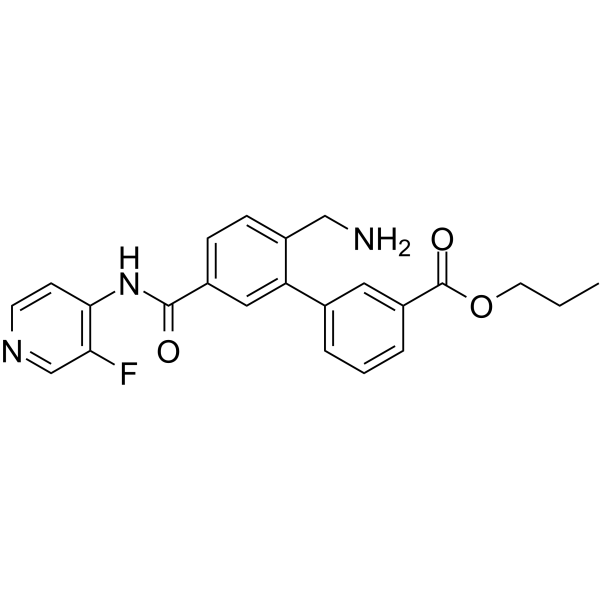
Tivanisiran (SYL1001) is a small interfering RNA (siRNA) targeting TRPV1 . Tivanisiran induces the degradation of TRPV1 mRNA, thereby inhibiting protein synthesis. Tivanisiran alleviates ocular discomfort and pain, and improves ocular hyperemia and tear quality. Tivanisiran is applicable to research related to dry eye disease .
loading...
    loading...
Cat. No.: HY-109191A
CAS No.: 2984963-50-8
Purity:  99.45%
Synonyms: PHP-201 hydrochloride; AMA0076 hydrochloride
Target:  

ROCK

Research Areas:  

Neurological Disease

Sovesudil (PHP-201) hydrochloride is a potent, ATP-competitive, locally acting Rho kinase (ROCK) inhibitor with IC50s of 3.7 and 2.3 nM for ROCK-I and ROCK-II, respectively. Sovesudil hydrochloride lowers intraocular pressure (IOP) without inducing hyperemia .
loading...
    loading...
Cat. No.: HY-116161A
CAS No.: 130209-76-6
Purity:  99.76%
Research Areas:  

Metabolic Disease

17-Phenyl trinor PGF2α isopropyl ester is a FP receptor agonist and intraocular pressure-lowering agent. 17-Phenyl trinor PGF2α isopropyl ester induces iris sphincter contraction, reduces intraocular pressure and pupil diameter, causes no ocular irritation, and only leads to mild conjunctival hyperemia. 17-Phenyl trinor PGF2α isopropyl ester is applicable to relevant research on glaucoma .
loading...
    loading...
Cat. No.: HY-106037
CAS No.: 53764-90-2
Research Areas:  

Others

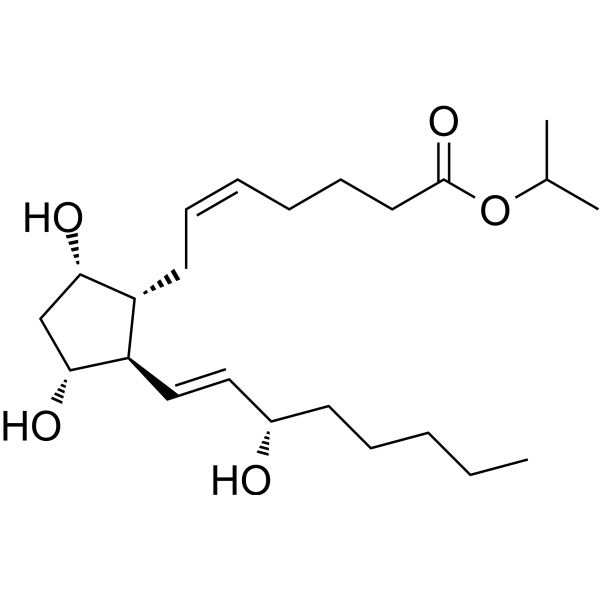
PGF2α-isopropyl ester is a Prostaglandin F2α (HY-12956) derivative, which is active in lowering the intraocular pressure (IOP) through increased uveoscleral outflow of aqueous humor. PGF2α-isopropyl ester causes side effects of conjunctival hyperemia and ocular irritation .
loading...
    loading...
Cat. No.: HY-113858
CAS No.: 103880-26-8
Synonyms: Brefanolol
Target:  

Adrenergic Receptor

Research Areas:  

Cardiovascular Disease

Brefonalol (Brefanolol) is an orally active, non-selective β-adrenergic receptor blocker with vasodilatory properties. Brefonalol exhibits an optimal balance between β-blockade and vasodilatory effects at low doses: it reduces blood pressure and slows heart rate, while increasing stroke volume instead of decreasing it, causing no significant elevation in peripheral resistance and increasing reactive hyperemia; at high doses, the β-blockade effect dominates. Brefonalol can be used in the research of arterial hypertension .
loading...
    loading...
Cat. No.: HY-109191AR
CAS No.: 2984963-50-8
Synonyms: PHP-201 hydrochloride (Standard); AMA0076 hydrochloride (Standard)
Research Areas:  

Neurological Disease

Sovesudil hydrochloride (Standard) is the analytical standard of Sovesudil (hydrochloride) (HY-109191A). This product is intended for research and analytical applications. Sovesudil (PHP-201) hydrochloride is a potent, ATP-competitive, locally acting Rho Kinase (ROCK) inhibitor with IC50s of 3.7 and 2.3 nM for ROCK-I and ROCK-II, respectively. Sovesudil hydrochloride lowers intraocular pressure (IOP) without inducing hyperemia .
loading...
    loading...
Cat. No.: HY-189808
Target:  

Histamine Receptor

Research Areas:  

Inflammation/Immunology

GD134 is a histamine H1/H4 receptor antagonist that antagonizes H1R and blocks histamine-induced signaling; it acts as an inverse agonist at H4R. GD134 exhibits negligible hERG binding affinity. GD134 reduces ocular hyperemia in a mouse conjunctival allergen challenge model without increasing the squinting score. GD134 can be used for research on allergic conjunctivitis .
loading...
    loading...
Cat. No.: HY-113858A
CAS No.: 3026677-28-8
Synonyms: Brefanolol hydrochloride
Target:  

Adrenergic Receptor

Research Areas:  

Cardiovascular Disease

Brefonalol (Brefanolol) hydrochloride is an orally active, non-selective β-adrenergic receptor blocker with vasodilatory properties. Brefonalol hydrochloride exhibits an optimal balance between β-blockade and vasodilatory effects at low doses: it reduces blood pressure and slows heart rate, while increasing stroke volume instead of decreasing it, causing no significant elevation in peripheral resistance and increasing reactive hyperemia; at high doses, the β-blockade effect dominates. Brefonalol hydrochloride can be used in the research of arterial hypertension .
loading...
    loading...
Cat. No.: HY-167153
CAS No.: 2186644-51-7
PNA5 is a novel, blood-brain barrier permeable glycosylated angiotensin-(1-7) peptide and MasR agonist. PNA5 inhibits IL-7, increases IL-10. PNA5 inhibits ROS generation, decreases Iba-1 expression. PNA5 exhibits sustained cognitive protective effects. PNA5 rescues blunted cerebral functional hyperemia. PNA5 can be used in the research of inflammation-related brain diseases .
loading...
    loading...
Cat. No.: HY-189807
Synonyms: VUF10775
Target:  

Histamine Receptor

Research Areas:  

Inflammation/Immunology

GD136 (VUF10775) is a histamine H1/H4 receptor antagonist that blocks histamine signaling. The pKi of GD136 for H1 is 7.61 (human), 7.80 (mouse), and 7.44 (rat), and for H4 is 7.93 (human), 7.38 (mouse), 7.28 (rat), and 7.38 (monkey). GD136 alleviates ocular hyperemia. GD136 can be used in research on allergic conjunctivitis .
loading...
    loading...
  • 1

