10 Results for "

intramolecular cyclization

" in MedChemExpress (MCE) Product Catalog:
Products (10)

10 Results for "intramolecular cyclization" in MCE Product Catalog:

Cat. No.: HY-P10909
CAS No.: 2925554-87-4
Synonyms: MBX 2109
Target:  

PTHR Drug Intermediate

Research Areas:  

Endocrinology

Canvuparatide (MBX 2109) is a PTH analog prodrug that releases the biologically active peptide through temperature- and pH-controlled intramolecular cyclization. The peptide released by Canvuparatide binds to and activates the PTH1 receptor, stimulating dose-dependent cAMP accumulation. Canvuparatide can be used in research on hypoparathyroidism .
loading...
    loading...
Cat. No.: HY-125372
CAS No.: 16348-49-5
Purity:  99.85%
Synonyms: ABAO
Research Areas:  

Others

2-Amino benzamidoxime (ABAO) acts as a bioconjugation reagent precursor and a fluorescent probe precursor. 2-Amino benzamidoxime contains an aniline group for imine activation of aldehydes, as well as a nucleophilic group (Nu:) located at the ortho position of the amine, which is responsible for intramolecular cyclization. 2-Amino benzamidoxime reacts with glyoxal at the N-terminus of phage-displayed peptide libraries. Derivatives of 2-Amino benzamidoxime can be used for protein bioconjugation. Derivatives of 2-Amino benzamidoxime serve as fluorescent probes .\n


loading...
    loading...
Cat. No.: HY-E70421
Target:  

Angiotensin Receptor

Research Areas:  

Others

Peptide ligase is an Asx-specific asparaginyl endopeptidase (AEP) ligase and cyclase that can be isolated from the pods of butterfly pea (Clitoria ternatea). Peptide ligase mediates traceless intramolecular cyclization of polypeptides. Peptide ligase mediates intermolecular ligation of polypeptides or proteins. Peptide ligase can be used to cyclize food-derived angiotensin-converting enzyme (ACE) inhibitory peptides, thereby enhancing the stability and biological activity of ACE inhibitory peptides. Peptide ligase is applicable to relevant research in the fields of food and biopharmaceuticals .
loading...
    loading...
Cat. No.: HY-34611
CAS No.: 25691-37-6
Synonyms: N-Boc-L-2,4-diaminobutyric acid; Boc-Dab-OH
Target:  

Drug Intermediate ASCT

Research Areas:  

Neurological Disease Cancer

Boc-L-2,4-Diaminobutyric acid (N-Boc-L-2,4-diaminobutyric acid; Boc-Dab-OH) is a versatile synthetic starting material with a cleavable protecting group. Boc-L-2,4-Diaminobutyric acid not only reduces the backbone cleavage rate by protecting the side-chain γ-amino group, but also triggers intramolecular cyclization of self-immolative linkers under acidic cleavage conditions, thus constructing stimuli-responsive materials. Boc-L-2,4-Diaminobutyric acid is also an important building block for bioactive molecules. It can be used in the synthesis of ASCT2 (SLC1A5) inhibitors and carboxynorspermine, and can also serve as an internal standard to support the quantitative detection of specific intracellular amino acids by UPLC-QQQ-MS .
loading...
    loading...
Cat. No.: HY-156249
CAS No.: 1466546-45-1
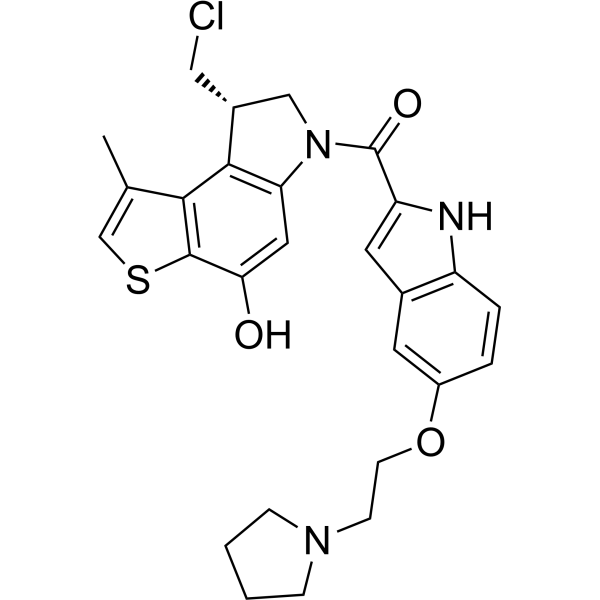
NMS-P528 is a DNA minor groove alkylating agent and ADC payload. NMS-P528 undergoes intramolecular cyclization to form reactive electrophilic derivatives, which in turn induce DNA damage, cell cycle arrest, and Apoptosis. NMS-P528 shows no significant anti-tumor activity as a free payload in a HER2-negative Raji lymphoma mouse xenograft model. NMS-P528 serves as the cytotoxic payload for the antibody-drug conjugate EV20/NMS-P945. NMS-P528 can be used in research related to breast cancer, gastric cancer, colon adenocarcinoma, Burkitt's lymphoma, neuroblastoma, pancreatic cancer, prostate cancer, head and neck cancer, ovarian cancer, and melanoma .
loading...
    loading...
Cat. No.: HY-121564
CAS No.: 95378-00-0
Radermachol is a red pigment that can be synthesized in four steps via a key ytterbium triflate-catalyzed furan cyclization and intramolecular nucleophilic acylation reaction .
loading...
    loading...
Cat. No.: HY-177482
CAS No.: 3011748-20-9
Target:  

Drug Intermediate

Research Areas:  

Neurological Disease Cancer

Pro-PTX is a Pd-sensitive Paclitaxel (HY-B0015) prodrug with anticancer activity. Pro-PTX triggers intramolecular cyclization via Pd-catalyzed depropargylation to release active Paclitaxel (HY-B0015) and a non-toxic byproduct. Pro-PTX exhibits low cytotoxicity and antiproliferative activity in cancer cells and non-cancerous human cerebrovascular pericytes. Pro-PTX is applicable for research related to non-small cell lung cancer, glioblastoma and lung cancer .
loading...
    loading...
Cat. No.: HY-E71593
Research Areas:  

Others

2-Methylfumaryl-CoA isomerase (EC 5.4.1.3), purified from the bacterium Chloroflexus aurantiacus, acts as an intramolecular CoA transferase and does not transfer CoA to free mesaconate, and is part of the 3-hydroxypropanoate cycle for carbon assimilation.
loading...
    loading...
Cat. No.: HY-D3191
L&M-D-MR is a highly specific fluorescent "AND" logic probe with response moieties for leucine aminopeptidase (LAP) and monoamine oxidase (MAO). The coexistence of both LAP and MAO is required for L&M-D-MR to trigger intramolecular cyclization, release fluorophores and activate fluorescence. In the presence of only a single enzyme, L&M-D-MR generates only an extremely weak signal. L&M-D-MR enables bioimaging in living cells and mouse models, and can effectively distinguish different subtypes of liver diseases via blood samples or test strips. L&M-D-MR is widely used in studies related to liver cirrhosis, hepatitis B and drug-induced liver injury .
loading...
    loading...
Cat. No.: HY-L951
505 compounds

Macrocyclic scaffolds are increasingly valued in modern drug discovery for their exceptional activity against undruggable targets (proteases, kinases, PPIs). 2026 marks a key commercial breakthrough for oral macrocyclic peptides: enlicitide, the world’s first oral PCSK9 macrocyclic peptide, has received FDA approval. Macrocyclic candidates targeting KRAS and other classic undruggable targets have also entered clinical development, validating macrocyclization as an effective strategy to overcome druggability barriers.

Two core R&D directions lead current macrocyclic drug design: AI-driven de novo generation and structural optimization of small-molecule macrocycles, and macrocyclic peptides based on sequence design and conformational engineering. Macrocycle druggability hinges on embedded linkers, which determine cyclization efficiency, final conformation and drug-like properties. Bifunctional reaction orthogonality is the core linker selection criterion. Our linker library enables stepwise intramolecular cyclization with suppressed side reactions, accommodates varied ring sizes, and covers three key reaction systems: amide condensation, nucleophilic substitution and CuAAC click chemistry.

Built on classical macrocyclization systems, the library is processed through reaction classification, bifunctional orthogonality evaluation, novelty clustering and redundancy removal, with PROTAC long-chain and ADC cleavable linkers explicitly excluded. Featuring rigid, semi-rigid and flexible scaffolds, it is widely applicable to small-molecule macrocycle synthesis and linear peptide cyclization.

