
7 Results for "

intraocular tissue

" in MedChemExpress (MCE) Product Catalog:
Products (7)

7 Results for "intraocular tissue" in MCE Product Catalog:

3
3 Cited Publications
Cat. No.: HY-19057A
CAS No.: 130466-38-5
Synonyms: MK-467 hydrochloride; L-659066 hydrochloride
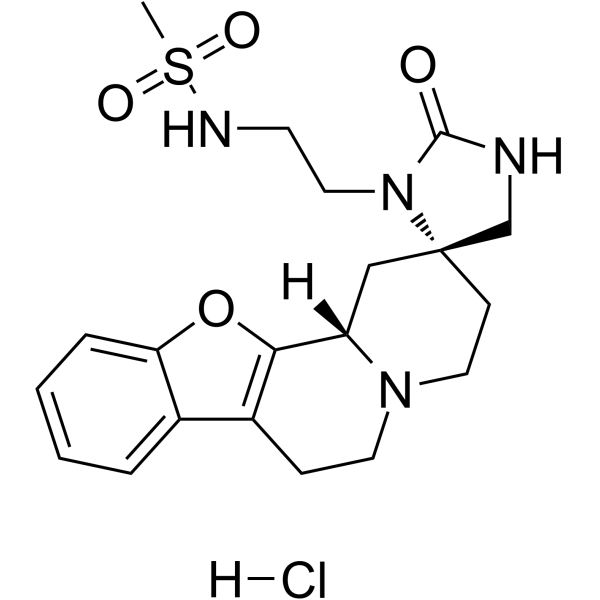
Vatinoxan hydrochloride (MK-467 hydrochloride) is a peripherally selective α2-Adrenoceptor antagonist. Vatinoxan hydrochloride blocks peripheral α2-adrenoceptor-mediated vasoconstriction, bradycardia, hyperglycemia, diuresis, lens opacity, and decreased intraocular pressure, delays pupil dilation, and maintains corneal thickness. Vatinoxan hydrochloride, when combined with Medetomidine (HY-17034)/benzodiazepines, reduces respiratory rate and increases pulse rate, cutaneous microcirculation, tissue oxygenation, peripheral heat loss, and cardiac index, while altering gastrointestinal perfusion and mean arterial pressure, without causing death, hypotension, or hypoglycemia, and blocks vasoconstriction of chelonian resistance arteries .
loading...
    loading...
3
3 Cited Publications
Cat. No.: HY-19057
CAS No.: 114914-42-0
Synonyms: MK-467; L-659066
Vatinoxan (MK-467) is a peripherally selective α2-Adrenoceptor antagonist. Vatinoxan blocks peripheral α2-adrenoceptor-mediated vasoconstriction, bradycardia, hyperglycemia, diuresis, lens opacity, and decreased intraocular pressure, delays pupil dilation, and maintains corneal thickness. Vatinoxan, when combined with Medetomidine (HY-17034)/benzodiazepines, reduces respiratory rate and increases pulse rate, cutaneous microcirculation, tissue oxygenation, peripheral heat loss, and cardiac index, while altering gastrointestinal perfusion and mean arterial pressure, without causing death, hypotension, or hypoglycemia, and blocks vasoconstriction of chelonian resistance arteries .
loading...
    loading...
Cat. No.: HY-153484A
CAS No.: 849758-52-7
Research Areas:  

Neurological Disease

Bevasiranib sodium is a siRNA that targets and silences VEGF-A. Bevasiranib sodium activates the RNA-induced silencing complex to degrade VEGF-A mRNA, mediates TLR3-related inhibition of choroidal neovascularization, and triggers RNA interference-mediated gene silencing through endogenous eukaryotic RNAi mechanisms. After intravitreal injection, Bevasiranib sodium distributes to various ocular tissues and resists degradation by intraocular nucleases, reducing choroidal neovascularization area and alleviating vascular leakage. Bevasiranib sodium can be used in research related to macular degeneration .
loading...
    loading...
Cat. No.: HY-124404
CAS No.: 82337-46-0
Purity:  ≥99.0%
12(R)-HETE is a CYP-dependent arachidonic acid metabolite that acts as a proinflammatory lipid mediator. 12 (R)-HETE widely exists in various tissues including the eye, skin and liver. In the cornea, 12(R)-HETE is metabolized via pathways such as β-oxidation into the precursor of 12(R)-HETrE. Without direct receptor binding, 12(R)-HETE indirectly activates AHR-mediated target gene transcription, while inhibiting the enzymatic activity of Na+,K+-ATPase and the intracellular calcium elevation induced by TP agonists. 12(R)-HETE also possesses multiple physiological effects such as chemotaxis, proangiogenesis, vasodilation, natriuresis, diuresis and intraocular pressure reduction, and can be widely used in studies related to psoriasis, inflammatory skin diseases and ocular inflammation .
loading...
    loading...
Cat. No.: HY-153484
CAS No.: 959961-96-7
Research Areas:  

Neurological Disease

Bevasiranib is a siRNA that targets and silences VEGF-A. Bevasiranib activates the RNA-induced silencing complex to degrade VEGF-A mRNA, mediates TLR3-related inhibition of choroidal neovascularization, and triggers RNA interference-mediated gene silencing through endogenous eukaryotic RNAi mechanisms. After intravitreal injection, Bevasiranib distributes to various ocular tissues and resists degradation by intraocular nucleases, reducing choroidal neovascularization area and alleviating vascular leakage. Bevasiranib can be used in research related to macular degeneration .
loading...
    loading...
Cat. No.: HY-129934
CAS No.: 607351-44-0
Synonyms: Lat-NEt
Research Areas:  

Endocrinology

Latanoprost ethyl amide (Lat-NEt) is a latanoprost analog in which the C-1 carboxyl group has been modified to an N-ethyl amide. Prostaglandin esters have been shown to have ocular hypotensive activity.1 Prostaglandin N-ethyl amides were recently introduced as alternative prostaglandin ocular hypotensive prodrugs. Although it has been claimed that prostaglandin ethyl amides are not converted to the free acids in vivo, studies in our laboratories have shown that bovine and human corneal tissue converts the N-ethyl amides of various prostaglandins to the free acids with a conversion rate of about 2.5 μg/g corneal tissue/hr. Lat-NEt would be expected to show the typical intraocular effects of Latanoprost free acid, but with the much slower hydrolysis pharmacokinetics of the prostaglandin N-amides.
loading...
    loading...
Cat. No.: HY-129934S
Synonyms: Lat-NEt-d4
Latanoprost ethyl amide-d4 (Lat-NEt-d4) is deuterium labeled Latanoprost ethyl amide. Latanoprost ethyl amide (Lat-NEt) is a latanoprost analog in which the C-1 carboxyl group has been modified to an N-ethyl amide. Prostaglandin esters have been shown to have ocular hypotensive activity.1 Prostaglandin N-ethyl amides were recently introduced as alternative prostaglandin ocular hypotensive prodrugs. Although it has been claimed that prostaglandin ethyl amides are not converted to the free acids in vivo, studies in our laboratories have shown that bovine and human corneal tissue converts the N-ethyl amides of various prostaglandins to the free acids with a conversion rate of about 2.5 μg/g corneal tissue/hr. Lat-NEt would be expected to show the typical intraocular effects of Latanoprost free acid, but with the much slower hydrolysis pharmacokinetics of the prostaglandin N-amides .
loading...
    loading...

