13 Results for "

mesoporous biochar

" in MedChemExpress (MCE) Product Catalog:
Products (13)

13 Results for "mesoporous biochar" in MCE Product Catalog:

1
1 Cited Publications
Cat. No.: HY-D1053
Synonyms: Sulfo-Cyanine7-N3
Target:  

Fluorescent Dye

Research Areas:  

Others

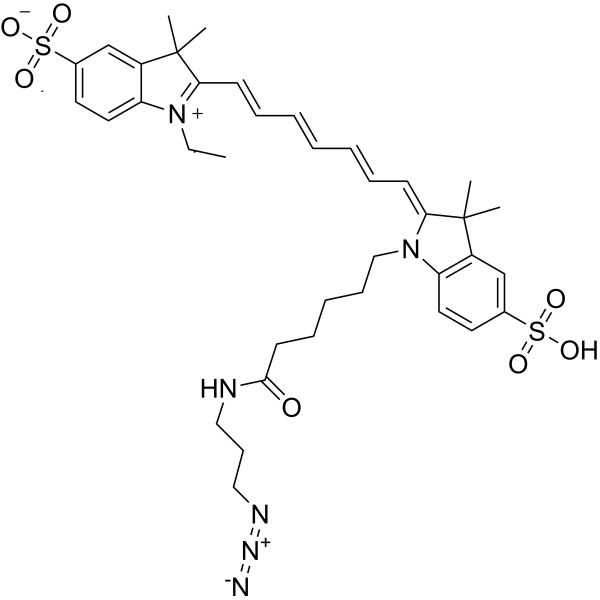
CY7-N3 (Sulfo-Cyanine7-N3) is a cyanine7 azide fluorescent dye and clickable quencher. CY7-N3 quenches the fluorescence of unreacted Cy5-DBCO, serves as a click chemistry quencher in the organelle-selective click labeling combined with flow cytometry (O-ClickFC) procedure for alkyne-labeled Palmitic acid (HY-N0830) in hematopoietic stem and progenitor cells, and can serve as a prodrug model loaded into DNAzyme-gated mesoporous Silicon dioxide (HY-W019831) nanoparticles. CY7-N3 can be used for click chemistry labeling and fluorescence imaging studies .
loading...
    loading...
Cat. No.: HY-W017446
CAS No.: 619-66-9
Synonyms: Tetraphthalaldehydic acid
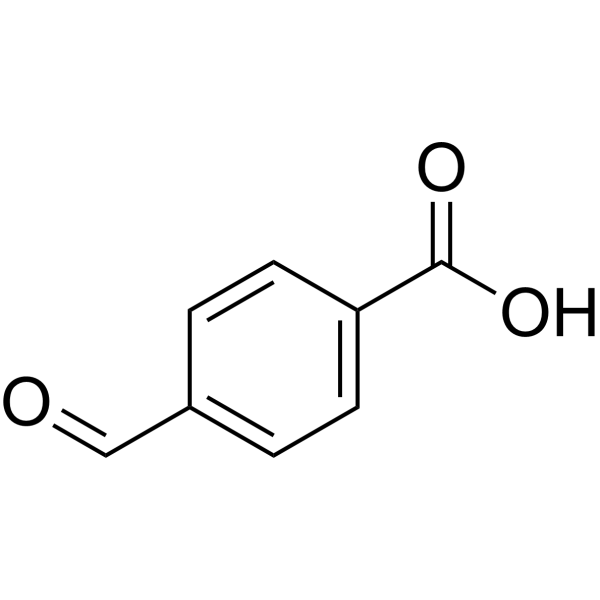
4-Formylbenzoic acid is an intermediate in the synthesis of terepthalic acid. 4-Formylbenzoic acid can react with barium carbonate to yield two-dimensional barium(II) coordination polymer. 4-Formylbenzoic acid can also be used in the synthesis of acid functionalized mesoporous silica catalyst via the condensation .
loading...
    loading...
Cat. No.: HY-P5832
CAS No.: 836606-84-9
Target:  

TGF-beta/Smad RUNX

Research Areas:  

Metabolic Disease

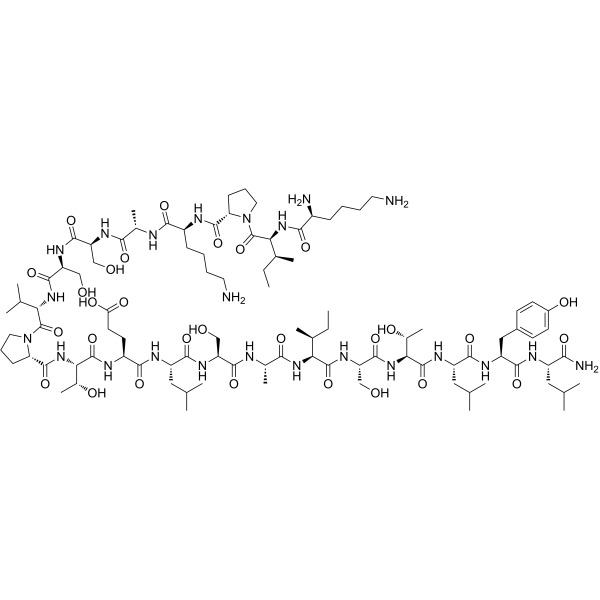
BMP2-derived peptide is an osteogenic inducer and BMP receptor ligand. BMP2-derived peptide binds to BMP receptors on the cell surface to form a complex, activates the downstream Smad signaling pathway, and regulates the expression of osteogenic transcription factors. BMP2-derived peptide effectively promotes the adhesion, proliferation, osteogenic differentiation and mineralization of bone marrow mesenchymal stem cells, significantly up-regulates the mRNA levels of OCN, Runx2 and type I collagen, and increases alkaline phosphatase activity and calcium deposition. BMP2-derived peptide induces osteoblast differentiation and ectopic bone regeneration, and improves cranial bone defect repair. Meanwhile, BMP2-derived peptide enhances the cytocompatibility of mesoporous silica nanoparticles, synergistically increases osteogenic activity with Dexamethasone (HY-14648), serving as an important tool for bone defect repair research .
loading...
    loading...
Cat. No.: HY-42984
CAS No.: 916753-62-3
BHQ-2 NHS is a fluorescence dark quencher with an absorption spectrum spanning 550-650 nm that overlaps with tetramethylrhodamine (TMR) emission. BHQ-2 NHS quenches TMR fluorescence when conjugated to mesoporous silica nanoparticles. BHQ-2 NHS can be used for the research of cancer .
loading...
    loading...
Cat. No.: HY-91018
CAS No.: 35141-36-7
Synonyms: N-[3-(Trimethoxysilyl)propyl]-N,N,N-trimethylammonium chloride, 50% in methanol
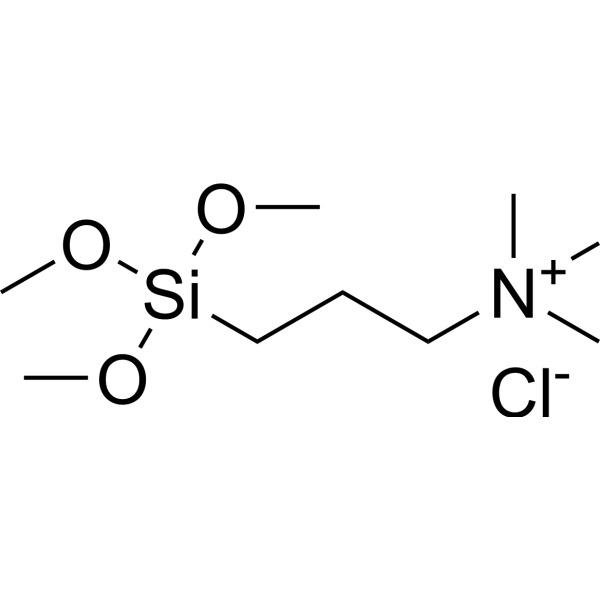
Trimethyl[3-(trimethoxysilyl)propyl]ammonium (N-[3-(Trimethoxysilyl)propyl]-N,N,N-trimethylammonium) chloride (50% in methanol) is a functional organic silane coupling agent and quaternary ammonium salt cationic functional monomer, which can be used for functionalizing mesoporous silica with electrochemical modified electrodes or surface chemical modification .
loading...
    loading...
Cat. No.: HY-184612
Mesoporous polydopamine nanoparticles are mesoporous nanomaterials formed by the self-polymerization of dopamine hydrochloride under alkaline conditions. Their main component is the dopamine polymer, a biomacromolecule exhibiting good adhesion and reducing properties, demonstrating excellent biocompatibility and bio-interaction capabilities.
loading...
    loading...
Cat. No.: HY-184614
Mesoporous polydopamine nanoparticles are mesoporous nanomaterials formed by the self-polymerization of dopamine hydrochloride under alkaline conditions. Their main component is the dopamine polymer, a biomacromolecule exhibiting good adhesion and reducing properties, demonstrating excellent biocompatibility and bio-interaction capabilities.
loading...
    loading...
Cat. No.: HY-184609
Hollow mesoporous copper sulfide nanoparticles are nanomaterials with unique structures and properties. Their hollow mesoporous structure enables the encapsulation of small molecules, facilitating in vivo delivery, while their surface can be functionalized for further modification. Due to their excellent properties, hollow mesoporous copper sulfide nanoparticles are widely used in fields such as magnetic resonance imaging, biosensoring, and nanoprobe construction.
loading...
    loading...
Cat. No.: HY-184633
Hollow mesoporous iron oxide nanoparticles are a type of nanomaterial with a special structure that combines hollow structure with mesoporous (mesoporous refers to pores with a diameter between 2 and 50 nanometers) characteristics. They are mainly composed of iron oxide (Fe3O4) with a hollow center. This structure can increase the specific surface area of the material while reducing its weight, thereby improving its application efficiency in fields such as catalysis and drug delivery.
loading...
    loading...
Cat. No.: HY-107205
CAS No.: 13861-22-8
Research Areas:  

Others

Propargyl methacrylate is an effective electrolyte additive used to stabilize the formation of the solid electrolyte interface (SEI) layer on meso-porous carbon microbeads (MCMB) in lithium-ion batteries .
loading...
    loading...
Cat. No.: HY-W739000
CAS No.: 53958-47-7
Research Areas:  

Others

Heptakis-(6-azido-6-deoxy)-β-cyclodextrin is a per-6-azido-β-cyclodextrin derivative functioning as a building block for mesoporous silica nanoparticle functionalization and a click-chemistry gatekeeper component in a dual-cargo release system. Heptakis-(6-azido-6-deoxy)-β-cyclodextrin enables controlled release of cargo molecules via click chemistry attachment .
loading...
    loading...
Cat. No.: HY-P12370
Research Areas:  

Endocrinology

LTHVVWL is a Kim-1-binding peptide. LTHVVWL functionalizes extracellular vesicles and exosomes to achieve targeted delivery to injured renal tubules. LTHVVWL modifies FRC-Exos to enhance specificity for injured renal tubules. LTHVVWL functionalizes nanoparticles for active targeting of injured kidneys. LTHVVWL is grafted onto mesoporous silica nanoparticles via a PEG linker to seal the outer layer and prevent leakage. LTHVVWL acts as a calcium chelator through hydrolysis, generating active BAPTA and reducing intracellular Ca 2+ overload. LTHVVWL can be used for acute kidney injury research .
loading...
    loading...
Cat. No.: HY-P11887
CAS No.: 1174559-81-9
VHPKQHR is a peptide-based delivery enhancer that binds to VCAM-1. VHPKQHR enables intracellular internalization of relevant nanomaterials and facilitates the targeted delivery of miRNA inhibitors to inflamed endothelial cells and endothelial cells activated by disturbed flow. When conjugated with magnetic mesoporous silica nanoparticles, VHPKQHR achieves targeted accumulation at atherosclerotic plaque sites. When displayed on the surface of polyelectrolyte complex micelles, VHPKQHR enhances the relevant effects of anti-miR-92a in Apoe -/- mice. When conjugated with ultrasmall superparamagnetic iron oxide nanoparticles, VHPKQHR forms a contrast agent for T1-weighted magnetic resonance imaging. VHPKQHR can be used in research related to atherosclerosis, stenosis and rheumatoid arthritis .
loading...
    loading...
  • 1

