
34 Results for "

microsphere

" in MedChemExpress (MCE) Product Catalog:
Products (34)

34 Results for "microsphere" in MCE Product Catalog:

4
4 Cited Publications
Cat. No.: HY-K0225

MCE Carboxyl Magnetic beads (200 nm, 10 mg/mL) are characterized by superparamagnetism, fast magnetic response, abundant carboxyl functional groups, monodispersity, and submicron scale particle size. Biological ligands (proteins, peptides, oligonucleotides, drug molecules, etc.) can be covalently coupled to the surface of microspheres under the action of special chemical reagents (such as EDC).

loading...
    loading...
Cat. No.: HY-126213
CAS No.: 326589-90-6
Purity:  ≥99.0%
Synonyms: 18:1 Lyso-PS
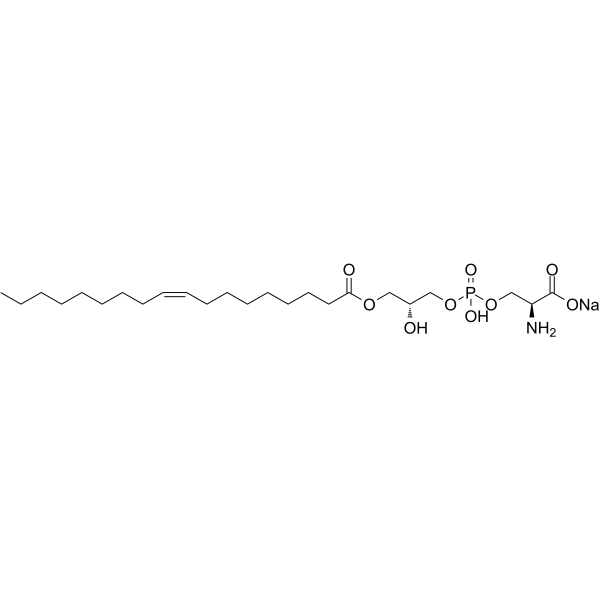
Oleoyl-2-hydroxy-sn-glycero-3-phospho-L-serine sodium (18:1 Lyso-PS) is a modified PS product generated following NADPH oxidase activation and Lyso-PS signal transduction. 1-Oleoyl-2-hydroxy-sn-glycero-3-phospho-L-serine sodium signals through macrophage G2A to enhance the phagocytic uptake of PS-dependent apoptotic (apoptosis) neutrophils and PS-exposed activated neutrophils. 1-Oleoyl-2-hydroxy-sn-glycero-3-phospho-L-serine sodium enhances macrophage phagocytic uptake of apoptotic cells, carboxylate-modified microspheres, and PS-exposed non-apoptotic activated neutrophils. 1-Oleoyl-2-hydroxy-sn-glycero-3-phospho-L-serine sodium serves as an acyl acceptor substrate for the lysophosphatidyltransferase At1g78690p to generate diacylphosphatidylserine. 1-Oleoyl-2-hydroxy-sn-glycero-3-phospho-L-serine sodium reduces the secretion of IL-8 and decreases the proportion of viable colon cancer cells. 1-Oleoyl-2-hydroxy-sn-glycero-3-phospho-L-serine sodium is applicable to studies on peritonitis and inflammatory bowel disease .
loading...
    loading...
Cat. No.: HY-W134328
CAS No.: 87915-38-6
Synonyms: Dextran blue (MW 2000000)
Blue dextran (Dextran blue) (MW 2000000) is a high-molecular-weight long-chain polymer of D-glucose. Blue dextran (MW 2000000) serves as an important model macromolecular drug and molecular weight estimation marker, and can be used as a standard for gel permeation chromatography. The release of Blue dextran (MW 2000000) from alginate microspheres is regulated by preparation conditions; its release rate in a pH 6.8 environment is significantly faster than that in pH 1.2, and it exhibits release characteristics close to zero-order kinetics under this condition .
loading...
    loading...
Cat. No.: HY-D2401F
Cy5-Polystyrene microsphere (100 nm) is a Cy5 (HY-D0821)-labeled microsphere that can be used for bioimaging and drug delivery .
loading...
    loading...
Cat. No.: HY-D2401F1
Cy5-Polystyrene microsphere (20um) is a Cy5 (HY-D0821)-labeled microsphere that can be used for bioimaging and drug delivery .
loading...
    loading...
Cat. No.: HY-141522A
CAS No.: 9050-94-6
Cross-linked dextran G 100, coarse are microspheres with an average particle size of D50 = 190-210 μm.
loading...
    loading...
Cat. No.: HY-148139A
CAS No.: 37224-29-6
Cross-linked dextran G 75, coarseThe average particle size is D50=190-210 μmof microspheres.
loading...
    loading...
Cat. No.: HY-138560A
CAS No.: 9048-71-9
Cross-linked dextran G 50, medium is a gel filtration medium. Cross-linked dextran G 50, medium can be used in gel permeation chromatography for fractionation of the glycopeptide mixture (Sphere protein separation range: 1.5K-30K Da; Polysaccharide separation range: 500-10K Da). Cross-linked dextran G 50, medium are microspheres with an average particle size of D50 = 220-250 μm .
loading...
    loading...
Cat. No.: HY-138560B
CAS No.: 9048-71-9
Cross-linked dextran G 50, fine is a gel filtration medium. Cross-linked dextran G 50, fine can be used in gel permeation chromatography for fractionation of the glycopeptide mixture (Sphere protein separation range: 1.5K-30K Da; Polysaccharide separation range: 500-10K Da). Cross-linked dextran G 50, fineThe average particle size is D50=110-130 μmof microspheres .
loading...
    loading...
Cat. No.: HY-106868
CAS No.: 88931-51-5
Synonyms: Isocarbacyclin methyl ester; TEI 9090; TTC 909
Clinprost (Isocarbacyclin methyl ester; TEI 9090; TTC 909) is a drug preparation of the stable prostaglandin I(2) analogue clinprost incorporated into lipid microspheres. Clinprost can reduce infarct volume in stroke rats .
loading...
    loading...
Cat. No.: HY-179073A
TRITC-Polysucrose 40 is TRITC-labeled Polysucrose 40 (HY-131960C). Polysucrose 40 is a copolymer of sucrose and epichlorohydrin. Polysucrose 40 can be used to prepare cross-linked polysucrose microspheres. TRITC-Polysucrose 40 is mainly used for permeability and microcirculation studies (Ex/Em = 544/570 nm) .
loading...
    loading...
Cat. No.: HY-B0746
CAS No.: 56767-76-1
Synonyms: dl-Flurbiprofen sodium
Target:  

Endogenous Metabolite

Research Areas:  

Inflammation/Immunology

Flurbiprofen sodium (dl-Flurbiprofen sodium) is a nonsteroidal anti-inflammatory agent (NSAID) with anti-inflammatory and analgesic activities. Flurbiprofen sodium is used to reduce bone resorption in periodontal disease, and it works by inhibiting carbonic anhydrase. Flurbiprofen sodium is formulated as biodegradable microspheres for use as a compound delivery system, particularly within the periodontal pocket. The release rate of flurbiprofen sodium is related to the concentration of polymer and polyvinyl alcohol used in its preparation .
loading...
    loading...
Cat. No.: HY-157232
Research Areas:  

Others

AC Antibody purification resin 2 is based on spherical, highly cross-linked agarose beads with a narrow size distribution and high mechanical stability. Used for the separation and purification of complex antibodies such as monoclonal antibody, double antibody, multi-antibody and Fc fusion protein
. Substrate: highly crosslinked agarose microspheres; Particle size: 65μm; Ligand: alkali-resistant recombinant Protein A; ADC purified resin.
loading...
    loading...
Cat. No.: HY-164036R
CAS No.: 2930690-12-1
Research Areas:  

Infection

Flurbiprofen (sodium) (Standard) is the analytical standard of Flurbiprofen (sodium). This product is intended for research and analytical applications. Flurbiprofen sodium (dl-Flurbiprofen sodium) is a nonsteroidal anti-inflammatory agent (NSAID) with anti-inflammatory and analgesic activities. Flurbiprofen sodium is used to reduce bone resorption in periodontal disease, and it works by inhibiting carbonic anhydrase. Flurbiprofen sodium is formulated as biodegradable microspheres for use as a compound delivery system, particularly within the periodontal pocket. The release rate of flurbiprofen sodium is related to the concentration of polymer and polyvinyl alcohol used in its preparation .
loading...
    loading...
Cat. No.: HY-184635
Monodisperse Fe3O4 microspheres (Monodisperse iron oxide microspheres) are microspheres composed of magnetic materials, with iron oxide as the main component. These microspheres are very uniform in size and exhibit monodispersity, meaning that the sizes of the microspheres are very similar with minimal differences.
loading...
    loading...
Cat. No.: HY-184640
Carboxylated magnetic microspheres are magnetic microspheres with abundant carboxyl functional groups on their surface. They are usually composed of superparamagnetic materials (such as Fe3O4) and polymer materials, with polystyrene microspheres as the core.
loading...
    loading...
Cat. No.: HY-184641
Aminated magnetic microspheres are superparamagnetic magnetic particles with amino functional groups modified on their surface, widely used in biomedical and molecular biology research. This 1μm aminated magnetic microsphere is composed of polystyrene and nano-iron oxide, exhibiting hydrophilicity and good biocompatibility. The aminated magnetic microspheres possess superparamagnetism, fast magnetic response, good monodispersity, ensuring reaction uniformity and detection consistency. The unique rough surface structure and polymer modification give the aminated magnetic microspheres a high amino density, allowing them to covalently couple with bioligands such as peptides, proteins, oligonucleotides, drug molecules, and glycoproteins through the action of special chemical reagents (such as glutaraldehyde). They serve as excellent coating materials and are important carrier tools in medical and biomolecular research.
loading...
    loading...
Cat. No.: HY-131960B
CAS No.: 68954-24-5
Polysucrose 20 is a copolymer of sucrose and epichlorohydrin. Polysucrose 20 can be used to prepare crosslinked polysucrose microspheres .
loading...
    loading...
Cat. No.: HY-131960C
CAS No.: 68954-24-5
Polysucrose 40 is a copolymer of sucrose and epichlorohydrin. Polysucrose 40 can be used to prepare crosslinked polysucrose microspheres .
loading...
    loading...
Cat. No.: HY-131960D
CAS No.: 68954-24-5
Polysucrose 1000 is a copolymer of sucrose and epichlorohydrin. Polysucrose 1000 can be used to prepare crosslinked polysucrose microspheres .
loading...
    loading...

