5 Results for "

optical microscopy

" in MedChemExpress (MCE) Product Catalog:
Products (5)

5 Results for "optical microscopy" in MCE Product Catalog:

Cat. No.: HY-W013973
CAS No.: 92-94-4
p-Terphenyl is a specialty material, and may be used in ionized radiation detectors, nonpolar laser dye, and single molecule optical probe of scanning near-field microscopy. p-Terphenyl can be used to synthesis p-Terphenyl derivatives, for the research of cancer and inflammatory diseases .
loading...
    loading...
Cat. No.: HY-W013973R
CAS No.: 92-94-4
p-Terphenyl (Standard) is the analytical standard of p-Terphenyl. This product is intended for research and analytical applications. p-Terphenyl is a specialty material, and may be used in ionized radiation detectors, nonpolar laser dye, and single molecule optical probe of scanning near-field microscopy. p-Terphenyl can be used to synthesis p-Terphenyl derivatives, for the research of cancer and inflammatory diseases .
loading...
    loading...
Cat. No.: HY-D3349
Target:  

Fluorescent Dye

Research Areas:  

Others

Fluorne rhodamine picolyl azide is a fluorescent dye used for optical microscopy and nanoscopy, which can be applied in fluorescence correlation spectroscopy (FCS), stimulated emission depletion (STED) nanoscopy, biomolecule labeling, and live-cell imaging .
loading...
    loading...
Cat. No.: HY-W013973S
CAS No.: 1718-51-0
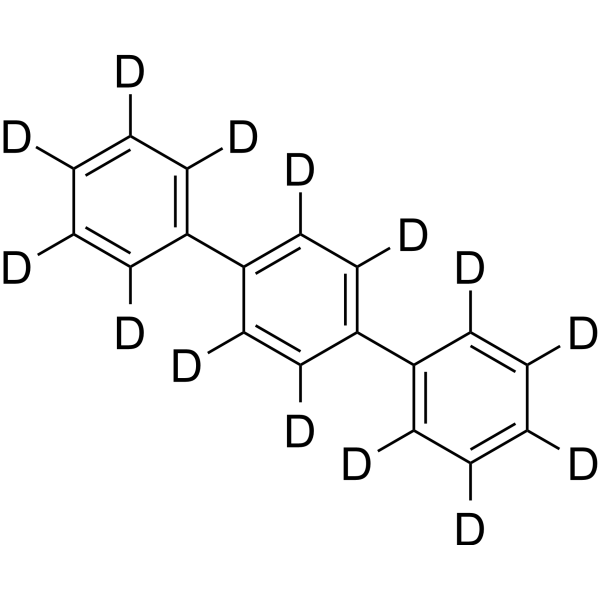
p-Terphenyl-d14 is the deuterium labeled p-Terphenyl (HY-W013973). p-Terphenyl is a specialty material, and may be used in ionized radiation detectors, nonpolar laser dye, and single molecule optical probe of scanning near-field microscopy. p-Terphenyl can be used to synthesis p-Terphenyl derivatives, for the research of cancer and inflammatory diseases .
loading...
    loading...
Cat. No.: HY-D1737
RADA is a fluorescent D-amino acid (FDAA) with high photostability and thermostability, which emits yellow-to-orange fluorescence. RADA shows low outer membrane permeability in wild-type Gram-negative Escherichia coli, but it targets penicillin-binding proteins and L,D-transpeptidases, mimics the interaction between acyl acceptors and enzyme intermediates, and integrates into peptidoglycan during biosynthesis. As a peptidoglycan labeling reagent, RADA metabolically integrates into the nascent peptidoglycan of live bacterial cells, labels the peptidoglycan at the poles and lateral walls of mycobacteria, and enables visualization of peptidoglycan synthesis and remodeling processes. RADA serves as a non-specific stain for fixed cells, is non-toxic to bacterial cells, and its red-shifted excitation/emission spectra reduce phototoxicity. RADA also supports virtual pulse-chase labeling experiments and stochastic optical reconstruction microscopy for sub-diffraction-limited imaging of bacterial cell walls .
loading...
    loading...

