12 Results for "

packing

" in MedChemExpress (MCE) Product Catalog:
Products (12)

12 Results for "packing" in MCE Product Catalog:

Cat. No.: HY-N16308
CAS No.: 3091879-77-2
Category:  

Lipids

Target:  

Fluorescent Dye

ER-Laurdan is a derivative of the membrane-permeable fluorescent probe Laurdan (HY-D0080) that targets the endoplasmic reticulum (ER). As a membrane fluidity reporter, ER-Laurdan specifically localizes to the ER luminal membrane, and exhibits a prominent solvatochromic response to fluidity changes caused by membrane packing and exogenous saturated fatty acid stress. ER-Laurdan shows no overlapping localization with mitochondria, enables quantitative analysis of ER membrane fluidity via generalized polarization ratio measurement, and allows automatic signal masking with the help of ER markers. With high specificity and quantitative capability, ER-Laurdan serves as an important tool for investigating metabolic disorders and associated changes in the physical properties of cell membranes .
loading...
    loading...
Cat. No.: HY-N1136
CAS No.: 511-15-9
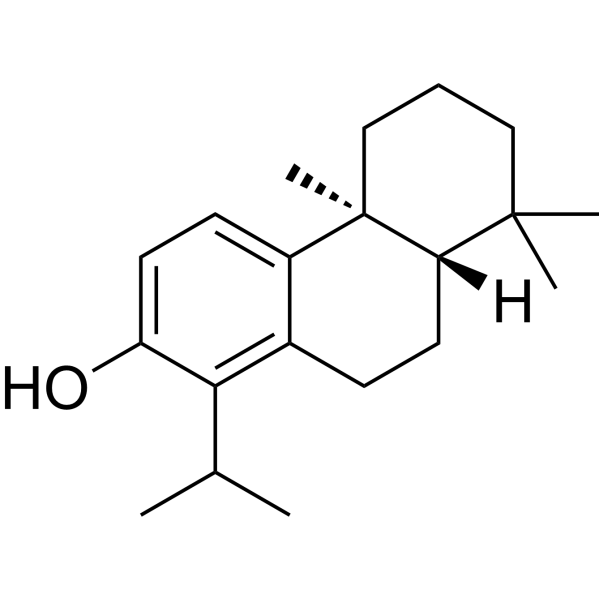
(+)-Totarol is a diterpenoid membrane-disrupting agent and membrane structure regulator found in plants of the genus Podocarpus spp. (+)-Totarol inserts into phospholipid model membranes, disrupts phospholipid packing, and impairs the functional integrity of membranes. (+)-Totarol exhibits antibacterial activity against a variety of bacterial species and β-lactam-resistant strains, and its action is associated with changes in membrane physical properties. (+)-Totarol can be used in studies related to bacterial infections .
loading...
    loading...
Cat. No.: HY-103703
CAS No.: 12609-80-2
DEAE Cross-linked dextran A 25 is a weak anion exchange chromatography packing material. DEAE Cross-linked dextran A 25 can be used for the analysis of trace metal humic acid complexes in river water and the purification of biomacromolecules. DEAE Cross-linked dextran A 25 can also be used for research on diseases related to abnormal AVP levels .
loading...
    loading...
Cat. No.: HY-W013396
CAS No.: 619-58-9
Research Areas:  

Others

4-Iodobenzoic acid is a 4-iodobenzoic acid that crystallizes as a dimer in the monoclinic space group P21/n, with a phase transition center temperature of 230.77 K, and exhibits intermolecular iodine-iodine van der Waals interactions. 4-Iodobenzoic acid can be used in studies of hydrogen bonding, crystal packing and solid-state phase transitions .
loading...
    loading...
Cat. No.: HY-175419
Synonyms: trans bis-Isatoic anhydride
Target:  

DNA/RNA Synthesis

Research Areas:  

Cancer

TBIA (trans bis-isatoic anhydride) is a covalent RNA crosslinker. TBIA selectively induces RNA tertiary interactions (e.g., multi-helix junctions, loop-helix packing). TBIA is promising for research of RNA higher-order structure and disease-associated RNAs (e.g., KRAS-mutant RNAs) .
loading...
    loading...
Cat. No.: HY-W700437
CAS No.: 2391-05-1
Threo-9,10-Dihydroxystearic acid is a synthetic dihydroxy fatty acid with the activity of altering lipid bilayer packing and fluidity. Threo-9,10-Dihydroxystearic acid can be used to study the dynamic properties of lipid membranes. Threo-9,10-Dihydroxystearic acid exhibits important biological functions in cell membranes or synthetic lipid models.
loading...
    loading...
Cat. No.: HY-N16300
CAS No.: 3091879-75-0
Target:  

Fluorescent Dye

Research Areas:  

Others

Mito-laurdan (bromide) is a Fluorescent dye for mitochondrial membrane fluidity and packing measurement. It depends on membrane potential for targeting: it contains a cationic triphenylphosphonium moiety that accumulates at the inner mitochondrial membrane due to the membrane's negative potential, connected via a 3-carbon linker. As a solvatochromic dye derived from Laurdan (HY-D0080), it retains the characteristic mechanism where fluorescence emission shifts based on membrane packing: in more fluid, loosely packed membranes, greater water penetration leads to increased dipolar relaxation and a bathochromic red shift in emission, while more ordered membranes show a blue-shifted emission; these shifts are quantified using generalized polarization, calculated from emission intensities in ordered and disordered spectral windows. Its excitation wavelength is 352 nm, with emission detected in ordered (409-463 nm) and disordered (473-516 nm) spectral windows. It localizes specifically to mitochondria in HeLa cells, showing high signal overlap with MitoTracker Deep Red, and can detect changes in inner mitochondrial membrane fluidity .
loading...
    loading...
Cat. No.: HY-178343
Target:  

Aurora Kinase Apoptosis

Research Areas:  

Cancer

Aurora A-IN-5 is a potent and highly selective Aurora A inhibitor (IC50 = 0.02 μM), showing 362-fold selectivity for over Aurora B. Aurora A-IN-5 shows its selectivity through unique C−H/π interactions, enhanced hydrophobic contacts, an open binding pocket, and tighter protein packing. Aurora A-IN-5 suppresses Aurora A autophosphorylation, thereby inhibiting cancer cell proliferation by inducing G2/M phase arrest, triggering apoptosis, and suppressing colony formation. Aurora A-IN-5 inhibits tumor growth in MDA-MB-231 xenograft mouse models. Aurora A-IN-5 can be used for breast, cervical, prostate, and lymphoma cancer research .
loading...
    loading...
Cat. No.: HY-W016174S
CAS No.: 180802-01-1
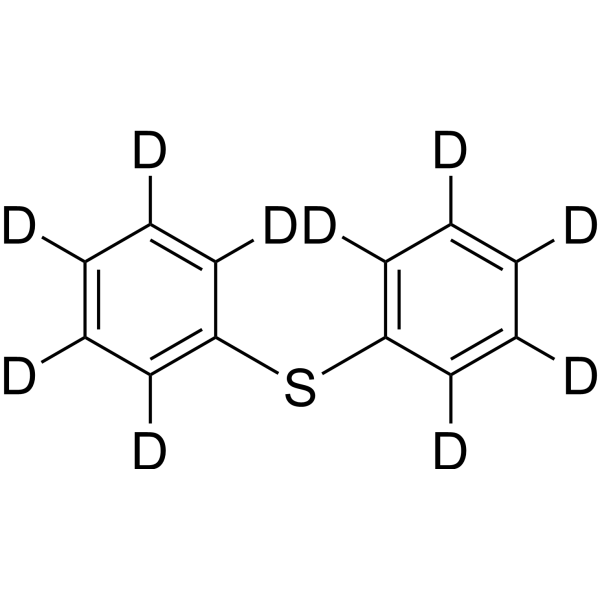
Diphenyl sulfide-d1 is the d1-labeled Diphenyl sulfide (HY-W016174). Diphenyl sulfide is an additive for organic photovoltaic devices. Diphenyl sulfide modulates vertical composition distribution of PTB7-Th:PC71BM photoactive layers, promoting enrichment of PTB7-Th at the upper surface and PC71BM at the bottom. Diphenyl sulfide promotes ordered molecular packing and crystallinity of PTB7-Th:PC71BM photoactive layers, including more compact π−π stacking of PTB7-Th. Diphenyl sulfide improves exciton dissociation, charge transport, and charge collection in PTB7-Th:PC71BM-based inverted polymer solar cells. Diphenyl sulfide acts as a solvent additive to improve the photovoltaic performance of inverted organic photovoltaic devices .
loading...
    loading...
Cat. No.: HY-157235
Research Areas:  

Inflammation/Immunology

AC Antibody affinity resin is AC commonly used packing. AC Antibody affinity resin has highly cross-linked agarose matrix with 85 μm of average particle size. AC Antibody affinity resin has alkali-resistant protein A derivative (E. coli) ligand. AC Antibody affinity resin can be used for antibody affinity chromatography .
loading...
    loading...
Cat. No.: HY-D3090
CAS No.: 2757682-04-3
Target:  

Fluorescent Dye

Research Areas:  

Others

NRLD is a lipid droplet-targeting solvatochromic fluorescent probe developed based on Nile Red (HY-D0718), which can target lipid droplets and sense the non-polar lipid microenvironment inside lipid droplets. NRLD exhibits superior lipid droplet-targeting selectivity compared to the parent Nile Red dye in HeLa cell imaging. NRLD achieves detection relying on the solvatochromic effect generated by excited-state charge transfer, and its emission wavelength shifts according to the local polarity changes of the microenvironment it locates in: the more compact and ordered the lipid packing and the lower the environmental polarity, the more blue-shifted the emission; the looser the lipid packing or the stronger the hydration and the higher the environmental polarity, the more red-shifted the emission. NRLD shows blue shift in the non-polar oil core of lipid droplets and red shift in high-polarity environments such as phosphate buffer .
loading...
    loading...
Cat. No.: HY-W016174
CAS No.: 139-66-2
Research Areas:  

Others

Diphenyl sulfide is an additive for organic photovoltaic devices. Diphenyl sulfide modulates vertical composition distribution of PTB7-Th:PC71BM photoactive layers, promoting enrichment of PTB7-Th at the upper surface and PC71BM at the bottom. Diphenyl sulfide promotes ordered molecular packing and crystallinity of PTB7-Th:PC71BM photoactive layers, including more compact π−π stacking of PTB7-Th. Diphenyl sulfide improves exciton dissociation, charge transport, and charge collection in PTB7-Th:PC71BM-based inverted polymer solar cells. Diphenyl sulfide acts as a solvent additive to improve the photovoltaic performance of inverted organic photovoltaic devices .
loading...
    loading...
  • 1

