5 Results for "

physiological experiments

" in MedChemExpress (MCE) Product Catalog:
Products (5)

5 Results for "physiological experiments" in MCE Product Catalog:

Cat. No.: HY-137875
CAS No.: 207386-83-2
Purity:  98.60%
Synonyms: N-Benzoyl-Gly-His-Leu hydrate
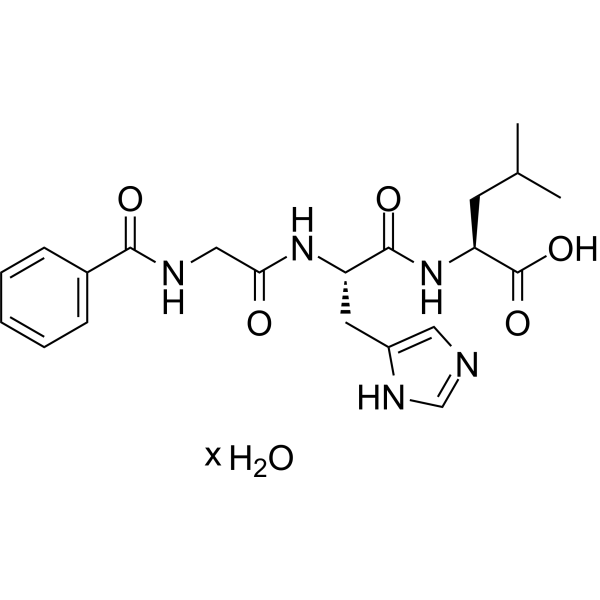
Hippuryl-His-Leu-OH (N-Benzoyl-Gly-His-Leu) hydrate is a specific substrate for angiotensin-converting enzyme ACE I and is a molecular tool used for ACE activity detection in in vitro experiments. Hippuryl-His-Leu-OH hydrate is hydrolyzed by ACE through competitive binding. Under ACE catalysis, Hippuryl-His-Leu-OH hydrate undergoes hydrolysis to produce hippuric acid (HA). The amount of HA produced can be used to quantitatively assess ACE activity or screen for ACE inhibitors. The His-Leu released from Hippuryl-His-Leu-OH hydrate can also react with o-phthalaldehyde or Fluorescamine (HY-D0715) for fluorescence detection. Hippuryl-His-Leu-OH hydrate can be applied to the in vitro screening of ACE inhibitors for hypertension and cardiovascular diseases, and is also used in the study of changes in ACE activity during physiological and pathological processes such as renal compensatory hypertrophy .
loading...
    loading...
Cat. No.: HY-P4551
CAS No.: 31373-65-6
Synonyms: N-Benzoyl-Gly-His-Leu
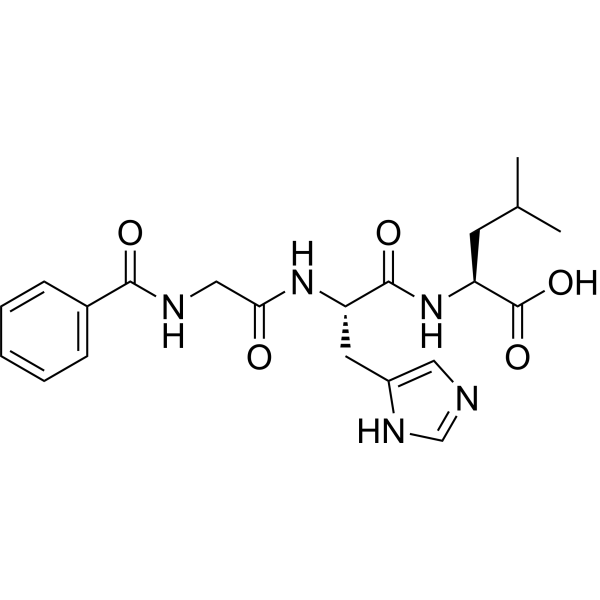
Hippuryl-His-Leu-OH (N-Benzoyl-Gly-His-Leu) is a specific substrate for angiotensin-converting enzyme (ACE I) and a molecular tool used for ACE activity detection in in vitro experiments. Hippuryl-His-Leu-OH is hydrolyzed by ACE through competitive binding. Under ACE catalysis, Hippuryl-His-Leu-OH undergoes hydrolysis to produce hippuric acid (HA). The amount of HA produced can be used to quantitatively assess ACE activity or screen for ACE inhibitors. The released His-Leu can also react with o-phthalaldehyde or Fluorescamine (HY-D0715) for fluorescence detection. Hippuryl-His-Leu-OH can be applied to the in vitro screening of ACE inhibitors for hypertension and cardiovascular diseases, and is also used in the study of ACE activity changes in physiological and pathological processes such as renal compensatory hypertrophy .
loading...
    loading...
Cat. No.: HY-155224
CAS No.: 61142-90-3
Synonyms: Sulfi/NO
Target:  

NO Synthase

Research Areas:  

Others

Sulpho NONOate (Sulfi/NO) does not produce NO at physiological pH. Sulpho NONOate can be used in the experiments about other NO-donor regents as a negative control .
loading...
    loading...
Cat. No.: HY-173283
Target:  

Fungal

Research Areas:  

Infection

Antifungal agent 129 (Compound 4g) is an inhibitor targeting Rhizoctonia solani, with an EC50 value of 4.27 mg/L. It has a good control effect against rice sheath blight in in vitro and in vivo experiments. Preliminary exploration through scanning electron microscopy, molecular docking, enzyme activity determination, and cytotoxicity experiments has revealed that Antifungal agent 129 may exert its inhibitory activity by affecting the cell structure or physiological processes of Rhizoctonia solani. Antifungal agent 129 can be used in the research of plant diseases in the agricultural field, such as rice sheath blight, which are caused by Rhizoctonia solani .
loading...
    loading...
Cat. No.: HY-127119
CAS No.: 525-02-0
Target:  

Endogenous Metabolite

Research Areas:  

Neurological Disease

Benanserin hydrochloride is a serotonin antagonist with psychopharmacological activity. Benanserin hydrochloride can be used to study specific behavioral manifestations in monitoring systems for drug effects. The effects of Benanserin hydrochloride can be sensitively and effectively assessed, for example, by measuring muscle movement capacity and reaction time. Benanserin hydrochloride is suitable for monitoring specific muscle physiological changes. The biological activity of Benanserin hydrochloride can provide reproducible bioassay parameters for experiments .
loading...
    loading...

