7 Results for "

tryptamine alkaloid

" in MedChemExpress (MCE) Product Catalog:
Products (7)

7 Results for "tryptamine alkaloid" in MCE Product Catalog:

2
2 Cited Publications
Cat. No.: HY-W014971
CAS No.: 343-94-2
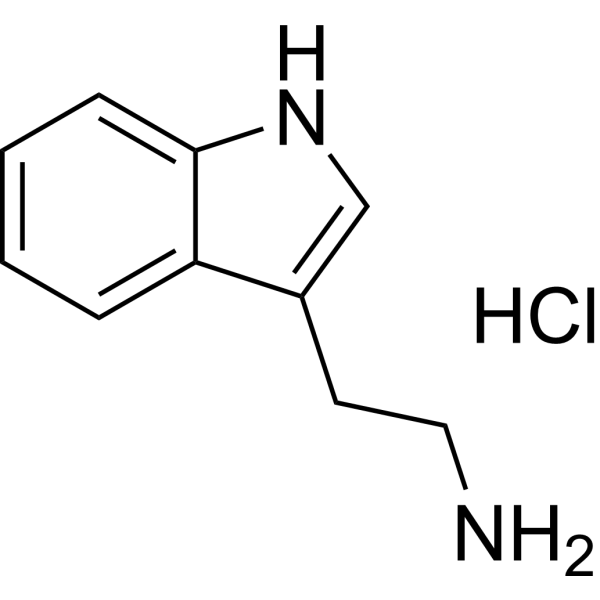
Tryptamine hydrochloride belongs to the class of indole alkaloids and is a derivative of the amino acid tryptophan. Tryptamine hydrochloride is psychoactive and acts as a neurotransmitter in the body, affecting mood, perception and cognition. In its hydrochloride form, Tryptamine hydrochloride hydrochloride, it is commonly used as a research chemical and as a starting material for the synthesis of other organic compounds. It can also occur naturally in certain plants and animals, including fungi and mammals. Due to the psychoactive properties of Tryptamine hydrochloride and its derivatives, its use and possession are controlled substances in many countries.
loading...
    loading...
Cat. No.: HY-B2132S1
CAS No.: 340257-60-5
Tryptamine-d4 (hydrochloride) is the deuterium labeled Tryptamine hydrochloride. Tryptamine hydrochloride, a monoamine alkaloid, similar to other trace amines, is believed to play a role as a neuromodulator or neurotransmitter .
loading...
    loading...
Cat. No.: HY-B2132R
CAS No.: 61-54-1
Synonyms: 3-(2-Aminoethyl)indole~2-(3-Indolyl)ethylamine (Standard)
Tryptamine (Standard) is the analytical standard of Tryptamine. This product is intended for research and analytical applications. Tryptamine is a monoamine alkaloid, similar to other trace amines, is believed to play a role as a neuromodulator or neurotransmitter.
loading...
    loading...
Cat. No.: HY-B2132S
CAS No.: 362049-48-7
Tryptamine-d2 (hydrochloride) is a deuterium labeled Tryptamine hydrochloride. Tryptamine hydrochloride is a monoamine alkaloid, similar to other trace amines, is believed to play a role as a neuromodulator or neurotransmitter .
loading...
    loading...
Cat. No.: HY-W014971S
CAS No.: 362049-49-8
Tryptamine-d2-1 hydrochloride is the deuterium labeled Tryptamine hydrochloride (HY-W014971). Tryptamine hydrochloride belongs to the class of indole alkaloids and is a derivative of the amino acid tryptophan. Tryptamine hydrochloride is psychoactive and acts as a neurotransmitter in the body, affecting mood, perception and cognition. In its hydrochloride form, Tryptamine hydrochloride hydrochloride, it is commonly used as a research chemical and as a starting material for the synthesis of other organic compounds. It can also occur naturally in certain plants and animals, including fungi and mammals. Due to the psychoactive properties of Tryptamine hydrochloride and its derivatives, its use and possession are controlled substances in many countries.
loading...
    loading...
Cat. No.: HY-N17973
CAS No.: 6879-55-6
(-)-Folicanthine is a dimeric tryptamine-related alkaloid found in the fruits of Chimonanthus praecox. (-)-Folicanthine shows cytotoxic against cancer cells. (-)-Folicanthine can be used for the research of cancer, such as gastric carcinoma and hepatocarcinoma .
loading...
    loading...
Cat. No.: HY-N20747
CAS No.: 28363-70-4
Synonyms: 4-Hydroxy-N-methyltryptamine; 4-HO-NMT
Norpsilocin (4-hydroxy-N-methyltrypt amine; 4-HO-NMT) is a natural tryptamine alkaloid isolated from the hallucinogenic mushroom Psilocybe cubensis. Norpsilocin activates human 5-HT2 receptors (5-HT2A: EC50 = 8.4 nM; 5-HT2B = 12.8 nM; 5-HT2C = 39.6 nM) and displays binding affinity toward 5-HT1 receptors (5-HT1B: Ki = 212 nM; 5-HT1D = 48.9 nM; 5-HT1E = 81.7 nM). Norpsilocin induces β-arrestin recruitment at the 5-HT1B receptor. Norpsilocin fails to produce psychedelic-like effects in mice, whereas high doses can induce hypothermia in vivo. Norpsilocin acts as an important research tool for exploring the structure–activity relationship of tryptamine hallucinogens and the pharmacology of serotonin receptors .
loading...
    loading...

