



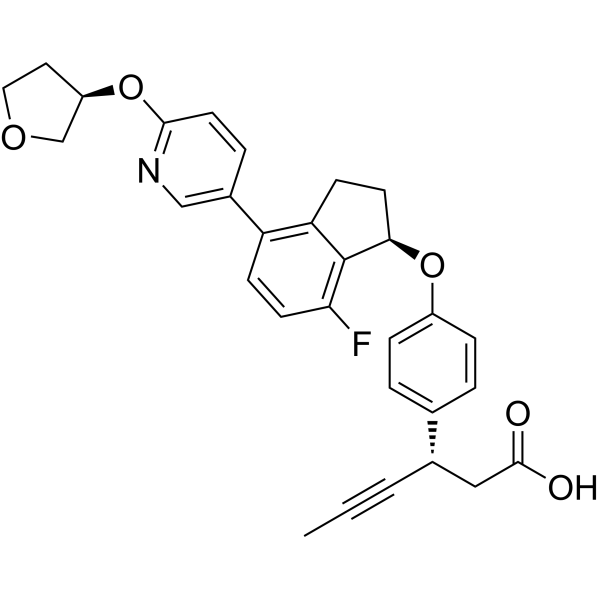
Xelaglifam
Xelaglifam is an orally active GPR40/FFAR1 agonist and PPARγ coactivator recruitment inhibitor (IC50 74.7 µM). Xelaglifam activates Gq/IP3/Ca2+ and β-arrestin, stimulates glucose-dependent insulin secretion from pancreatic β cells, improves glucose tolerance, reduces fasting hyperglycemia, protects pancreatic β cells, inhibits DP1, BSEP (IC50 14.3 µM), MRP2 (39.9 µM) and MRP4 (4.4 µM), activates FXR, regulates bile acid homeostasis, and modulates mitochondrial function, membrane potential and cellular ATP. Xelaglifam can be used for research on type 2 diabetes.
For research use only. We do not sell to patients.
- CAS No.: 2230597-99-4
- Formula: C30H28FNO5
- Molecular Weight:501.55
-
Storage:
Please store the product under the recommended conditions in the Certificate of Analysis.

To place orders, for customer services and technical support, please contact: MedChemExpress USA
Tel: 609-228-6898 E-mail: [email protected] [email protected]


-
 Biological Activity
-
Chemical Information
- Protocols
- Purity & Documentation
- References
-
 Help & FAQs


All Arrestin Isoforms
More

Biological Activity
Description
|
FFAR1 |
Gq |
GPR40 |
PPARγ 74.7 μM (IC50) |
IP3 |
β-arrestin |
DP1 |
BSEP 14.3 μM (IC50) |
MRP2 39.9 μM (IC50) |
MRP4 4.4 μM (IC50) |
FXR |
In Vitro
Xelaglifam selectively activates FFA1/GPR40 (EC50 0.020 μM) over FFA2, FFA3, and FFA4 (>10 μM)[1].
Xelaglifam (60 min at 37°C, 5% CO2) stimulates IP1 accumulation in CHO-K1 cells overexpressing human GPR40 with an EC50 of 0.8 nM[1].
Xelaglifam enhances β-arrestin 2 recruitment in DLD-1 cells overexpressing human GPR40 with an EC50 of 68.0 nM and an Emax of 99.4%[1].
Xelaglifam induces ERK activation in CHO-K1 cells overexpressing human GPR40 with an EC50 of 110.6 nM[1].
Xelaglifam activates calcium mobilization in CHO-K1 cells expressing human, rat, or monkey GPR40, with EC50 values of 114.3, 103.9, and 758.8 nM, respectively[1].
Xelaglifam inhibits BSEP, MRP2, and MRP4 in membrane vesicle assays with IC50 values of 14.3, 39.9, and 4.4 µM, respectively, and does not inhibit MRP3[2].
MedChemExpress (MCE) has not independently confirmed the accuracy of these methods. They are for reference only.
Parmacokinetics
| Species | Dose | Route | Tmax | Cmax | AUClast | AUC0-24 |
|---|---|---|---|---|---|---|
| Rat[2] | 30 mg/kg | p.o. | 4 h | 32.6 μg/mL | / | 236 μg·h/mL |
| Rat[2] | 30 mg/kg | p.o. | 1 h | 33.1 μg/mL | / | 250 μg·h/mL |
| Rat[2] | 100 mg/kg | p.o. | 4 h | 94.3 μg/mL | / | 1240 μg·h/mL |
| Rat[2] | 100 mg/kg | p.o. | 8 h | 89.1 μg/mL | / | 1300 μg·h/mL |
| Rat[2] | 300 mg/kg | p.o. | 4 h | 201 μg/mL | / | 2660 μg·h/mL |
| Rat[2] | 300 mg/kg | p.o. | 4 h | / | / | 2370 μg·h/mL |
| Monkey[2] | 10 mg/kg | p.o. | 2 h | 39200 ng/mL | 575000 ng·h/mL | / |
| Monkey[2] | 10 mg/kg | p.o. | 4 h | 24100 μg/mL | 341000 μg·h/mL | / |
| Monkey[2] | 20 mg/kg | p.o. | 2 h | 55800 ng/mL | 799000 ng·h/mL | / |
| Monkey[2] | 20 mg/kg | p.o. | 3 h | 64500 μg/mL | 891000 μg·h/mL | / |
| Monkey[2] | 40 mg/kg | p.o. | 2 h | 77300 ng/mL | 1120000 ng·h/mL | / |
| Monkey[2] | 40 mg/kg | p.o. | 3 h | 80400 μg/mL | 1310000 μg·h/mL | / |
In Vivo
Xelaglifam (3-30 mg/kg; oral; single administration) does not induce hypoglycemia in SD rats at doses up to 30 mg/kg[1].
Xelaglifam (0.1-1 mg/kg; oral; once daily for 2 weeks) dose-dependently improves glucose tolerance in SD rats[1].
Xelaglifam (0.3 mg/kg; oral; single administration) shows additive or synergistic glucose-lowering effects when combined with SGLT-2 inhibitors in SD rats[1].
Xelaglifam (0.2-20 mg/kg; oral; single administration) improves glucose tolerance in GK rats, with sustained effects at doses of 1 mg/kg and above[1].
Xelaglifam (0.3-3 mg/kg; oral; single administration) improves glucose tolerance in OLETF rats[1].
Xelaglifam (0.3-3 mg/kg; oral; once daily for 6 weeks) improves glucose tolerance, reduces fasting hyperglycemia, and increases insulin in OLETF rats[1].
Xelaglifam (1 mg/kg; oral; twice daily for 4 weeks) improves glucose tolerance and fasting blood glucose in ZDF rats while increasing HOMA-β[1].
Xelaglifam (1-10 mg/kg/day; oral; once daily for 6 weeks) increases pancreatic β-cell cluster area and number in ZDF rats[1].
MedChemExpress (MCE) has not independently confirmed the accuracy of these methods. They are for reference only.
-
Animal Model:Sprague-Dawley (male, 7-9 weeks old)[1]
-
Dosage:0.1, 0.3, 1, or 3 mg/kg
-
Administration:p.o.; single administration
-
Result:Administration at the dose of 3 or 10 mg/kg Fasiglifam (HY-10480) and 1 or 3 mg/kg Xelaglifam decreased blood glucose levels at 15, 30, and 60 min compared with vehicle.
The 0.3 mg/kg Xelaglifam group also showed a decrease at 15 and 30 min.
Blood glucose AUC (0-60 min) was reduced in all groups except Xelaglifam 0.1 mg/kg, with glucose tolerance improvement rates of 11.4%, 24.3%, 40.7%, or 53.0% for Xelaglifam at 0.1, 0.3, 1, or 3 mg/kg, respectively.
Insulin secretion over 15 min was increased in all groups, with 10 mg/kg Fasiglifam and 1 and 3 mg/kg Xelaglifam increasing insulin secretion and decreasing blood glucose.
-
Animal Model:Sprague-Dawley (male, 7-9 weeks old)[1]
-
Dosage:3 or 30 mg/kg
-
Administration:p.o.; single administration
-
Result:Xelaglifam at 3 or 30 mg/kg showed no difference in blood glucose compared with vehicle.
-
Animal Model:Sprague-Dawley (male, 7-9 weeks old)[1]
-
Dosage:0.1, 0.3, or 1 mg/kg
-
Administration:p.o.; once daily for 2 weeks
-
Result:In the 0.1, 0.3, or 1 mg/kg Xelaglifam groups, glucose tolerance improvement rates were 12.8%, 16.4%, or 20.1%, respectively, compared with control.
All groups exhibited a decrease in blood glucose AUC.
-
Animal Model:Sprague-Dawley (male, 7-9 weeks old)[1]
-
Dosage:0.3 mg/kg
-
Administration:p.o.; single administration
-
Result:In the intraperitoneal glucose tolerance test (IPGTT), the reduction in glucose AUC (0-120 min) was similar or greater by combination administration of Xelaglifam with SGLT-2 inhibitors than the sum of their respective glucose AUC (0-120 min) reductions in single-agent administration, indicating an additive effect.
Combination administration of Xelaglifam with SGLT-2 inhibitors resulted in a greater decrease in glucose AUC (0-120 min) than the sum of their respective effects, being significantly different from single-agent administration, which confirms a synergistic effect.
-
Animal Model:Goto-Kakizaki (male, 10 weeks old at start; experiments at 35, 43, or 48 weeks of age)[1]
-
Dosage:0.2, 1, 5, 10, or 20 mg/kg
-
Administration:p.o.; single administration
-
Result:1 mg/kg of Xelaglifam exhibited a similar blood glucose reduction effect (33.4% and 15.6% for 1 and 5 h OGTT, respectively) as 10 mg/kg Fasiglifam (29.1% and 13.7% for the 1 and 5 h OGTT, respectively).
Dose-dependent changes in blood glucose were observed in Xelaglifam groups (0.2-20 mg/kg), with Xelaglifam at 1 mg/kg and higher doses showing sustained glucose tolerance improvements.
-
Animal Model:Otsuka Long Evans Tokushima Fatty (male, 4 weeks old at arrival; hyperglycemia at 23 weeks of age)[1]
-
Dosage:0.3, 1, or 3 mg/kg
-
Administration:p.o.; single administration
-
Result:After single oral dosing, all groups exhibited decreased blood glucose at all time points.
The glucose tolerance improvement rates were 33.9%, 46.9%, or 53.7% for 0.3, 1, or 3 mg/kg Xelaglifam, respectively.
-
Animal Model:Otsuka Long Evans Tokushima Fatty (male, 4 weeks old at arrival; repeated dosing starting at 26 weeks of age)[1]
-
Dosage:0.3, 1, or 3 mg/kg
-
Administration:p.o.; once daily for 6 weeks
-
Result:After 6 weeks of repeated dosing, glucose tolerance improvement rates were 22.6%, 35.1%, and 44.1% for 0.3, 1, or 3 mg/kg Xelaglifam, respectively.
Showed a better glucose-lowering effect at a 30-fold lower dose.
Fasting blood glucose measurements at day 44 showed a decrease of 30% in the Xelaglifam 1 mg/kg group, with a 3-4-fold increase in fasting blood insulin and an increase in HOMA-β.
After 6 weeks of repeated dosing in OLETF rats, fasting insulin levels increased approximately 4-fold over vehicle.
-
Animal Model:Zucker Diabetic Fatty (male, 8 weeks old at study start; ZL rats as controls)[1]
-
Dosage:1 mg/kg
-
Administration:p.o.; twice daily for 4 weeks
-
Result:The AUC for glucose tolerance of Xelaglifam was reduced by 34%, respectively, compared with vehicle.
Fasting blood glucose of Fasiglifam and Xelaglifam was significantly reduced by 14.5% and 18.3%, respectively.
HOMA-β increased 2-fold, and fasting blood insulin levels showed a trend toward a 21% increase.
-
Animal Model:Zucker Diabetic Fatty (male, 5 weeks old at arrival; divided at 8 weeks of age)[1]
-
Dosage:1 or 10 mg/kg/day
-
Administration:p.o.; once daily for 6 weeks
-
Result:The area of microscopic β-cell clusters increased by 53.8% and 55.1% in Xelaglifam 1 and 10 mg/kg/day groups, respectively, compared with control.
The number of microscopic β-cell clusters increased by 13.7% and 27% in Xelaglifam 1 and 10 mg/kg/day groups, respectively.
Positive staining for anti-insulin antibodies tended to increase in Xelaglifam groups.
-
Animal Model:ob/ob (leptin-deficient; male, 5 weeks of age at start)[2]
-
Dosage:0.2 mg/kg/day; 1 mg/kg/day; 5 mg/kg/day; 25 mg/kg/day
-
Administration:oral gavage; once daily; 12 weeks
-
Result:The administration of Xelaglifam for 12 weeks resulted in a dose-dependent reduction in HbA1c levels, with Xelaglifam 25 mg/kg showing a significant reduction from 4 weeks.
Clinical Trial
| NCT Number | Sponsor | Condition | Start Date |
Phase

|
|---|---|---|---|---|
| NCT01329991 | Plexxikon| | 2011-05 | PHASE1 |


Chemical Information
-
CAS No. 2230597-99-4
-
Molecular Weight 501.55
-
Formula C30H28FNO5
-
SMILES
FC1=C(C(CC2)=C(C3=CN=C(O[C@@H]4CCOC4)C=C3)C=C1)[C@@H]2OC5=CC=C(C=C5)[C@@H](C#CC)CC(O)=O
-
Synonyms
IDG-16177
-
Shipping
Room temperature in continental US; may vary elsewhere.
-
Storage
Please store the product under the recommended conditions in the Certificate of Analysis.


Purity & Documentation
References

Calculators
Concentration (start) × Volume (start) = Concentration (final) × Volume (final)


Xelaglifam Related Classifications
HY-147420 Related Classifications
 Powered by Bioz