



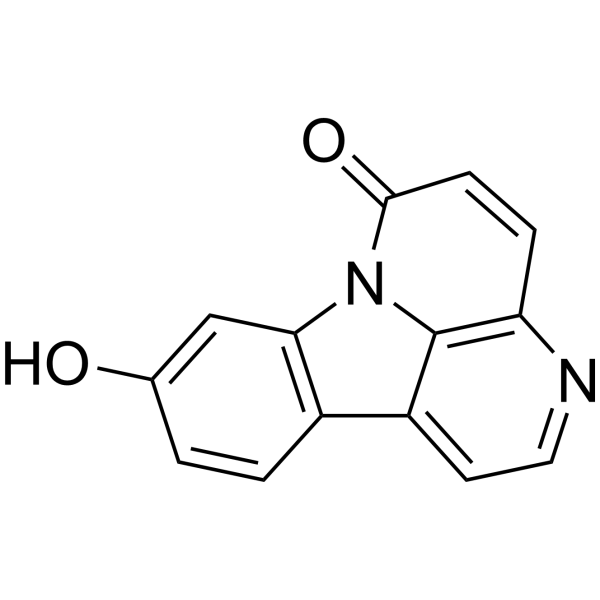
9-Hydroxycanthin-6-one
9-Hydroxycanthin-6-one is a β-carboline alkaloid. 9-Hydroxycanthin-6-one can be isolated from the roots of E. longifolia. 9-Hydroxycanthin-6-one inhibits TNF-α-induced activation of the NF-κB pathway. 9-Hydroxycanthin-6-one activates GSK3β independently of CK1α, drives phosphorylation and degradation of β-catenin, and inhibits the Wnt signaling pathway. 9-Hydroxycanthin-6-one exerts selective cytotoxicity against Wnt-dependent colon cancer cells. 9-Hydroxycanthin-6-one can be used in studies related to colon cancer.
For research use only. We do not sell to patients.
- CAS No.: 138544-91-9
- Formula: C14H8N2O2
- Molecular Weight:236.23
-
Storage:
4°C, protect from light
* In solvent : -80°C, 6 months; -20°C, 1 month (protect from light)

To place orders, for customer services and technical support, please contact: MedChemExpress USA
Tel: 609-228-6898 E-mail: [email protected] [email protected]


-
 Biological Activity
-
Chemical Information
-
Solvent & Solubility
- Protocols
- Purity & Documentation
- References
-
 Help & FAQs


Biological Activity
Description
IC50 & Target
[1]|
GSK3β |
Cellular Effect
|
Cell Line

|
Type | Value | Description | References |
|---|---|---|---|---|
| A549 | ED50 |
10 μg/mL
Compound: 9-hydroxycanthin-6-one
|
Cytotoxicity against human A549 cells by SRB assay
Cytotoxicity against human A549 cells by SRB assay
|
[PMID: 14575431] |
| Breast carcinoma cell | IC50 |
1.5 μg/mL
Compound: 31
|
Cytotoxicity against human Breast cancer cell
Cytotoxicity against human Breast cancer cell
|
[PMID: 34332400] |
| Calu-3 | CC50 |
>100 μM
Compound: Table 1, R10C2
|
Cytotoxicity against human Calu-3 cells assessed as reduction in cell viability incubated for 48 hrs by PrestoBlue reagent based assay
Cytotoxicity against human Calu-3 cells assessed as reduction in cell viability incubated for 48 hrs by PrestoBlue reagent based assay
|
[PMID: 36399766] |
| Cancer cell lines | ED50 |
2.6 μg/mL
Compound: 3
|
Cytotoxicity against human breast cancer cells
Cytotoxicity against human breast cancer cells
|
[PMID: 1800638] |
| Cancer cell lines | ED50 |
3.8 μg/mL
Compound: 3
|
Cytotoxicity against human lung cancer cells
Cytotoxicity against human lung cancer cells
|
[PMID: 1800638] |
| Cancer cell lines | ED50 |
4.8 μg/mL
Compound: 3
|
Cytotoxicity against human colon cancer cells
Cytotoxicity against human colon cancer cells
|
[PMID: 1800638] |
| Colon cancer cell line | IC50 |
1.5 μg/mL
Compound: 31
|
Cytotoxicity against human Colon cancer cell line
Cytotoxicity against human Colon cancer cell line
|
[PMID: 34332400] |
| DLD-1 | IC50 |
>40 μM
Compound: 1
|
Cytotoxicity against Wnt-dependent human DLD1 cells assessed as cell viability after 24 hrs by fluorescence assay
Cytotoxicity against Wnt-dependent human DLD1 cells assessed as cell viability after 24 hrs by fluorescence assay
|
[PMID: 25905468] |
| Fibrosarcoma cell line | IC50 |
1.5 μg/mL
Compound: 31
|
Cytotoxicity against human Fibrosarcoma cell line
Cytotoxicity against human Fibrosarcoma cell line
|
[PMID: 34332400] |
| HCT-116 | IC50 |
30 μM
Compound: 1
|
Cytotoxicity against Wnt-dependent human HCT116 cells assessed as cell viability after 24 hrs by fluorescence assay
Cytotoxicity against Wnt-dependent human HCT116 cells assessed as cell viability after 24 hrs by fluorescence assay
|
[PMID: 25905468] |
| HCT-8 | CC50 |
60.88 μM
Compound: Table 1, R10C2
|
Cytotoxicity against human HCT-8 cells assessed as redcution in cell viability incubated for 96 hrs by PrestoBlue reagent based assay
Cytotoxicity against human HCT-8 cells assessed as redcution in cell viability incubated for 96 hrs by PrestoBlue reagent based assay
|
[PMID: 36399766] |
| HEK293 | IC50 |
36.7 μM
Compound: 1
|
Cytotoxicity against HEK293 cells assessed as cell viability after 24 hrs by fluorescence assay
Cytotoxicity against HEK293 cells assessed as cell viability after 24 hrs by fluorescence assay
|
[PMID: 25905468] |
| HEK293 | IC50 |
6.8 μM
Compound: 1
|
Activation of GSK-3beta in HEK293 cells assessed as suppression of TCF/beta-catenin transcriptional activity after 24 hrs by SuperTOPFlash reporter gene assay
Activation of GSK-3beta in HEK293 cells assessed as suppression of TCF/beta-catenin transcriptional activity after 24 hrs by SuperTOPFlash reporter gene assay
|
[PMID: 25905468] |
| HEK-293T | IC50 |
>40 μM
Compound: 1
|
Cytotoxicity against HEK293T cells assessed as cell viability after 24 hrs by fluorescence assay
Cytotoxicity against HEK293T cells assessed as cell viability after 24 hrs by fluorescence assay
|
[PMID: 25905468] |
| HepG2 | CC50 |
>100 μM
Compound: Table 1, R10C2
|
Cytotoxicity against human HepG2 cells assessed as reduction in cell viability incubated for 48 hrs by PrestoBlue reagent based assay
Cytotoxicity against human HepG2 cells assessed as reduction in cell viability incubated for 48 hrs by PrestoBlue reagent based assay
|
[PMID: 36399766] |
| KB | ED50 |
2 μg/mL
Compound: 3
|
Cytotoxicity against human KB cells
Cytotoxicity against human KB cells
|
[PMID: 1800638] |
| KB | IC50 |
1.5 μg/mL
Compound: 31
|
Cytotoxicity against human Vincristine-resistant KB cells
Cytotoxicity against human Vincristine-resistant KB cells
|
[PMID: 34332400] |
| KB-V1 | ED50 |
>20 μg/mL
Compound: 3
|
Cytotoxicity against human KBV1 cells
Cytotoxicity against human KBV1 cells
|
[PMID: 1800638] |
| Lung cancer cell line | IC50 |
1.5 μg/mL
Compound: 31
|
Cytotoxicity against human Lung cancer cell line
Cytotoxicity against human Lung cancer cell line
|
[PMID: 34332400] |
| MCF7 | ED50 |
19.6 μg/mL
Compound: 9-hydroxycanthin-6-one
|
Cytotoxicity against human MCF7 cells by SRB assay
Cytotoxicity against human MCF7 cells by SRB assay
|
[PMID: 14575431] |
| Melanoma cell | ED50 |
5.4 μg/mL
Compound: 3
|
Cytotoxicity against human melanoma cells
Cytotoxicity against human melanoma cells
|
[PMID: 1800638] |
| Melanoma cell line | IC50 |
1.5 μg/mL
Compound: 31
|
Cytotoxicity against human Melanoma cell line
Cytotoxicity against human Melanoma cell line
|
[PMID: 34332400] |
| MRC5 | CC50 |
>100 μM
Compound: Table 1, R10C2
|
Cytotoxicity against human MRC5 cells assessed as reduction in cell viability incubated for 48 hrs by PrestoBlue reagent based assay
Cytotoxicity against human MRC5 cells assessed as reduction in cell viability incubated for 48 hrs by PrestoBlue reagent based assay
|
[PMID: 36399766] |
| P388 | ED50 |
1.5 μg/mL
Compound: 3
|
Cytotoxicity against mouse P388 cells
Cytotoxicity against mouse P388 cells
|
[PMID: 1800638] |
| RKO | IC50 |
>40 μM
Compound: 1
|
Cytotoxicity against Wnt-independent human RKO cells assessed as cell viability after 24 hrs by fluorescence assay
Cytotoxicity against Wnt-independent human RKO cells assessed as cell viability after 24 hrs by fluorescence assay
|
[PMID: 25905468] |
| SW480 | IC50 |
17.4 μM
Compound: 1
|
Cytotoxicity against Wnt-independent human SW480 cells assessed as cell viability after 24 hrs by fluorescence assay
Cytotoxicity against Wnt-independent human SW480 cells assessed as cell viability after 24 hrs by fluorescence assay
|
[PMID: 25905468] |
| Vero | CC50 |
>100 μM
Compound: Table 1, R10C2
|
Cytotoxicity against African green monkey Vero cells assessed as reduction in cell viability incubated for 48 hrs by PrestoBlue reagent based assay
Cytotoxicity against African green monkey Vero cells assessed as reduction in cell viability incubated for 48 hrs by PrestoBlue reagent based assay
|
[PMID: 36399766] |
In Vitro
9-Hydroxycanthin-6-one (3.8-30 μM; 30 min pretreatment, 4 h TNF-α stimulation) potently inhibits TNF-α-induced NF-κB activation in HEK-293/NF-κB-luc cells with an IC50 of 3.8 μM, and exhibits no cytotoxicity at 30 μM[1].
9-Hydroxycanthin-6-one (5-20 μM; 24 h) potently and selectively inhibits TCF/β-catenin transcriptional activity in STF/293 cells with an IC50 of 6.8 μM, while preserving high cell viability[2].
9-Hydroxycanthin-6-one (24 h) selectively inhibits the viability of Wnt-dependent human colon cancer cells (SW480, HCT116) with IC50 values of 17.4 μM and 30.0 μM, respectively, while sparing Wnt-independent and noncancer cell lines[2].
9-Hydroxycanthin-6-one (10-30 μM; 24 h) dose-dependently reduces total β-catenin levels (in whole cell, cytosolic, and nuclear fractions) and increases β-catenin phosphorylation at GSK3β target sites (Ser33/Ser37/Thr41) in SW480 cells, without altering CK1α-mediated β-catenin phosphorylation or total GSK3β/CK1α levels[2].
9-Hydroxycanthin-6-one (30 μM; 24 h post-siRNA transfection) inhibits Wnt signaling in SW480 cells through GSK3β activation independent of CK1α, as it reduces β-catenin and increases GSK3β-mediated β-catenin phosphorylation even when CK1α is knocked down[2].
MedChemExpress (MCE) has not independently confirmed the accuracy of these methods. They are for reference only.
-
Cell Line:SW480 cells
-
Concentration:10, 20, 30 μM
-
Incubation Time:24 h
-
Result:Dose-dependently decreased total β-catenin protein levels in whole cellular, cytosolic, and nuclear fractions.
Dose-dependently increased phosphorylated β-catenin at Ser33/Ser37/Thr41 (GSK3β phosphorylation sites).
Had no effect on phosphorylated β-catenin at Ser45 (CK1α phosphorylation site) or total GSK3β/CK1α protein levels.
-
Cell Line:SW480 cells
-
Concentration:30 μM
-
Incubation Time:24 h (post-siRNA transfection)
-
Result:Decreased β-catenin levels and increased phosphorylated β-catenin at Ser33/Ser37/Thr41 in cells transfected with control siRNA.
Attenuated reduction in β-catenin levels in cells transfected with GSK3β siRNA.
Decreased phosphorylated GSK3β at Ser9 (inactive form) protein levels.\nDecreased β-catenin levels and increased phosphorylated β-catenin at Ser33/Ser37/Thr41 in both control siRNA-transfected and CK1α siRNA-transfected cells.
Decreased phosphorylated GSK3β at Ser9 levels in CK1α siRNA-transfected cells.
In Vivo
MedChemExpress (MCE) has not independently confirmed the accuracy of these methods. They are for reference only.
-
Animal Model:TOPdGFP transgenic strain; wild-type AB strain (embryos)[2]
-
Dosage:300 μM (TOPdGFP activity, Wnt target gene expression, pigment cell assessment); 100 μM (eyeless phenotype rescue)
-
Administration:immersion in E3 medium; 10 hpf to 24 hpf (TOPdGFP activity); immersion in E3 medium; 4 hpf to 24 hpf (Wnt target gene expression); immersion in E3 medium; 4 hpf to 30 hpf (pigment cell assessment); immersion in E3 medium; 4 hpf to 30 hpf, co-administered with 0.5 μM BIO (eyeless phenotype rescue)
-
Result:Reduced TOPdGFP activity in the midbrain tectum of 24 hpf embryos without inducing excess cell death (control MO group: 100% activity, n=10; p53 MO group: 100% activity, n=10).
Reduced zic2a expression in the midbrain tectum of 24 hpf embryos (control MO group: 55% expression, n=6; p53 MO group: 54% expression, n=7).
Reduced mitf expression in neural-crest cells of 24 hpf embryos (control MO group: 50% expression, n=7; p53 MO group: 60% expression, n=9).
Reduced the number of pigment cells in the tails of 30 hpf embryos (100% reduction, n=10).
Rescued the eyeless phenotype induced by 0.5 μM BIO in 30 hpf embryos, with 46% showing fully rescued eyes (n=6) and 54% showing slightly rescued eyes (n=7).


Chemical Information
-
CAS No. 138544-91-9
-
Appearance Solid
-
Molecular Weight 236.23
-
Formula C14H8N2O2
-
Color Light yellow to yellow
-
SMILES
O=C1N2C3=C(N=CC=C3C4=C2C=C(O)C=C4)C=C1
-
Structure Classification
-
Initial Source
-
Shipping
Room temperature in continental US; may vary elsewhere.
-
Storage
4°C, protect from light
* In solvent : -80°C, 6 months; -20°C, 1 month (protect from light)


Solvent & Solubility
In Vitro:
DMSO : 10 mg/mL (42.33 mM; Need ultrasonic; Hygroscopic DMSO has a significant impact on the solubility of product, please use newly opened DMSO)
Please refer to the solubility information to select the appropriate solvent. Once prepared, please aliquot and store the solution to prevent product inactivation from repeated freeze-thaw cycles.
Storage method and period of stock solution: -80°C, 6 months; -20°C, 1 month (protect from light). When stored at -80°C, please use it within 6 months. When stored at -20°C, please use it within 1 month.
Concentration (start) × Volume (start) = Concentration (final) × Volume (final)
In Vivo:
Select the appropriate dissolution method based on your experimental animal and administration route.
- For the following dissolution methods, please ensure to first prepare a clear stock solution using an In Vitro approach and then sequentially add co-solvents:
- To ensure reliable experimental results, the clarified stock solution can be appropriately stored based on storage conditions. As for the working solution for In Vivo experiments, it is recommended to prepare freshly and use it on the same day.
- The percentages shown for the solvents indicate their volumetric ratio in the final prepared solution. If precipitation or phase separation occurs during preparation, heat and/or sonication can be used to aid dissolution.
Add each solvent one by one: 10% DMSO 40% PEG300 5% Tween-80 45% Saline
Solubility: 1 mg/mL (4.23 mM); Suspended solution; Need ultrasonic
This protocol yields a suspended solution of 1 mg/mL. Suspended solution can be used for oral and intraperitoneal injection.
Taking 1 mL working solution as an example, add 100 μL DMSO stock solution (10.0 mg/mL) to 400 μL PEG300, and mix evenly; then add 50 μL Tween-80 and mix evenly; then add 450 μL Saline to adjust the volume to 1 mL.
Preparation of Saline: Dissolve 0.9 g sodium chloride in ddH₂O and dilute to 100 mL to obtain a clear Saline solution.
In Vivo Dissolution Calculator
Please enter the basic information of animal experiments:
-
-
-
-
Recommended: Prepare an additional quantity of animals to account for potential losses during experiments.
Please enter your animal formula composition:
-
%DMSO +
Recommended: Keep the proportion of DMSO in working solution below 2% if your animal is weak.
-
%+
-
+%Tween-80 + +
-
%Saline +
The co-solvents required include: DMSO, . All of co-solvents are available by MedChemExpress (MCE). , Tween 80. All of co-solvents are available by MedChemExpress (MCE).
Working solution concentration: 0.22 mg/mL
Method for preparing stock solution: mg drug dissolved in μL DMSO. Stock solution concentration: mg/mL. * In solvent : -80°C, 6 months; -20°C, 1 month (protect from light)
1. Take μL DMSO stock solution;
2. Add μL .
μL , mix evenly;
3. Then add μL Tween 80, mix evenly;
4. Then add μL
Please ensure that the stock solution in the first step is dissolved to a clear state, and add co-solvents in sequence. You can use ultrasonic heating (ultrasonic cleaner, recommended frequency 20-40 kHz), vortexing, etc. to assist dissolution.


Purity & Documentation
-
Data Sheet (287 KB)
-
SDS (252 KB)
- English - EN (252 KB)
- Français - FR (252 KB)
- Deutsch - DE (252 KB)
- Norwegian - NO (252 KB)
- Español - ES (252 KB)
- Swedish - SV (252 KB)
- Italian - IT (252 KB)
- Korean - KR (252 KB)
- Portuguese - PT (252 KB)
-
Handling Instructions (2659 KB)
References
[1].
Thi Van Anh Tran, et al. NF-κB inhibitors from Eurycoma longifolia. J Nat Prod. 2014 Mar 28;77(3):483-8.
[Content Brief]
[2]. Ohishi K, et al. 9-Hydroxycanthin-6-one, a β-Carboline Alkaloid from Eurycoma longifolia, Is the First Wnt Signal Inhibitor through Activation of Glycogen Synthase Kinase 3β without Depending on Casein Kinase 1α. J Nat Prod. 2015 May 22;78(5):1139-46. [Content Brief]


Complete Stock Solution Preparation Table
Please refer to the solubility information to select the appropriate solvent. Once prepared, please aliquot and store the solution to prevent product inactivation from repeated freeze-thaw cycles.
Storage method and period of stock solution: -80°C, 6 months; -20°C, 1 month (protect from light). When stored at -80°C, please use it within 6 months. When stored at -20°C, please use it within 1 month.
| Optional Solvent | Concentration Solvent Mass | 1 mg | 5 mg | 10 mg | 25 mg |
|---|---|---|---|---|---|
| DMSO | 1 mM | 4.2332 mL | 21.1658 mL | 42.3316 mL | 105.8291 mL |
| 5 mM | 0.8466 mL | 4.2332 mL | 8.4663 mL | 21.1658 mL | |
| 10 mM | 0.4233 mL | 2.1166 mL | 4.2332 mL | 10.5829 mL | |
| 15 mM | 0.2822 mL | 1.4111 mL | 2.8221 mL | 7.0553 mL | |
| 20 mM | 0.2117 mL | 1.0583 mL | 2.1166 mL | 5.2915 mL | |
| 25 mM | 0.1693 mL | 0.8466 mL | 1.6933 mL | 4.2332 mL | |
| 30 mM | 0.1411 mL | 0.7055 mL | 1.4111 mL | 3.5276 mL | |
| 40 mM | 0.1058 mL | 0.5291 mL | 1.0583 mL | 2.6457 mL |


9-Hydroxycanthin-6-one Related Classifications
HY-N7183 Related Classifications
 Powered by Bioz