



DS21150768

Based on 1 Customer Validation
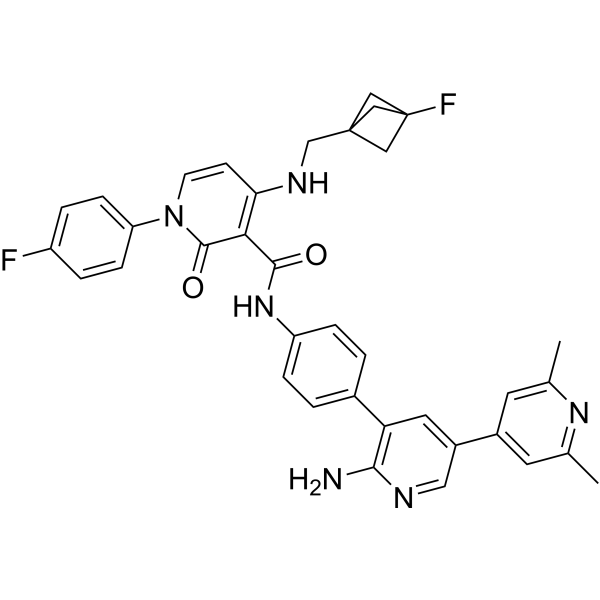
DS21150768 is an orally active HPK1 inhibitor with an IC50 of 3.27 nM against hHPK1. DS21150768 decreases pSLP76 levels and increases IL-2 levels. DS21150768 shows antitumor effects in multiple syngeneic mouse tumor models, and in combination with anti-PD-1 antibody enhances antitumor efficacy in multiple models. DS21150768 induces immune-related gene signatures in responsive tumor models.
For research use only. We do not sell to patients.
- Purity : 99.16%
- CAS No.: 3074816-62-6
- Formula: C36H32F2N6O2
- Molecular Weight:618.68
-
Storage:Powder -20°C, 3 years , 4°C, 2 years ; In solvent -80°C, 6 months , -20°C, 1 month

To place orders, for customer services and technical support, please contact: MedChemExpress USA
Tel: 609-228-6898 E-mail: [email protected] [email protected]


-
 Biological Activity
-
Chemical Information
-
Solvent & Solubility
- Protocols
- Purity & Documentation
- References
-
 Help & FAQs


All MAP4K Isoforms
More

Biological Activity
Description
IC50 & Target
[1]|
HPK1 3.27 nM (IC50) |
IL-2 |
Cellular Effect
|
Cell Line

|
Type | Value | Description | References |
|---|---|---|---|---|
| Jurkat | IC50 |
61.9 nM
|
Inhibition of anti-CD3/CD28-induced SLP76 phosphorylation in human Jurkat Clone E6-1 cells incubated 24 hrs then stimulated 60 mins, measured by AlphaLISA SureFire Ultra p-SLP-76 (Ser376) assay.
Inhibition of anti-CD3/CD28-induced SLP76 phosphorylation in human Jurkat Clone E6-1 cells incubated 24 hrs then stimulated 60 mins, measured by AlphaLISA SureFire Ultra p-SLP-76 (Ser376) assay.
|
37944847 |
In Vitro
DS21150768 (32-20,000 nM) binds human HPK1 with a KD of 6.08 nM and a dissociation half-life of 722 min[1].
DS21150768 (200 nM) inhibits 10 of 174 tested kinases by >50% and shows no >20% inhibition among highlighted TCR pathway kinases[1].
DS21150768 (0.1 μM; 4 h) exhibits >99.8% protein binding in male BALB/c mouse serum[1].
MedChemExpress (MCE) has not independently confirmed the accuracy of these methods. They are for reference only.
In Vivo
DS21150768 (100 mg/kg; oral; once every 2 days) alone produces 38% tumor growth inhibition in the B16-BL6 syngeneic tumor mouse model, and in combination with an anti-PD-1 antibody produces 29% tumor growth inhibition[1].
DS21150768 (100 mg/kg; oral; once every 2 days), both alone and in combination with an anti-PD-1 antibody, produces 18% tumor growth inhibition in the B16-F10 syngeneic tumor mouse model[1].
DS21150768 (100 mg/kg; oral; once every 2 days) alone produces 44% tumor growth inhibition in the CT26.WT syngeneic tumor mouse model, and in combination with an anti-PD-1 antibody produces 67% tumor growth inhibition[1].
DS21150768 (100 mg/kg; oral; once every 2 days) alone produces 33% tumor growth inhibition in the EMT6 syngeneic tumor mouse model, and in combination with an anti-PD-1 antibody produces 90% tumor growth inhibition[1].
DS21150768 (100 mg/kg; oral; once every 2 days) alone produces 21% tumor growth inhibition in the H22 syngeneic tumor mouse model, and in combination with an anti-PD-1 antibody produces 80% tumor growth inhibition[1].
DS21150768 (100 mg/kg; oral; once every 2 days) alone produces 36% tumor growth inhibition in the RM-1 syngeneic tumor model, and in combination with an anti-PD-1 antibody produces 43% tumor growth inhibition[1].
MedChemExpress (MCE) has not independently confirmed the accuracy of these methods. They are for reference only.
-
Animal Model:C57BL/6JJcl; HPK1-knockout (HPK1-KO) mice with a C57BL/6J background[1]
-
Dosage:30 mg/kg; 100 mg/kg
-
Administration:p.o.; single dose
-
Result:At 30 and 100 mg/kg, splenic pSLP76 was substantially reduced after 24 h, and suppression was maintained for 48 h.
At 30 mg/kg, IFN-γ was elevated in plasma and spleen.
At 100 mg/kg, both IL-2 and IFN-γ were increased.
The enhancement of plasma IFN-γ level was completely abrogated in HPK1-KO mice.
-
Animal Model:BALB/c[1]
-
Dosage:100 mg/kg
-
Administration:p.o.; once every 2 days
-
Result:Tumor growth inhibition (TGI) at endpoint for monotherapy was 10%.
Tumor growth inhibition (TGI) at endpoint for the combination with anti-PD-1 antibody was 20%.
-
Animal Model:C57BL/6[1]
-
Dosage:100 mg/kg
-
Administration:p.o.; once every 2 days
-
Result:Tumor growth inhibition (TGI) at endpoint for monotherapy was 38%.
Monotherapy significantly inhibited tumor growth.
Tumor growth inhibition (TGI) at endpoint for the combination with anti-PD-1 antibody was 29%.
-
Animal Model:C57BL/6[1]
-
Dosage:100 mg/kg
-
Administration:p.o.; once every 2 days
-
Result:Tumor growth inhibition (TGI) at endpoint for monotherapy was 18%.
Tumor growth inhibition (TGI) at endpoint for the combination with anti-PD-1 antibody was 18%.
-
Animal Model:BALB/c[1]
-
Dosage:100 mg/kg
-
Administration:p.o.; once every 2 days
-
Result:Tumor growth inhibition (TGI) at endpoint for monotherapy was 44%.
Monotherapy significantly inhibited tumor growth.
Tumor growth inhibition (TGI) at endpoint for the combination with anti-PD-1 antibody was 67%.
-
Animal Model:BALB/c[1]
-
Dosage:100 mg/kg
-
Administration:p.o.; once every 2 days
-
Result:Tumor growth inhibition (TGI) at endpoint for monotherapy was 33%.
Tumor growth inhibition (TGI) at endpoint for the combination with anti-PD-1 antibody was 90%.
-
Animal Model:BALB/c[1]
-
Dosage:100 mg/kg
-
Administration:p.o.; once every 2 days
-
Result:Tumor growth inhibition (TGI) at endpoint for monotherapy was 21%.
Tumor growth inhibition (TGI) at endpoint for the combination with anti-PD-1 antibody was 80%.
-
Animal Model:C57BL/6[1]
-
Dosage:100 mg/kg
-
Administration:p.o.; once every 2 days
-
Result:Tumor growth inhibition (TGI) at endpoint for monotherapy was 12%.
Tumor growth inhibition (TGI) at endpoint for the combination with anti-PD-1 antibody was 80%.
-
Animal Model:C57BL/6[1]
-
Dosage:100 mg/kg
-
Administration:p.o.; once every 2 days
-
Result:Tumor growth inhibition (TGI) at endpoint for monotherapy was 13%.
Tumor growth inhibition (TGI) at endpoint for the combination with anti-PD-1 antibody was 19%.
-
Animal Model:C57BL/6[1]
-
Dosage:100 mg/kg
-
Administration:p.o.; once every 2 days
-
Result:Tumor growth inhibition (TGI) at endpoint for monotherapy was 38%.
Monotherapy significantly inhibited tumor growth.
Tumor growth inhibition (TGI) at endpoint for the combination with anti-PD-1 antibody was 80%.
-
Animal Model:C57BL/6[1]
-
Dosage:100 mg/kg
-
Administration:p.o.; once every 2 days
-
Result:Tumor growth inhibition (TGI) at endpoint for monotherapy was 60%.
Monotherapy significantly inhibited tumor growth.
Tumor growth inhibition (TGI) at endpoint for the combination with anti-PD-1 antibody was 81%.
-
Animal Model:BALB/c[1]
-
Dosage:100 mg/kg
-
Administration:p.o.; once every 2 days
-
Result:Tumor growth inhibition (TGI) at endpoint for monotherapy was 44%.
Monotherapy significantly inhibited tumor growth.
Tumor growth inhibition (TGI) at endpoint for the combination with anti-PD-1 antibody was 50%.
-
Animal Model:C57BL/6[1]
-
Dosage:100 mg/kg
-
Administration:p.o.; once every 2 days
-
Result:Tumor growth inhibition (TGI) at endpoint for monotherapy was 36%.
Monotherapy significantly inhibited tumor growth.
Tumor growth inhibition (TGI) at endpoint for the combination with anti-PD-1 antibody was 43%.


Chemical Information
-
CAS No. 3074816-62-6
-
Appearance Solid
-
Molecular Weight 618.68
-
Formula C36H32F2N6O2
-
Color Off-white to light yellow
-
SMILES
FC1=CC=C(N2C(C(C(NC3=CC=C(C4=C(N)N=CC(C5=CC(C)=NC(C)=C5)=C4)C=C3)=O)=C(NCC6(C7)CC7(F)C6)C=C2)=O)C=C1
-
Shipping
Room temperature in continental US; may vary elsewhere.
-
Storage
Powder -20°C 3 years 4°C 2 years In solvent -80°C 6 months -20°C 1 month


Solvent & Solubility
In Vitro:
DMSO : 100 mg/mL (161.63 mM; Need ultrasonic; Hygroscopic DMSO has a significant impact on the solubility of product, please use newly opened DMSO)
Please refer to the solubility information to select the appropriate solvent. Once prepared, please aliquot and store the solution to prevent product inactivation from repeated freeze-thaw cycles.
Storage method and period of stock solution: -80°C, 6 months; -20°C, 1 month. When stored at -80°C, please use it within 6 months. When stored at -20°C, please use it within 1 month.
Concentration (start) × Volume (start) = Concentration (final) × Volume (final)
In Vivo:
Select the appropriate dissolution method based on your experimental animal and administration route.
- For the following dissolution methods, please ensure to first prepare a clear stock solution using an In Vitro approach and then sequentially add co-solvents:
- To ensure reliable experimental results, the clarified stock solution can be appropriately stored based on storage conditions. As for the working solution for In Vivo experiments, it is recommended to prepare freshly and use it on the same day.
- The percentages shown for the solvents indicate their volumetric ratio in the final prepared solution. If precipitation or phase separation occurs during preparation, heat and/or sonication can be used to aid dissolution.
Add each solvent one by one: 10% DMSO 90% (20% SBE-β-CD in Saline)
Solubility: ≥ 2.5 mg/mL (4.04 mM); Suspended solution
This protocol yields a suspended solution of ≥ 2.5 mg/mL (saturation unknown). Suspended solution can be used for oral and intraperitoneal injection.
Taking 1 mL working solution as an example, add 100 μL DMSO stock solution (25.0 mg/mL) to 900 μL 20% SBE-β-CD in Saline, and mix evenly.
Preparation of 20% SBE-β-CD in Saline (4°C, storage for one week): 2 g SBE-β-CD powder is dissolved in 10 mL Saline, completely dissolve until clear.
In Vivo Dissolution Calculator
Please enter the basic information of animal experiments:
-
-
-
-
Recommended: Prepare an additional quantity of animals to account for potential losses during experiments.
Please enter your animal formula composition:
-
%DMSO +
Recommended: Keep the proportion of DMSO in working solution below 2% if your animal is weak.
-
%+
-
+%Tween-80 + +
-
%Saline +
The co-solvents required include: DMSO, . All of co-solvents are available by MedChemExpress (MCE). , Tween 80. All of co-solvents are available by MedChemExpress (MCE).
Working solution concentration: 0.22 mg/mL
Method for preparing stock solution: mg drug dissolved in μL DMSO. Stock solution concentration: mg/mL.
1. Take μL DMSO stock solution;
2. Add μL .
μL , mix evenly;
3. Then add μL Tween 80, mix evenly;
4. Then add μL
Please ensure that the stock solution in the first step is dissolved to a clear state, and add co-solvents in sequence. You can use ultrasonic heating (ultrasonic cleaner, recommended frequency 20-40 kHz), vortexing, etc. to assist dissolution.


Purity & Documentation
-
Data Sheet (290 KB)
-
SDS (251 KB)
- English - EN (251 KB)
- Français - FR (251 KB)
- Deutsch - DE (251 KB)
- Norwegian - NO (251 KB)
- Español - ES (251 KB)
- Swedish - SV (251 KB)
- Italian - IT (251 KB)
- Korean - KR (251 KB)
- Portuguese - PT (251 KB)
-
Handling Instructions (2659 KB)
References


Complete Stock Solution Preparation Table
Please refer to the solubility information to select the appropriate solvent. Once prepared, please aliquot and store the solution to prevent product inactivation from repeated freeze-thaw cycles.
Storage method and period of stock solution: -80°C, 6 months; -20°C, 1 month. When stored at -80°C, please use it within 6 months. When stored at -20°C, please use it within 1 month.
| Optional Solvent | Concentration Solvent Mass | 1 mg | 5 mg | 10 mg | 25 mg |
|---|---|---|---|---|---|
| DMSO | 1 mM | 1.6163 mL | 8.0817 mL | 16.1634 mL | 40.4086 mL |
| 5 mM | 0.3233 mL | 1.6163 mL | 3.2327 mL | 8.0817 mL | |
| 10 mM | 0.1616 mL | 0.8082 mL | 1.6163 mL | 4.0409 mL | |
| 15 mM | 0.1078 mL | 0.5388 mL | 1.0776 mL | 2.6939 mL | |
| 20 mM | 0.0808 mL | 0.4041 mL | 0.8082 mL | 2.0204 mL | |
| 25 mM | 0.0647 mL | 0.3233 mL | 0.6465 mL | 1.6163 mL | |
| 30 mM | 0.0539 mL | 0.2694 mL | 0.5388 mL | 1.3470 mL | |
| 40 mM | 0.0404 mL | 0.2020 mL | 0.4041 mL | 1.0102 mL | |
| 50 mM | 0.0323 mL | 0.1616 mL | 0.3233 mL | 0.8082 mL | |
| 60 mM | 0.0269 mL | 0.1347 mL | 0.2694 mL | 0.6735 mL | |
| 80 mM | 0.0202 mL | 0.1010 mL | 0.2020 mL | 0.5051 mL | |
| 100 mM | 0.0162 mL | 0.0808 mL | 0.1616 mL | 0.4041 mL |


DS21150768 Related Classifications
HY-157149 Related Classifications
 Powered by Bioz