



FM 1-43FX

Based on 1 Customer Validation
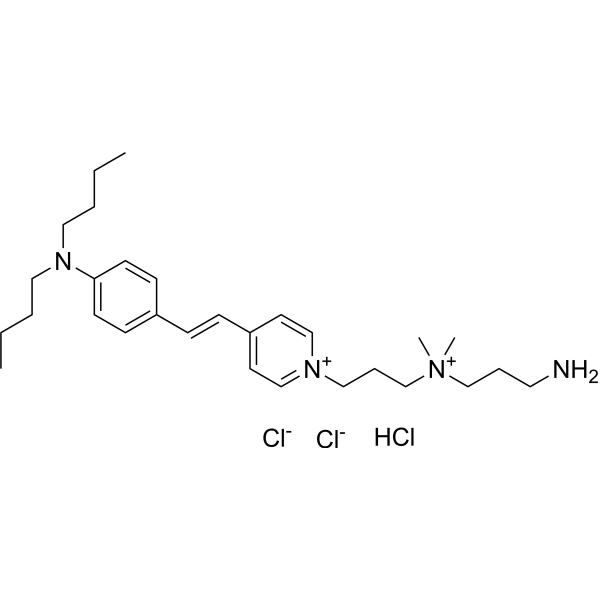
FM 1-43FX is a fluorescent styryl membrane dye that stains lipids green. FM 1-43FX labels extracellular vesicle lipid membranes, exosomes/microvesicles, and various sensory neurons through an endocytosis/vesicle recycling-dependent mechanism, and can label NFH-, calbindin-, and TH-positive mechanoreceptor subtypes. FM 1-43FX acts as a membrane-permeable MET channel blocker, partially inhibiting PIEZO1 and PIEZO2 currents in a voltage-dependent manner, and is used to assess cochlear/zebrafish MET function and detect fungal EV lipid transfer. FM 1-43FX can be used for research on progressive hearing loss.
For research use only. We do not sell to patients.
- Purity : 99.64%
- CAS No.: 1415018-97-1
- Formula: C29H49Cl3N4
- Molecular Weight:560.09
-
Storage:
-20°C, sealed storage, away from moisture and light
* In solvent : -80°C, 6 months; -20°C, 1 month (sealed storage, away from moisture and light)

To place orders, for customer services and technical support, please contact: MedChemExpress USA
Tel: 609-228-6898 E-mail: [email protected] [email protected]


-
 Biological Activity
-
Chemical Information
-
Solvent & Solubility
- Purity & Documentation
- References
-
 Help & FAQs


Biological Activity
Description
In Vitro
FM 1-43FX (100 ng/mL-10 mg/mL; incubated at 37°C in the dark for 10 min) enables quantification of exosomes derived from HEK293, Kuramochi, and Ovsaho cell lines by dedicated flow cytometry, with event counts comparable to protein-specific markers and linear dilution behavior[1].
FM 1-43FX (1 μM; 15 s) specifically labels Mir9614C>A/+ mouse cochlear hair cell explants and allows the collection of > 300 labeled cells per cochlea for downstream NGS[2].
FM 1-43FX (10 mM; 20 min) uptake is promoted by PIEZO2 activity in HEK P1KO cells, PIEZO2R2686H increases accumulation by 393% relative to WT, PIEZO1 loading is less robust than that of PIEZO2,
Ruthenium red (HY-103311) inhibits uptake with an IC50 value of 115-135 mM[3].
FM 1-43FX inhibits mechanically activated PIEZO currents in a voltage-dependent manner without altering the single-channel conductance of PIEZO1 in HEK P1KO and Neuro2A-P1ko cells expressing PIEZO1 and PIEZO2; in cell culture, PIEZO1 uptake of FM 1-43FX is also less robust than that of PIEZO2[3].
Uptake of FM 1-43FX is induced by Capsaicin (HY-10448) in cultured HEK cells expressing TRPV1, and TRPV1 overexpression alone permits partial FM 1-43FX permeation in the absence of channel-activating stimuli[3].
FM 1-43FX (30 µM) labels VSMC membrane extensions that penetrate the 7.5 µm Transwell pores and overlap with the EC membrane by more than 5 µm in mouse EC-VSMC Transwell co-cultures[4].
FM 1-43FX (5 µg/mL; incubated at 0°C for 5 min) labels the plasma membrane in MDA-MB-435 cells and colocalizes with SW107 under two-photon microscopy, supporting the plasma membrane localization of the sigma-2 receptor[6].
FM 1-43FX (3 μM; 30 s) uptake is significantly reduced in P30 Baiap2l2−/− cochlear OHCs and IHCs, indicating impaired MET function[7].
MedChemExpress (MCE) has not independently confirmed the accuracy of these methods. They are for reference only.
In Vivo
FM 1-43FX (10 µL/g, 200 µM; intraperitoneal injection; single injection) labeling of lanceolate endings in hindlimb skin is reduced by hair shaft removal[3].
FM 1-43FX (intraperitoneal simulation of intraperitoneal injection; single administration; bladder filling at 30 µL/min for 60 minutes) enhances labeling of urethral neurons in male mice due to bladder filling that induces urination[3].
MedChemExpress (MCE) has not independently confirmed the accuracy of these methods. They are for reference only.
-
Animal Model:C57BL/6J, HoxB8Cre+;Piezo2f/f, Phox2bCre+;Piezo2f/f (mixed sexes; 10-24 weeks)[3]
-
Dosage:1.12 mg/kg
-
Administration:i.p.; single injection
-
Result:At 24 h after i.p. administration, bright cell-body labeling was seen in DRGs; widespread DRG labeling was nearly absent from caudal DRGs in HoxB8Cre+;Piezo2f/f mice.
Quantification revealed a gradient of decreasing fluorescence in HoxB8Cre+;Piezo2f/f KO ganglia corresponding to the rostral-to-caudal gradient of HoxB8Cre expression.
In Phox2bCre+;Piezo2f/f mice, nodose neuronal cell-body labeling was virtually absent, whereas labeling in the adjacent jugular ganglion remained.
Aortic arch baroreceptor endings showed a subset of labeled neurons in WT mice; these endings were not labeled in Phox2bCre+;Piezo2f/f animals.
Cutaneous end-organ structures, including lanceolate, circumferential, and Merkel-cell neurite complexes, frequently labeled 24 h post i.p. injection in WT mice; labeling of terminal endings on hind-leg skin was absent in HoxB8Cre+;Piezo2f/f mice, though NFH-immunostained innervation remained.
At 48 h post-injection, 50.6% of NFH-positive DRGs showed uptake, 68.3% of calbindin-expressing neurons accumulated label, and 95% of TH-positive neurons were co-labeled; among labeled neurons, overlap was low with TRKA (0.6%), CGRP (3.3%), and IB4 (2.2%).
In hairy skin, 45% of signal overlapped with NFH, 51% of total NFH signal overlapped, 25% of total calbindin signal overlapped, and about 2.5% of labeling colocalized with CGRP; less than 1% of CGRP signal was positive for myelin-like labeling of Merkel-cell neurite afferents.
Terminal Schwann cell marker S100b showed minimal overlap, and no clearly labeled Schwann cell bodies were detected.
Time-course analysis showed baroreceptor ending labeling at the periphery before nodose cell bodies (1.5 vs 6 h), robust DRG cell-body labeling at 12 h, and bright labeling after 7 weeks.
Mice housed with touch stimuli accumulated more labeling in back and caudal regions than mice housed with no touch stimuli.
In the male pelvic urethra, WT mice showed 24 h neuronal labeling, while HoxB8Cre+;Piezo2f/f KO mice showed no neuronal labeling; urethral mean pixel intensity was lower in KO animals.
Tree-like urethral neurons were nearly all NFH positive, were not CGRP positive, and were still present in HoxB8Cre+;Piezo2f/f KO animals by immunostaining.
-
Animal Model:C57BL/6J (adult animals)[3]
-
Dosage:10 µL/g at 200 µM
-
Administration:i.p.; single injection
-
Result:Labeling of lanceolate endings was reduced in shaved and depilated hind-leg skin, whereas the hairy regions in the contralateral control leg displayed bright labeling.
At the border between hairy and depilated skin, lanceolate labeling was present in hairy skin immediately adjacent to unlabeled depilated skin.


Chemical Information
-
CAS No. 1415018-97-1
-
Appearance Solid
-
Molecular Weight 560.09
-
Formula C29H49Cl3N4
-
Color Orange to reddish brown
-
SMILES
NCCC[N+](C)(CCC[N+]1=CC=C(C=C1)/C=C/C2=CC=C(N(CCCC)CCCC)C=C2)C.[Cl-].Cl.[Cl-]
-
Shipping
Room temperature in continental US; may vary elsewhere.
-
Storage
-20°C, sealed storage, away from moisture and light
* In solvent : -80°C, 6 months; -20°C, 1 month (sealed storage, away from moisture and light)


Solvent & Solubility
In Vitro:
DMSO : 50 mg/mL (89.27 mM; Need ultrasonic; Hygroscopic DMSO has a significant impact on the solubility of product, please use newly opened DMSO)
Please refer to the solubility information to select the appropriate solvent. Once prepared, please aliquot and store the solution to prevent product inactivation from repeated freeze-thaw cycles.
Storage method and period of stock solution: -80°C, 6 months; -20°C, 1 month (sealed storage, away from moisture and light). When stored at -80°C, please use it within 6 months. When stored at -20°C, please use it within 1 month.
Concentration (start) × Volume (start) = Concentration (final) × Volume (final)


Purity & Documentation
-
Data Sheet (281 KB)
-
SDS (252 KB)
- English - EN (252 KB)
- Français - FR (252 KB)
- Deutsch - DE (252 KB)
- Norwegian - NO (252 KB)
- Español - ES (252 KB)
- Swedish - SV (252 KB)
- Italian - IT (252 KB)
- Korean - KR (252 KB)
- Portuguese - PT (252 KB)
-
Handling Instructions (2659 KB)
References


Complete Stock Solution Preparation Table
Please refer to the solubility information to select the appropriate solvent. Once prepared, please aliquot and store the solution to prevent product inactivation from repeated freeze-thaw cycles.
Storage method and period of stock solution: -80°C, 6 months; -20°C, 1 month (sealed storage, away from moisture and light). When stored at -80°C, please use it within 6 months. When stored at -20°C, please use it within 1 month.
| Optional Solvent | Concentration Solvent Mass | 1 mg | 5 mg | 10 mg | 25 mg |
|---|---|---|---|---|---|
| DMSO | 1 mM | 1.7854 mL | 8.9271 mL | 17.8543 mL | 44.6357 mL |
| 5 mM | 0.3571 mL | 1.7854 mL | 3.5709 mL | 8.9271 mL | |
| 10 mM | 0.1785 mL | 0.8927 mL | 1.7854 mL | 4.4636 mL | |
| 15 mM | 0.1190 mL | 0.5951 mL | 1.1903 mL | 2.9757 mL | |
| 20 mM | 0.0893 mL | 0.4464 mL | 0.8927 mL | 2.2318 mL | |
| 25 mM | 0.0714 mL | 0.3571 mL | 0.7142 mL | 1.7854 mL | |
| 30 mM | 0.0595 mL | 0.2976 mL | 0.5951 mL | 1.4879 mL | |
| 40 mM | 0.0446 mL | 0.2232 mL | 0.4464 mL | 1.1159 mL | |
| 50 mM | 0.0357 mL | 0.1785 mL | 0.3571 mL | 0.8927 mL | |
| 60 mM | 0.0298 mL | 0.1488 mL | 0.2976 mL | 0.7439 mL | |
| 80 mM | 0.0223 mL | 0.1116 mL | 0.2232 mL | 0.5579 mL |


FM 1-43FX Related Classifications
HY-D1765 Related Classifications
 Powered by Bioz