



GB111-NH2 hydrochloride

Based on 1 Customer Validation
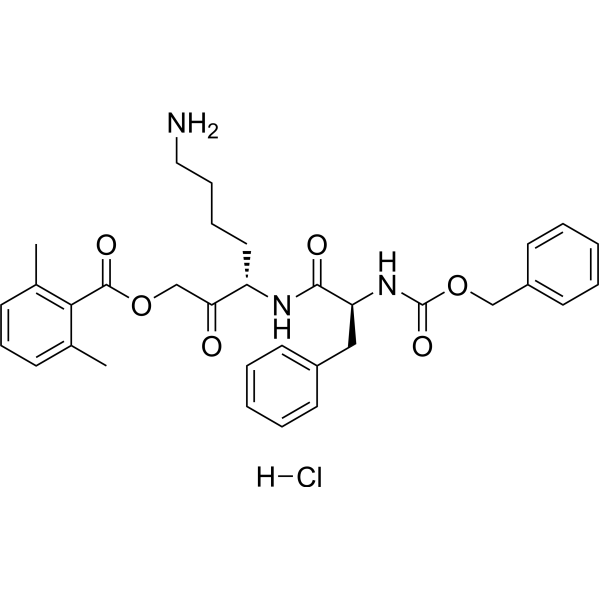
GB111-NH2 hydrochloride is a covalent cysteine cathepsin inhibitor. GB111-NH2 hydrochloride blocks cathepsin B/L/S activity, probe binding, and BMV109 signal in biopsy tissue. GB111-NH2 hydrochloride blocks brain cathepsin GB123 binding under ex vivo conditions. GB111-NH2 hydrochloride induces oxidative stress, autophagy inhibition, apoptosis, proliferation/S-phase entry, arginase activity, and non-autonomous apoptosis of neighboring tumor cells. GB111-NH2 hydrochloride reduces primary breast tumor volume, causes tumor regression, and alters macrophage morphology. GB111-NH2 hydrochloride restores marginal zone architecture and elevates lymphotoxin α (LTα) and splenic lymphotoxin β receptor (LTβR) signaling. GB111-NH2 hydrochloride can be used for research on chronic epilepsy, breast cancer, and atherosclerosis.
For research use only. We do not sell to patients.
- Purity : 98.41%
- Formula: C33H40ClN3O6
- Molecular Weight:610.14
-
Storage:
-20°C, sealed storage, away from moisture and light
* In solvent : -80°C, 6 months; -20°C, 1 month (sealed storage, away from moisture and light)

To place orders, for customer services and technical support, please contact: MedChemExpress USA
Tel: 609-228-6898 E-mail: [email protected] [email protected]


-
 Biological Activity
-
Chemical Information
-
Solvent & Solubility
- Protocols
- Purity & Documentation
- References
-
 Help & FAQs


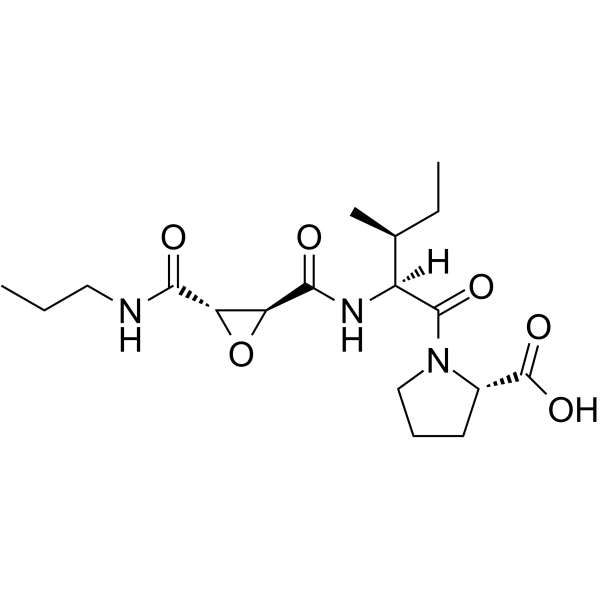
All Cathepsin Isoforms
More

Biological Activity
Description
In Vitro
GB111-NH2 hydrochloride (5 μM; 30 min) inhibits ex vivo cathepsin labeling in mouse brain lysates and in rat and human epileptic brain tissue sections[2].
GB111-NH2 hydrochloride (0.1-10 μM; 1 h) inhibits recombinant cathepsins B, L, and S more effectively than JPM-OEt (HY-102087)[4].
MedChemExpress (MCE) has not independently confirmed the accuracy of these methods. They are for reference only.
In Vivo
MedChemExpress (MCE) has not independently confirmed the accuracy of these methods. They are for reference only.
-
Animal Model:BALB/c (male, 3-4 weeks old)[1]
-
Dosage:40 mg/kg (5 h before T-GNP injection); 20 mg/kg (48 h after T-GNP injection)
-
Administration:intraperitoneal; twice; 5 h before and 48 h after T-GNP injection
-
Result:Resulted in lower tumor X-ray absorption/CT signal than T-GNP-ABP alone in 4T1 tumor-bearing mice.
Showed lower tumor signal by quantification of gold attenuation in CT scans and lower tumor gold accumulation by FAAS at 72 h.
-
Animal Model:BALB/c (female, 4-5 weeks old)[4]
-
Dosage:40 mg/kg
-
Administration:i.p.; once daily; for 3 days
-
Result:Caused an increase in TAM caspase-3 activity by FACS.
The remaining tumor cell populations exhibited increased Nucview staining, indicating increased apoptosis throughout the tumor.
Primary tumor size measured externally on the mouse fat pad was reduced on day 4, and the tumor growth curve showed a decrease in tumor size in treated mice.
DCFDA signal specifically colocalized with F4/80 in TAMs of treated mice and not in the remaining cells of the tumor mass.
No increase in cell death was detected in circulating CD11b+ cells from the same treated mice.
-
Animal Model:CD19-Cre/TSC1f/f (TSC1BKO)[5]
-
Dosage:1 mg/mouse in 10% DMSO, 15% Tween 80, 75% PBS
-
Administration:intraperitoneal injection; two rounds of 3 days followed by 3 days of saline; one week
-
Result:Efficiently blocked all cathepsin activity in the spleen in vivo, as assessed by ex vivo residual GB123 activity.
Analysis of marginal zone structure revealed intact MOMA-1 rings and intact MAdCAM1 structures in TSC1BKO mice.
LTα expression was elevated.
LTβR-positive cells appeared in the spleens of TSC1BKO mice.
Flow cytometry analyses did not detect regain of marginal zone B cells.
Marginal zone architecture was restored in a manner indistinguishable from normal mice.
- Phagocytosis Functional Assay
- Detection of Apoptosis
- TUNEL staining for apoptotic DNA fragmentation
- Annexin V plus membrane-impermeant dye apoptosis staining
- ROS/oxidative-stress fluorescent staining
- Autophagy
- Apoptosis Solutions
- Research Protocol for Cardiovascular Diseases
- Lysosome and acidic-vesicle live-cell staining
- Macroautophagy Solutions
- Breast Cancer Modeling
- Cell Viability Determination by MTT Colorimetric Assay


Chemical Information
-
Appearance Solid
-
Molecular Weight 610.14
-
Formula C33H40ClN3O6
-
Color White to off-white
-
SMILES
[H]Cl.O=C(OCC([C@@H](NC([C@@H](NC(OCC1=CC=CC=C1)=O)CC2=CC=CC=C2)=O)CCCCN)=O)C3=C(C)C=CC=C3C
-
Shipping
Room temperature in continental US; may vary elsewhere.
-
Storage
-20°C, sealed storage, away from moisture and light
* In solvent : -80°C, 6 months; -20°C, 1 month (sealed storage, away from moisture and light)


Solvent & Solubility
In Vitro:
DMSO : 125 mg/mL (204.87 mM; Need ultrasonic; Hygroscopic DMSO has a significant impact on the solubility of product, please use newly opened DMSO)
Please refer to the solubility information to select the appropriate solvent. Once prepared, please aliquot and store the solution to prevent product inactivation from repeated freeze-thaw cycles.
Storage method and period of stock solution: -80°C, 6 months; -20°C, 1 month (sealed storage, away from moisture and light). When stored at -80°C, please use it within 6 months. When stored at -20°C, please use it within 1 month.
Concentration (start) × Volume (start) = Concentration (final) × Volume (final)
In Vivo:
Select the appropriate dissolution method based on your experimental animal and administration route.
- For the following dissolution methods, please ensure to first prepare a clear stock solution using an In Vitro approach and then sequentially add co-solvents:
- To ensure reliable experimental results, the clarified stock solution can be appropriately stored based on storage conditions. As for the working solution for In Vivo experiments, it is recommended to prepare freshly and use it on the same day.
- The percentages shown for the solvents indicate their volumetric ratio in the final prepared solution. If precipitation or phase separation occurs during preparation, heat and/or sonication can be used to aid dissolution.
Add each solvent one by one: 10% DMSO 40% PEG300 5% Tween-80 45% Saline
Solubility: 5 mg/mL (8.19 mM); Clear solution; Need ultrasonic
This protocol yields a clear solution of 5 mg/mL.
Taking 1 mL working solution as an example, add 100 μL DMSO stock solution (50.0 mg/mL) to 400 μL PEG300, and mix evenly; then add 50 μL Tween-80 and mix evenly; then add 450 μL Saline to adjust the volume to 1 mL.
Preparation of Saline: Dissolve 0.9 g sodium chloride in ddH₂O and dilute to 100 mL to obtain a clear Saline solution.
In Vivo Dissolution Calculator
Please enter the basic information of animal experiments:
-
-
-
-
Recommended: Prepare an additional quantity of animals to account for potential losses during experiments.
Please enter your animal formula composition:
-
%DMSO +
Recommended: Keep the proportion of DMSO in working solution below 2% if your animal is weak.
-
%+
-
+%Tween-80 + +
-
%Saline +
The co-solvents required include: DMSO, . All of co-solvents are available by MedChemExpress (MCE). , Tween 80. All of co-solvents are available by MedChemExpress (MCE).
Working solution concentration: 0.22 mg/mL
Method for preparing stock solution: mg drug dissolved in μL DMSO. Stock solution concentration: mg/mL. * In solvent : -80°C, 6 months; -20°C, 1 month (sealed storage, away from moisture and light)
1. Take μL DMSO stock solution;
2. Add μL .
μL , mix evenly;
3. Then add μL Tween 80, mix evenly;
4. Then add μL
Please ensure that the stock solution in the first step is dissolved to a clear state, and add co-solvents in sequence. You can use ultrasonic heating (ultrasonic cleaner, recommended frequency 20-40 kHz), vortexing, etc. to assist dissolution.


Purity & Documentation
-
Data Sheet (292 KB)
-
SDS (252 KB)
- English - EN (252 KB)
- Français - FR (252 KB)
- Deutsch - DE (252 KB)
- Norwegian - NO (252 KB)
- Español - ES (252 KB)
- Swedish - SV (252 KB)
- Italian - IT (252 KB)
- Korean - KR (252 KB)
- Portuguese - PT (252 KB)
-
Handling Instructions (2659 KB)
References


Complete Stock Solution Preparation Table
Please refer to the solubility information to select the appropriate solvent. Once prepared, please aliquot and store the solution to prevent product inactivation from repeated freeze-thaw cycles.
Storage method and period of stock solution: -80°C, 6 months; -20°C, 1 month (sealed storage, away from moisture and light). When stored at -80°C, please use it within 6 months. When stored at -20°C, please use it within 1 month.
| Optional Solvent | Concentration Solvent Mass | 1 mg | 5 mg | 10 mg | 25 mg |
|---|---|---|---|---|---|
| DMSO | 1 mM | 1.6390 mL | 8.1948 mL | 16.3897 mL | 40.9742 mL |
| 5 mM | 0.3278 mL | 1.6390 mL | 3.2779 mL | 8.1948 mL | |
| 10 mM | 0.1639 mL | 0.8195 mL | 1.6390 mL | 4.0974 mL | |
| 15 mM | 0.1093 mL | 0.5463 mL | 1.0926 mL | 2.7316 mL | |
| 20 mM | 0.0819 mL | 0.4097 mL | 0.8195 mL | 2.0487 mL | |
| 25 mM | 0.0656 mL | 0.3278 mL | 0.6556 mL | 1.6390 mL | |
| 30 mM | 0.0546 mL | 0.2732 mL | 0.5463 mL | 1.3658 mL | |
| 40 mM | 0.0410 mL | 0.2049 mL | 0.4097 mL | 1.0244 mL | |
| 50 mM | 0.0328 mL | 0.1639 mL | 0.3278 mL | 0.8195 mL | |
| 60 mM | 0.0273 mL | 0.1366 mL | 0.2732 mL | 0.6829 mL | |
| 80 mM | 0.0205 mL | 0.1024 mL | 0.2049 mL | 0.5122 mL | |
| 100 mM | 0.0164 mL | 0.0819 mL | 0.1639 mL | 0.4097 mL |


GB111-NH2 hydrochloride Related Classifications
HY-115454A Related Classifications
 Powered by Bioz