



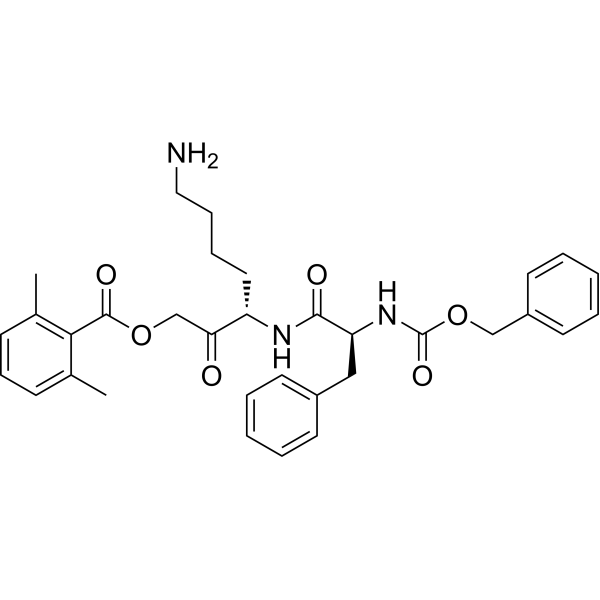
GB111-NH2
GB111-NH2 is a covalent cysteine cathepsin inhibitor. GB111-NH2 blocks cathepsin B/L/S activity, probe binding, and BMV109 signal in biopsy tissue. GB111-NH2 blocks brain cathepsin GB123 binding under ex vivo conditions. GB111-NH2 induces oxidative stress, autophagy inhibition, apoptosis, proliferation/S-phase entry, arginase activity, and non-autonomous apoptosis of neighboring tumor cells. GB111-NH2 reduces primary breast tumor volume, causes tumor regression, and alters macrophage morphology. GB111-NH2 restores marginal zone architecture and elevates lymphotoxin α (LTα) and splenic lymphotoxin β receptor (LTβR) signaling. GB111-NH2 can be used for research on chronic epilepsy, breast cancer, and atherosclerosis.
For research use only. We do not sell to patients.
- CAS No.: 956479-18-8
- Formula: C33H39N3O6
- Molecular Weight:573.68
-
Storage:
Please store the product under the recommended conditions in the Certificate of Analysis.

To place orders, for customer services and technical support, please contact: MedChemExpress USA
Tel: 609-228-6898 E-mail: [email protected] [email protected]


-
 Biological Activity
-
Chemical Information
- Protocols
- Purity & Documentation
- References
-
 Help & FAQs


All Cathepsin Isoforms
More

Biological Activity
Description
In Vitro
GB111-NH2 (5 μM; 30 min) inhibits ex vivo cathepsin labeling in mouse brain lysates and in rat and human epileptic brain tissue sections[2].
GB111-NH2 (0.1-10 μM; 1 h) inhibits recombinant cathepsins B, L, and S more effectively than JPM-OEt (HY-102087)[4].
MedChemExpress (MCE) has not independently confirmed the accuracy of these methods. They are for reference only.
In Vivo
MedChemExpress (MCE) has not independently confirmed the accuracy of these methods. They are for reference only.
-
Animal Model:BALB/c (male, 3-4 weeks old)[1]
-
Dosage:40 mg/kg (5 h before T-GNP injection); 20 mg/kg (48 h after T-GNP injection)
-
Administration:intraperitoneal; twice; 5 h before and 48 h after T-GNP injection
-
Result:Resulted in lower tumor X-ray absorption/CT signal than T-GNP-ABP alone in 4T1 tumor-bearing mice.
Showed lower tumor signal by quantification of gold attenuation in CT scans and lower tumor gold accumulation by FAAS at 72 h.
-
Animal Model:BALB/c (female, 4-5 weeks old)[4]
-
Dosage:40 mg/kg
-
Administration:i.p.; once daily; for 3 days
-
Result:Caused an increase in TAM caspase-3 activity by FACS.
The remaining tumor cell populations exhibited increased Nucview staining, indicating increased apoptosis throughout the tumor.
Primary tumor size measured externally on the mouse fat pad was reduced on day 4, and the tumor growth curve showed a decrease in tumor size in treated mice.
DCFDA signal specifically colocalized with F4/80 in TAMs of treated mice and not in the remaining cells of the tumor mass.
No increase in cell death was detected in circulating CD11b+ cells from the same treated mice.
-
Animal Model:CD19-Cre/TSC1f/f (TSC1BKO)[5]
-
Dosage:1 mg/mouse in 10% DMSO, 15% Tween 80, 75% PBS
-
Administration:intraperitoneal injection; two rounds of 3 days followed by 3 days of saline; one week
-
Result:Efficiently blocked all cathepsin activity in the spleen in vivo, as assessed by ex vivo residual GB123 activity.
Analysis of marginal zone structure revealed intact MOMA-1 rings and intact MAdCAM1 structures in TSC1BKO mice.
LTα expression was elevated.
LTβR-positive cells appeared in the spleens of TSC1BKO mice.
Flow cytometry analyses did not detect regain of marginal zone B cells.
Marginal zone architecture was restored in a manner indistinguishable from normal mice.
- Phagocytosis Functional Assay
- Detection of Apoptosis
- TUNEL staining for apoptotic DNA fragmentation
- Annexin V plus membrane-impermeant dye apoptosis staining
- ROS/oxidative-stress fluorescent staining
- Autophagy
- Apoptosis Solutions
- Research Protocol for Cardiovascular Diseases
- Lysosome and acidic-vesicle live-cell staining
- Macroautophagy Solutions
- Breast Cancer Modeling
- Cell Viability Determination by MTT Colorimetric Assay


Chemical Information
-
CAS No. 956479-18-8
-
Molecular Weight 573.68
-
Formula C33H39N3O6
-
SMILES
O=C(OCC([C@@H](NC([C@@H](NC(OCC1=CC=CC=C1)=O)CC2=CC=CC=C2)=O)CCCCN)=O)C3=C(C)C=CC=C3C
-
Shipping
Room temperature in continental US; may vary elsewhere.
-
Storage
Please store the product under the recommended conditions in the Certificate of Analysis.


Purity & Documentation
References

Calculators
Concentration (start) × Volume (start) = Concentration (final) × Volume (final)


GB111-NH2 Related Classifications
HY-115454 Related Classifications
 Powered by Bioz