



Human α-defensin 5
Based on 1 publication(s) in Google Scholar
Human α-defensin 5 is an orally active antimicrobial peptide with diverse biological activities including antibacterial, antiviral, and antiparasitic effects. Human α-defensin 5 kills UPEC, inhibits bacterial biofilm formation, and disrupts bacterial outer membrane integrity. Human α-defensin 5 is hijacked by Shigella flexneri, enhancing Shigella adhesion, aggregation, and invasion of host epithelial cells, and aggravating histopathological damage in corneal and colonic tissues as well as fever. Human α-defensin 5 inhibits LPS-induced pro-inflammatory cytokine production and NF-κB signaling pathway activation, upregulates the tight junction proteins ZO-1 and occludin, and maintains intestinal epithelial barrier integrity. Human α-defensin 5 inhibits various non-enveloped viruses and exhibits killing activity against Toxoplasma gondii tachyzoites. Human α-defensin 5 reduces UPEC bacterial load in the bladder and urine and alleviates inflammatory damage in a rat catheter-associated urinary tract infection model. Human α-defensin 5 can be used in research related to bacterial infections, viral infections, parasitic infections, and inflammatory bowel disease.
For research use only. We do not sell to patients.
- Formula: C144H238N50O45S6
- Molecular Weight:3582.13
-
Storage:
Please store the product under the recommended conditions in the Certificate of Analysis.

To place orders, for customer services and technical support, please contact: MedChemExpress USA
Tel: 609-228-6898 E-mail: [email protected] [email protected]


-
 Biological Activity
-
Chemical Information
- Protocols
- Purity & Documentation
- References
-
 Help & FAQs


Publications Citing Use of MedChemExpress (MCE) Human α-defensin 5
MoreAll Parasite Isoforms
More

Biological Activity
Description
In Vitro
Human α-defensin 5 promotes Sf301 infection in vitro in concentrated human ileal fluid[1].
Human α-defensin 5-mediated adhesion to HeLa cells is enhanced in Sf301 and E. coli due to fimbrial defects, whereas fimbriated strains are largely insensitive[1].
Human α-defensin 5-mediated adhesion of Sf301 involves multiple bacterial surface proteins, and OmpC complementation increases adhesion[1].
Human α-defensin 5 (HD-5) (1-640 µg/mL; 24 hours) inhibits UPEC strain 729 with an MIC of 60 µg/mL (17 µM)[3].
Human α-defensin 5 (1/2X-2X MIC) kills UPEC strain 729 in a dose-dependent manner, inhibits its biofilm formation, and disrupts membrane integrity[3].
Human α-defensin 5 (1/2X-4X MIC) permeabilizes the outer membrane of UPEC strain 729 in a dose-dependent manner[3].
Human α-defensin 5 maintains Caco-2 monolayer barrier integrity by increasing TEER and ZO-1/occludin expression and reducing FITC-dextran permeability[2].
Human α-defensin 5 (480-60 µg/mL; 1 h) exhibits minimal hemolysis against human erythrocytes at 1X and 2X MIC (<5% at 2X MIC), with higher hemolysis at 4X MIC (30%) and 8X MIC (42%)[3].
MedChemExpress (MCE) has not independently confirmed the accuracy of these methods. They are for reference only.
In Vivo
Human α-defensin 5 (8 μM; intrarectal; single inoculation; 4-48 hr) enhances Shigella adhesion and colonization and exacerbates colonic tissue damage and fever in guinea pigs[1].
Human α-defensin 5 (8 μM; intraluminal instillation; single inoculation; 2 hr) enhances Shigella adhesion and colonization in the murine ileal and colonic loop model[1].
Human α-defensin 5 (200 µg per rat; intravesical; for 3 consecutive days starting on day 1 post infection) reduces UPEC burden in urine and bladder and ameliorates infection-associated inflammation and histopathological damage in a female SD rat catheter-associated UTI model[3].
Human α-defensin 5 (200 µg per rat; oral; for 3 consecutive days starting on day 1 post infection) reduces UPEC burden in urine and bladder to a lesser extent than intravesical administration in a female SD rat catheter-associated UTI model[3].
MedChemExpress (MCE) has not independently confirmed the accuracy of these methods. They are for reference only.
-
Animal Model:Hartley (female pathogen-free, 6-8 weeks old, 120-250 g)[1]
-
Dosage:4 μM or 8 μM (co-inoculated with 106 CFU Sf301); 8 μM (alone)
-
Administration:conjunctival; single inoculation; 7 consecutive days
-
Result:Observed that 3 out of 15 control animals developed full‑blown keratoconjunctivitis and one exhibited mild irritation after one‑week observation.
Recorded elevated high‑grade keratoconjunctivitis incidence to six animals within 3 days and 11 of 15 animals within one week under 4 μM treatment.
Documented three animal deaths at 8 μM exposure.
Detected no adverse effects in animals receiving 8 μM agent alone.
-
Animal Model:Hartley (female pathogen-free, 6-8 weeks old, 120-250 g)[1]
-
Dosage:8 μM (incubated with 1×10⁸ CFU Sf301 or alone)
-
Administration:intrarectal; single inoculation; 4, 8, 24, 48 hr
-
Result:Demonstrated that HD‑5‑exposed Shigella exhibited enhanced early colonic adhesion and colonization at 4‑8 h post‑challenge, surpassing both 1×10⁸ CFU and even 1×10⁹ CFU mock‑treated inocula.
Exacerbated tissue injury from 1×10⁸ CFU Sf301, triggering edema, erosion and crypt distortion matching high‑dose mock infection.
Produced aggravated mucosal‑submucosal destruction and multiple colonic infection foci at 48 h for HD‑5‑treated Sf301, while mock‑challenged tissues largely recovered.
Induced substantial fever with a mean 1.3 °C body‑temperature rise starting at 24 h in infected animals.
-
Animal Model:BALB/c (female pathogen-free, 8 weeks old, 20-30 g)[1]
-
Dosage:8 μM (incubated with 1×10⁷ CFU Sf301)
-
Administration:intraluminal instillation; single inoculation; 2 hr
-
Result:Shigella showed much more robust adhesion and colonization than mock-treated bacteria in both colonic and ileal loops.
-
Animal Model:Sprague Dawley (female; 200-250 g)[4]
-
Dosage:0.2 mL dosing volume delivering 200 μg HD‑5
-
Administration:intravesical or oral for 3 successive days starting on day 1 post infection
-
Result:Reduced UPEC burden in urine and bladder and ameliorates infection-associated inflammation and histopathological damage in a female SD rat catheter-associated UTI model.
Reduced UPEC burden in urine and bladder to a lesser extent than intravesical administration in a female SD rat catheter-associated UTI model.


Chemical Information
-
Molecular Weight 3582.13
-
Formula C144H238N50O45S6
-
Sequence
Ala-Thr-Cys-Tyr-Cys-Arg-Thr-Gly-Arg-Cys-Ala-Thr-Arg-Glu-Ser-Leu-Ser-Gly-Val-Cys-Glu-Ile-Ser-Gly-Arg-Leu-Tyr-Arg-Leu-Cys-Cys-Arg (Disulfide bridge:Cys3-Cys31,Cys5-Cys20,Cys10-Cys30)
-
Sequence Shortening
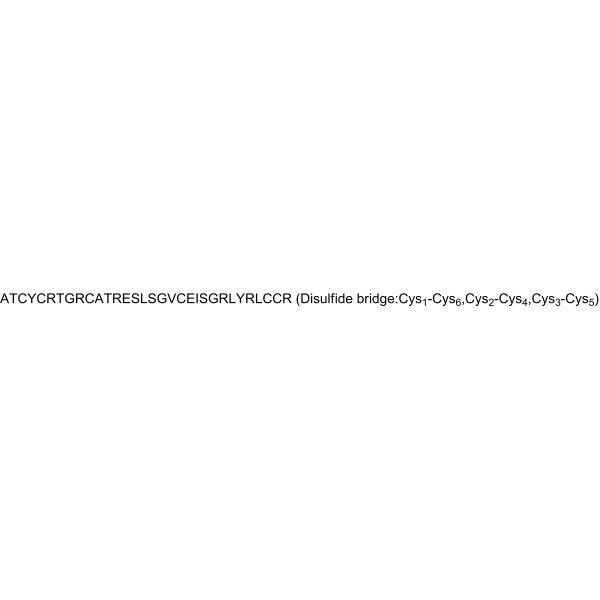
ATCYCRTGRCATRESLSGVCEISGRLYRLCCR (Disulfide bridge:Cys3-Cys31,Cys5-Cys20,Cys10-Cys30)
-
Shipping
Room temperature in continental US; may vary elsewhere.
-
Storage
Please store the product under the recommended conditions in the Certificate of Analysis.


Publications (1)
-
Journal Impact Factor
-
Most Recent


Purity & Documentation
References
[1]. Xu D, et al. Human Enteric α-Defensin 5 Promotes Shigella Infection by Enhancing Bacterial Adhesion and Invasion. Immunity. 2018 Jun 19;48(6):1233-1244.e6. [Content Brief]
[4]. Gounder AP, et al. Critical determinants of human α-defensin 5 activity against non-enveloped viruses. J Biol Chem. 2012 Jul 13;287(29):24554-62. [Content Brief]
[5]. Tanaka T, et al. Parasiticidal activity of human alpha-defensin-5 against Toxoplasma gondii. In Vitro Cell Dev Biol Anim. 2010 Jun;46(6):560-5. [Content Brief]

Calculators
Concentration (start) × Volume (start) = Concentration (final) × Volume (final)


Human α-defensin 5 Related Classifications
HY-P5694 Related Classifications
 Powered by Bioz