



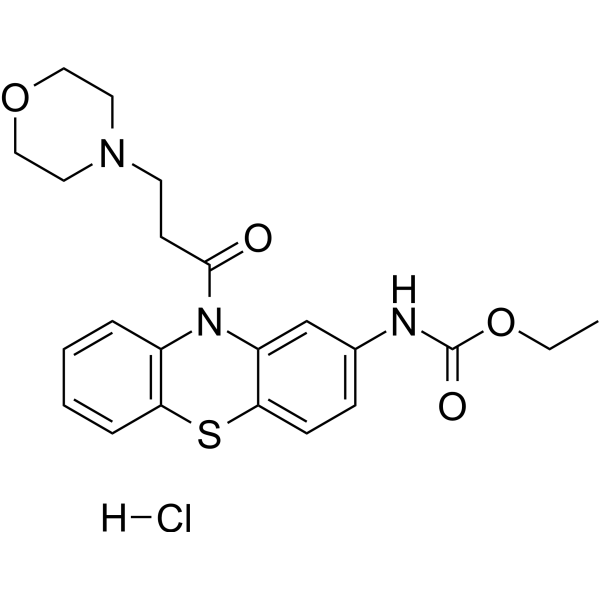
Moricizine Hydrochloride

Based on 1 Customer Validation
Moricizine Hydrochloride (EN 313) is an orally active cardiac sodium channel blocker. Moricizine Hydrochloride blocks inactivated sodium channels in a slow dissociation manner, inhibiting late and peak sodium currents, p-CaMKII, atrial enlargement, and cardiac hypertrophy. Moricizine Hydrochloride can be used in research on atrial fibrillation and arrhythmias.
For research use only. We do not sell to patients.
- Purity : 98.0%
- CAS No.: 29560-58-5
- Formula: C22H26ClN3O4S
- Molecular Weight:463.98
-
Storage:
4°C, sealed storage, away from moisture
* In solvent : -80°C, 6 months; -20°C, 1 month (sealed storage, away from moisture)

To place orders, for customer services and technical support, please contact: MedChemExpress USA
Tel: 609-228-6898 E-mail: [email protected] [email protected]


-
 Biological Activity
-
Chemical Information
-
Solvent & Solubility
- Protocols
- Purity & Documentation
- References
-
 Help & FAQs


Biological Activity
Description
Cellular Effect
|
Cell Line

|
Type | Value | Description | References |
|---|---|---|---|---|
| COS-7 | IC50 |
3 μM
|
Inhibition of hH1 Na+ current in COS7 cells assessed by whole-cell voltage-clamp at holding potential -100 mV, reducing current to 50% of control.
Inhibition of hH1 Na+ current in COS7 cells assessed by whole-cell voltage-clamp at holding potential -100 mV, reducing current to 50% of control.
|
12402511 |
In Vitro
Moricizine (30 μM; 24 h) Hydrochloride reduces Ang II (Angiotensin II human) (HY-13948)- and ATX II-induced upregulation of p-CaMKII without altering total CaMKII or Nav1.5 expression in HL-1 cells[1].
Moricizine (10 µM) Hydrochloride reversibly disrupts electrical coupling and prevents action potential firing in working cardiomyocytes of the right atrium of Wistar rats, while leaving sinoatrial node pacemaker activity intact[4].
Moricizine (0.3-10 μM; 60 min) Hydrochloride inhibits Vmax in guinea pig right ventricular papillary muscles with an IC20 of 1.3 μM and produces use-dependent block with slow recovery (τR 26.4 s)[7].
Moricizine (20 µM; 28 h) Hydrochloride alters circadian clock and cardiac channel gene expression in Per2::LucSV reporter cells[2].
Moricizine (30 µM) Hydrochloride extends the circadian period of Per2::Luc atrial explants from 23.9 hours to 24.6 hours[2].
Moricizine Hydrochloride binds to mouse liver microsomal CYP with a high-affinity spectral dissociation constant Ksl of 3.7 µM[3].
Moricizine Hydrochloride preferentially inhibits mouse liver microsomal CYP1A1 and CYP1A2, with Ki values of 0.43 and 0.98 µM, respectively[3].
Moricizine Hydrochloride competitively inhibits theophylline 3-demethylation and 8-hydroxylation in untreated mouse liver microsomes, with Ki values of 0.84 and 1.5 µM, respectively[3].
Moricizine (3-30 μM) Hydrochloride blocks cloned hH1 Na+ channels in COS7 cells[5].
Moricizine (10-300 μM; 5 min) Hydrochloride blocks resting-state INa in cat ventricular myocytes in a concentration-dependent manner, with a Hill coefficient of 13 and a Kd of 105 μM[6].
MedChemExpress (MCE) has not independently confirmed the accuracy of these methods. They are for reference only.
-
Cell Line:HL-1 cells
-
Concentration:30 μM
-
Incubation Time:24 h
-
Result:Reduced Ang II- and ATX II-induced p-CaMKII upregulation without altering total CaMKII or Nav1.5 expression.
-
Cell Line:Per2::LucSV reporter cells (mouse ear fibroblasts)
-
Concentration:20 µM
-
Incubation Time:28 h
-
Result:Produced significant circadian time-dependent changes in most core clock genes.
Two-way ANOVA showed significant differences between DMSO and moricizine for Bmal1, Cry2, Per1, Per3, Scn5a, Kcnj2, Ncx1, and Klf15.
Altered rhythmic expression was observed for Bmal1, Cry2, Per3, Rev-erba, and Dbp, consistent with period lengthening.
Cardiac channel/regulatory genes showed significant expression changes, notably Scn5a, Kcnj2, Ncx1, and Klf15.
In Vivo
Moricizine (1.25 mg per mouse; intraperitoneal injection; once daily at CT11; 5 days) Hydrochloride does not significantly alter the free-running period in wheel-running experiments in wild-type C57BL6/J mice, although trends toward period lengthening and phase shifting are observed during administration[2].
MedChemExpress (MCE) has not independently confirmed the accuracy of these methods. They are for reference only.
-
Animal Model:C57Bl/6 (male, 6-8 weeks, wild-type)[1]
-
Dosage:22.5 mg/kg
-
Administration:every 8 hours; 4 weeks
-
Result:In Ang II + Moricizine-treated mice, AF inducibility was 40%.
AF duration was increased in Ang II-treated mice, and moricizine cotreatment prevented this Ang II-induced increase in AF duration.
Body weight to heart weight ratio indicated that Ang II administration caused cardiac hypertrophy, and moricizine coadministration alleviated this effect.
Echocardiographic measurements in the Ang II + Moricizine group were: LAD 1.87 mm; LVEF 65.23%; FS 35.45%; CO 16.04 mL/min; LVESD 4.42 mm; LVEDD 3.72 mm; LVESV 21.84 μL; LVEDV 60.89 μL; stroke volume 39.06 μL.
-
Animal Model:C57BL/6J (wild-type; nine weeks of age)[2]
-
Dosage:1.25 mg per mouse (calculated as approximately 50 mg/kg/day)
-
Administration:i.p.; once daily at ZT2; 5 days
-
Result:Increased total, daytime, and nighttime sleep amounts.
Mean sleep bout length was not altered, although variation in sleep bout length was greater in moricizine-treated mice.
The sleep-wake transition threshold was lower in the moricizine group (0.157 vs. 0.652).
In heart tissue, Clock and Bmal1 expression levels were reduced at ZT2, as were Cry1, Cx43, and Kcnd2; Per1 expression changed only at ZT14.
-
Animal Model:C57BL6/J (wild-type; male; nine weeks of age)[2]
-
Dosage:1.25 mg per mouse
-
Administration:i.p.; once daily at CT11; 5 days
-
Result:Free-running periods were virtually identical before and after administration.
During moricizine administration, there was a slight trend of period lengthening and phase shift; circadian activity pattern and total activity showed marginal effects.
Clinical Trial
| NCT Number | Sponsor | Condition | Start Date |
Phase
|
|---|---|---|---|---|
| NCT01329991 | 2011-05 | PHASE1 |


Chemical Information
-
CAS No. 29560-58-5
-
Appearance Solid
-
Molecular Weight 463.98
-
Formula C22H26ClN3O4S
-
Color Off-white to light brown
-
SMILES
O=C(OCC)NC(C=C1N2C(CCN3CCOCC3)=O)=CC=C1SC4=C2C=CC=C4.[H]Cl
-
Synonyms
EN 313; Ethmozin; Moracizine
-
Shipping
Room temperature in continental US; may vary elsewhere.
-
Storage
4°C, sealed storage, away from moisture
* In solvent : -80°C, 6 months; -20°C, 1 month (sealed storage, away from moisture)


Solvent & Solubility
In Vitro:
DMSO : 100 mg/mL (215.53 mM; Need ultrasonic; Hygroscopic DMSO has a significant impact on the solubility of product, please use newly opened DMSO)
Please refer to the solubility information to select the appropriate solvent. Once prepared, please aliquot and store the solution to prevent product inactivation from repeated freeze-thaw cycles.
Storage method and period of stock solution: -80°C, 6 months; -20°C, 1 month (sealed storage, away from moisture). When stored at -80°C, please use it within 6 months. When stored at -20°C, please use it within 1 month.
Concentration (start) × Volume (start) = Concentration (final) × Volume (final)


Purity & Documentation
-
Data Sheet (295 KB)
-
SDS (393 KB)
- English - EN (393 KB)
- Français - FR (393 KB)
- Deutsch - DE (393 KB)
- Norwegian - NO (393 KB)
- Español - ES (393 KB)
- Swedish - SV (393 KB)
- Italian - IT (393 KB)
- Korean - KR (393 KB)
- Portuguese - PT (393 KB)
-
Handling Instructions (2659 KB)
References


Complete Stock Solution Preparation Table
Please refer to the solubility information to select the appropriate solvent. Once prepared, please aliquot and store the solution to prevent product inactivation from repeated freeze-thaw cycles.
Storage method and period of stock solution: -80°C, 6 months; -20°C, 1 month (sealed storage, away from moisture). When stored at -80°C, please use it within 6 months. When stored at -20°C, please use it within 1 month.
| Optional Solvent | Concentration Solvent Mass | 1 mg | 5 mg | 10 mg | 25 mg |
|---|---|---|---|---|---|
| DMSO | 1 mM | 2.1553 mL | 10.7763 mL | 21.5527 mL | 53.8816 mL |
| 5 mM | 0.4311 mL | 2.1553 mL | 4.3105 mL | 10.7763 mL | |
| 10 mM | 0.2155 mL | 1.0776 mL | 2.1553 mL | 5.3882 mL | |
| 15 mM | 0.1437 mL | 0.7184 mL | 1.4368 mL | 3.5921 mL | |
| 20 mM | 0.1078 mL | 0.5388 mL | 1.0776 mL | 2.6941 mL | |
| 25 mM | 0.0862 mL | 0.4311 mL | 0.8621 mL | 2.1553 mL | |
| 30 mM | 0.0718 mL | 0.3592 mL | 0.7184 mL | 1.7961 mL | |
| 40 mM | 0.0539 mL | 0.2694 mL | 0.5388 mL | 1.3470 mL | |
| 50 mM | 0.0431 mL | 0.2155 mL | 0.4311 mL | 1.0776 mL | |
| 60 mM | 0.0359 mL | 0.1796 mL | 0.3592 mL | 0.8980 mL | |
| 80 mM | 0.0269 mL | 0.1347 mL | 0.2694 mL | 0.6735 mL | |
| 100 mM | 0.0216 mL | 0.1078 mL | 0.2155 mL | 0.5388 mL |


Moricizine Hydrochloride Related Classifications
HY-B0615A Related Classifications
 Powered by Bioz