4 Results for "

APOE lipidation

" in MedChemExpress (MCE) Product Catalog:
Products (4)

4 Results for "APOE lipidation" in MCE Product Catalog:

1
1 Cited Publications
Cat. No.: HY-117006
CAS No.: 1031195-19-3
Purity:  98.55%
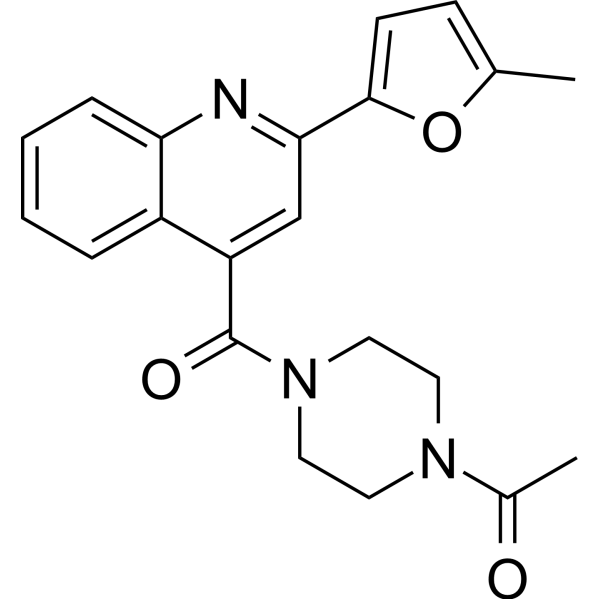
Synonyms: 1-{4-[2-(5-Methylfuran-2-yl)quinoline-4-carbonyl]piperazin-1-yl}ethan-1-one
Target:  

Sirtuin

Research Areas:  

Cardiovascular Disease

E1231 is an orally active activator of Sirtuin 1 (SIRT1) (EC50=0.83 μM), to modulate cholesterol and lipid metabolism. E1231 interactes with SIRT1 (KD=9.61 μM) and deacetylated liver X receptor-alpha (LXRα), and increases ATP-binding cassette transporter A1 (ABCA1) expression. E1231 also reduces atherosclerotic plaque development in ApoE -/- mice model. E1231 can be used for research in cholesterol and lipid disorder-related diseases .
loading...
    loading...
Cat. No.: HY-169080
CAS No.: 2839627-76-6
Target:  

Apolipoprotein

Research Areas:  

Neurological Disease

ABCA1 inducer 1 is a nonlipogenic ABCA1 inducer. ABCA1 inducer 1 increases ABCA1 expression, enhances apolipoprotein (APOE) lipidation and reverses multiple Alzheimer’s disease (AD) phenotypes, without increasing triglycerides in E3/4FAD mice that express human APOE 3/4 .
loading...
    loading...
Cat. No.: HY-P12363
MyomP1 peptide is a functionalized modification group targeting apolipoprotein E (ApoE). MyomP1 peptide restricts the adsorption of ApoE on lipid nanoparticles, reduces ApoE-mediated hepatic uptake, and confers liver detargeting. MyomP1 peptide attenuates innate immune activation by reducing the expression of inflammatory markers and decreasing macrophage recruitment at the injection site. MyomP1 peptide is useful for research on rare muscle diseases .
loading...
    loading...
Cat. No.: HY-W1130452
CAS No.: 2639634-86-7
Target:  

Liposome

Research Areas:  

Cancer

Lipid C16-C is an ionizable cationic lipid that can be used to prepare lipid nanoparticles (LNPs) for mRNA delivery. Lipid C16-C mediates ApoE-independent macropinocytosis-based mRNA delivery to macrophages, with endosomal acidification enabling endosomal escape and release of mRNA cargo into the cytosol .
loading...
    loading...

