18 Results for "

BTK phosphorylation

" in MedChemExpress (MCE) Product Catalog:
Products (18)

18 Results for "BTK phosphorylation" in MCE Product Catalog:

5
5 Cited Publications
Cat. No.: HY-122562
CAS No.: 2231744-29-7
Purity:  98.35%
Target:  

PROTACs Btk

Research Areas:  

Cancer

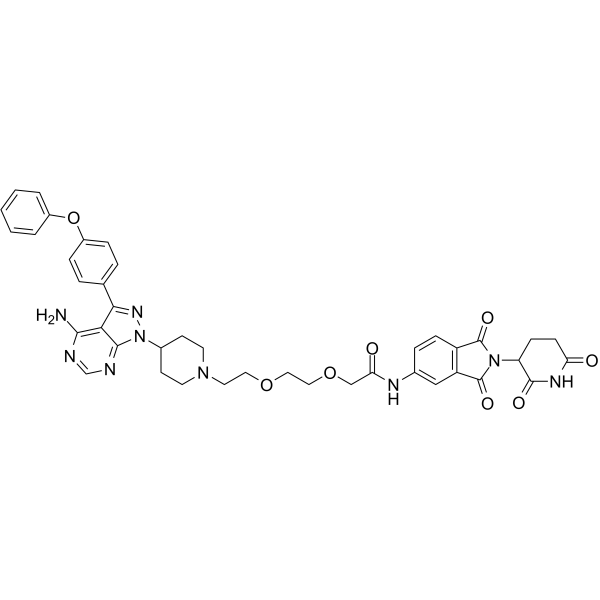
MT-802 is a BTK PROTAC degrader. MT-802 degrades wild-type BTK (DC50 = 14.6 nM) and BTK mutants including E41K, C481S (DC50 = 14.9 nM), C481R, C481Y, C481T, C481F, L528W, and inhibits their Y223 phosphorylation. BI-4732 can be used for the study of Ibrutinib (HY-10997)-resistant chronic lymphocytic leukemia (CLL). (Pink: BTK ligand (HY-150885), Blue: CRBN Ligand (HY-14658), Black: Linker (HY-141371), E3 ligase ligand-linker conjugate (HY-176340)) .
loading...
    loading...
4
4 Cited Publications
Cat. No.: HY-19816
CAS No.: 1557267-42-1
Synonyms: Abivertinib; AC0010
Target:  

EGFR Btk Apoptosis

Research Areas:  

Cancer

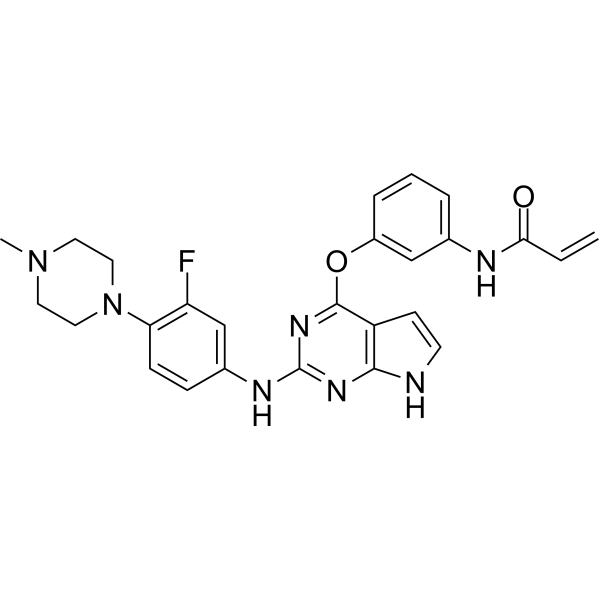
Avitinib (Abivertinib) is a third-generation, irreversible and orally active selective EGFR inhibitor, with IC50 values of 0.18 nM, 0.18 nM, 7.68 nM and against EGFR L858R, EGFR T790M and wild-type EGFR. Avitinib is also a BTK inhibitor that induces apoptosis and inhibits phosphorylation of BTK in mantle cell lymphoma. Avitinib shows anticancer effects .
loading...
    loading...
4
4 Cited Publications
Cat. No.: HY-19816A
CAS No.: 1557268-88-8
Synonyms: Abivertinib maleate; AC0010 maleate
Target:  

EGFR Btk Apoptosis

Research Areas:  

Cancer

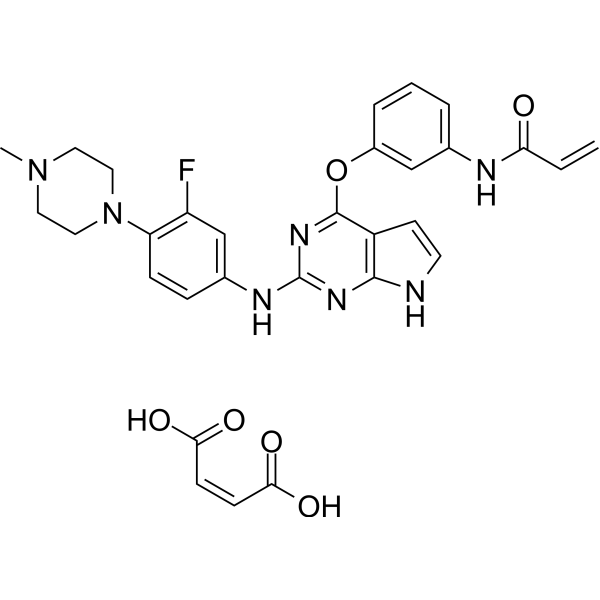
Avitinib (Abivertinib) maleate is a third-generation, irreversible and orally active selective EGFR inhibitor, with IC50 values of 0.18 nM, 0.18 nM, 7.68 nM and against EGFR L858R, EGFR T790M and wild-type EGFR. Avitinib maleate is also a BTK inhibitor that induces apoptosis and inhibits phosphorylation of BTK in mantle cell lymphoma. Avitinib maleate shows anticancer effects .
loading...
    loading...
1
1 Cited Publications
Cat. No.: HY-139481
CAS No.: 1415823-49-2
Purity:  99.86%
Synonyms: TL-895
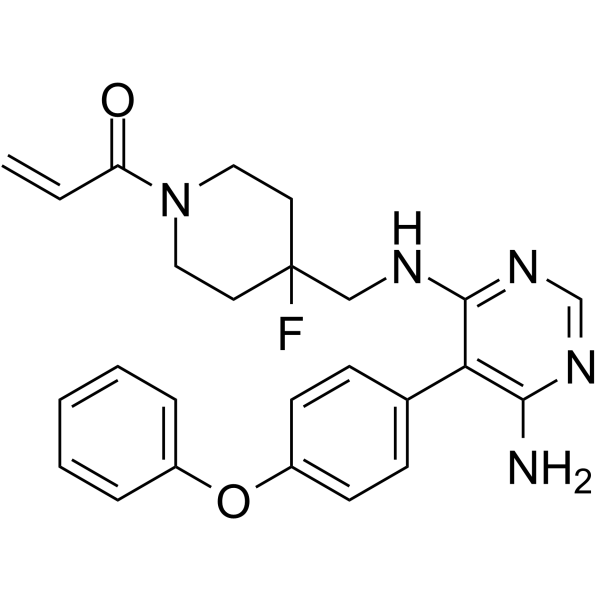
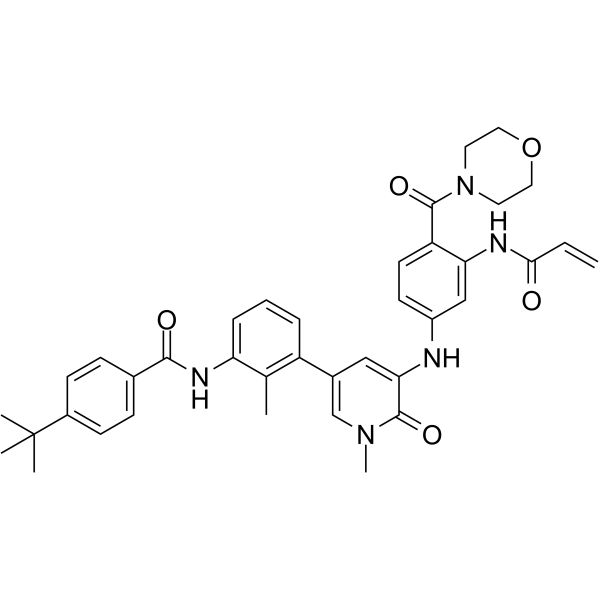
Flixebrutinib (TL-895) is a potent, orally active, ATP-competitive, and highly selective irreversible BTK inhibitor. Flixebrutinib is active against recombinant BTK (average IC50: 1.5 nM) and inhibits only three additional kinases BLK, BMX (IC50 = 1.6 nM) and TXK with IC50 within tenfold of BTK activity. Flixebrutinib inhibits BTK auto-phosphorylation at the Y223 phosphorylation site (IC50: 1-10 nM). The Flixebrutinib effectively inhibits the production of inflammatory factors such as IL-8, IL-1β, MCP-1 and TNF-α by monocytes or macrophages, and reduces the chemotactic migration of MF cells towards SDF-1. Flixebrutinib is used be for studies of chronic lymphocytic leukemia (CLL), myelofibrosis (MF), and B-cell malignancies .
loading...
    loading...
Cat. No.: HY-163962
CAS No.: 2451070-32-7
L18I is a Bruton's tyrosine kinase (BTK) PROTAC degrader that targets wild-type and BTK C481, and recruits the cereblon E3 ligase to mediate proteasomal degradation. L18I regulates the BCR, TLR, FcγR and NLRP3 inflammasome signaling pathways, inhibits the phosphorylation of PLCγ-2, ERK1/2 and p38, and reduces the levels of B cell activation markers CD25, CD69 and CD86. L18I downregulates the NF-κB, TNF and TLR signaling pathways, reduces the production of pro-inflammatory cytokines, and decreases immune cell infiltration and immune complex deposition. L18I inhibits the proliferation of BTK-expressing lymphoma cells, induces tumor regression in xenograft models, and exhibits synergistic activity when combined with inhibitors of SYK, PI3K or Lyn. L18I can be used in research related to lupus, diffuse alveolar hemorrhage and B-cell lymphoma .
loading...
    loading...
Cat. No.: HY-168963
Target:  

PROTACs Btk Itk p38 MAPK

Research Areas:  

Cancer

PROTAC BTK Degrader-13 is a reagent targeting BTK, with a DC50 of 0.27 μM. PROTAC BTK Degrader-13 degrades BTK in a proteasome-dependent manner and inhibits BTK-mediated downstream signaling pathways by reducing the phosphorylation levels of BTK and p38 MAPK. PROTAC BTK Degrader-13 exerts selective cytotoxic effects on BTK-overexpressing lymphoma cells and ITK-positive cells. PROTAC BTK Degrader-13 can be used in studies related to B-cell lymphoma .
loading...
    loading...
Cat. No.: HY-146672
CAS No.: 2404604-06-2
Target:  

Itk

Research Areas:  

Cancer

ITK inhibitor 6 (compound 43) is a potent and selective ITK inhibitor with IC50s of 4 nM, 133 nM, 320 nM, 2360 nM, 155 nM for ITK, BTK, JAK3, EGFR, LCK, respectively. ITK inhibitor 6 inhibits phosphorylation of PLCγ1 and ERK1/2. ITK inhibitor 6 shows antiproliferative activities .
loading...
    loading...
Cat. No.: HY-124605
CAS No.: 1630804-24-8
Target:  

Syk Btk Apoptosis

Research Areas:  

Cancer

IQS-019 is a B cell receptor (BCR) kinase inhibitor. IQS-019 can inhibit the de-phosphorylation of constitutive and IgM-activated Syk, Lyn, and Btk. IQS-019 can inhibit cell proliferation, migration and induce apoptosis. IQS-019 exhibits antitumor activity and can be used for the research of cancer, such as B cell lymphoma .
loading...
    loading...
Cat. No.: HY-120406
CAS No.: 1431727-04-6
Research Areas:  

Cancer

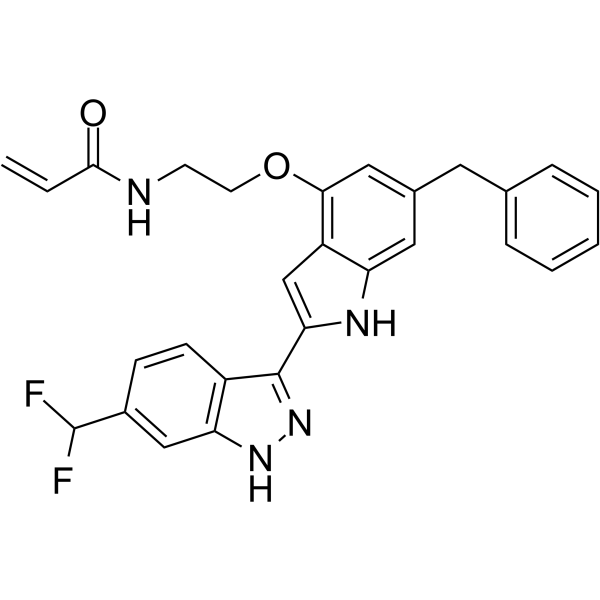
LPS-123 is a covalently irreversible BTK inhibitor with an IC50 of < 5 nM. LPS-123 simultaneously inhibits the catalytic activity of BTK at Tyr551 and its self-activation at Tyr223. LPS-123 inhibits phosphorylation of the AKT/mTOR and MAPK signaling pathways, activation of PLCγ2, ERK1/2, p38, AKT, and mTOR, and blocks the production of CCL3 and CCL4 chemokines. LPS-123 exhibits significant anti-proliferative activity against various B-cell lymphoma cell lines and effectively induces apoptosis via a caspase-dependent pathway. LPS-123 also demonstrates significant antitumor activity in the OCI-Ly7 xenograft model. LPS-123 can be used for lymphoma research .
loading...
    loading...
Cat. No.: HY-101521
CAS No.: 2095280-64-9
Target:  

Btk

Research Areas:  

Cancer

CHMFL-BTK-01 (compound 9) is a highly selective irreversible BTK inhibitor, with an IC50 of 7 nM. CHMFL-BTK-01 (compound 9) potently inhibited BTK Y223 auto-phosphorylation .
loading...
    loading...
Cat. No.: HY-168427
CAS No.: 1822357-78-7
Synonyms: Abivertinib maleate dihydrate; AC0010 maleate dihydrate
Target:  

EGFR Btk Apoptosis

Research Areas:  

Cancer

Avitinib (Abivertinib) maleate dihydrate is a third-generation, irreversible and orally active selective EGFR inhibitor, with IC50 values of 0.18 nM, 0.18 nM, 7.68 nM and against EGFR L858R, EGFR T790M and wild-type EGFR. Avitinib maleate dihydrate is also a BTK inhibitor that induces apoptosis and inhibits phosphorylation of BTK in mantle cell lymphoma. Avitinib maleate dihydrate shows anticancer effects .
loading...
    loading...
Cat. No.: HY-101798
CAS No.: 2058116-52-0
Target:  

PI3K

Research Areas:  

Cancer

MDVN1003 is a Bruton's tyrosine kinase (BTK) and phosphatidylinositol-3-kinase delta (PI3Kδ) dual inhibitor which prevents the activation of B cells and inhibits the phosphorylation of protein kinase B (AKT) and extracellular signal-regulated kinase 1/2 (ERK 1/2). MDVN1003 can be used for non-Hodgkin’s lymphoma (NHL) research .
loading...
    loading...
Cat. No.: HY-L009
4,033 compounds

Kinase is an enzyme that adds phosphate groups to other molecules. This process is known as phosphorylation. Protein phosphorylation is a key aspect in the regulation of a large number of cellular processes including cellular division, metabolism, signal transduction, and so on. There are over 500 kinases encoded by the human genome and it has been estimated that kinases regulate approximately 50% of cellular functions. Kinases are a large group of drug targets in drug discovery. Kinase inhibitors are an important class of drugs that block certain enzymes involved in diseases such as cancer and inflammatory disorders.

Kinase inhibitor library designed by MCE contains 4,033 kinase inhibitors and regulators mainly targeting protein kinases (VEGFR, EGFR, BTK, CDK, Akt, etc.), lipid kinases (PI3K, PI4K, SK, etc.) and carbohydrate kinases (Hexokinase), and is a useful tool for kinase drug discovery and related research.

Cat. No.: HY-184940
Target:  

Btk Glycoprotein VI PKC

Research Areas:  

Cardiovascular Disease

BTK-IN-50 is a covalent BTK inhibitor with an IC50 of 6 nM. BTK-IN-50 blocks collagen-induced platelet aggregation by inhibiting the GPVI-mediated BTK-PLCγ2-PKC signaling cascade, and attenuates CRP-XL-induced phosphorylation of BTK, PLCγ2 and PKC substrates in platelets. BTK-IN-50 can be used for research related to thrombosis .
loading...
    loading...
Cat. No.: HY-190481
CAS No.: 3119675-75-8
Target:  

Btk Apoptosis JAK

Research Areas:  

Cancer

BTK-IN-52 is a BTK inhibitor with an IC50 of 126.70 nM. BTK-IN-52 inhibits BTK phosphorylation, induces G0/G1 cell cycle arrest and apoptosis (apoptosis) in cancer cells, and inhibits cancer cell proliferation. BTK-IN-52 inhibits tumor growth in xenograft models. BTK-IN-52 inhibits off-target TEC and JAK2 kinases in selectivity assays. BTK-IN-52 can be used in research related to hematological diseases and lymphoma .
loading...
    loading...
Cat. No.: HY-160167A
CAS No.: 2662512-14-1
Synonyms: (R,R)-DZD8586
Target:  

Btk

Research Areas:  

Cancer

(R,R)-Birelentinib ((R,R)-DZD8586) (Compound 14) is a potent BTK inhibitor with IC50 values for BTK WT and BTK C481S of 0.7 and 0.86 nM, respectively. (R,R)-Birelentinib inhibits the self-phosphorylation of BTK and its IC50 is 24.3 nM. (R,R)-Birelentinib exhibits significant anti-proliferative activity against wild-type and C481S mutant HEK293 cells. (R,R)-Birelentinib can be used for the study of drug-resistant B-cell malignancies .
loading...
    loading...
Cat. No.: HY-183397
CAS No.: 1557268-90-2
Synonyms: Abivertinib dihydrochloride; AC0010 dihydrochloride
Target:  

EGFR Btk Apoptosis

Research Areas:  

Cancer

Avitinib (Abivertinib) dihydrochloride is a third-generation, irreversible and orally active selective EGFR inhibitor, with IC50 values of 0.18 nM, 0.18 nM, 7.68 nM and against EGFR L858R, EGFR T790M and wild-type EGFR. Avitinib dihydrochloride is also a BTK inhibitor that induces apoptosis and inhibits phosphorylation of BTK in mantle cell lymphoma. Avitinib dihydrochloride shows anticancer effects .
loading...
    loading...
Cat. No.: HY-L009M
271 compounds

Kinases is a class of enzymes that adds chemicals called phosphates to other molecules, such as sugars or proteins. Protein phosphorylation serves as a critical regulatory mechanism for numerous cellular processes including cell division, metabolism, and signal transduction, with approximately 50% of cellular functions in humans being regulated by kinase activity. In drug discovery, kinases represent a major category of therapeutic targets, and kinase inhibitors constitute an important class of pharmaceuticals that block the activity of specific disease-associated enzymes, particularly in cancer and inflammatory disorders. Small molecule kinase inhibitors represent one of the fastest-growing drug categories, having received U.S. Food and Drug Administration (FDA) approval for both oncological and non-oncological indications. As of September 2023, over 70 FDA-approved small molecule kinase inhibitors are commercially available.

The MCE Kinase Inhibitor Library Mini contains 271 kinase inhibitors primarily targeting protein kinases (VEGFR, EGFR, BTK, CDK, Akt, etc.), lipid kinases (PI3K, PI4K, SK, etc.), and carbohydrate kinases. This collection includes 1-3 highly specific representative compounds per target, optimized for screening of kinase-related drug targets in pharmaceutical research.

  • 1

