51 Results for "

DNA recombination

" in MedChemExpress (MCE) Product Catalog:
Products (51)

51 Results for "DNA recombination" in MCE Product Catalog:

2
2 Cited Publications
Cat. No.: HY-K1041A

MCE Seamless DNA Assembly Ultra Kit is a next-generation recombinant cloning kit that allows the recombination of single or multiple DNA fragments in a single reaction.

loading...
    loading...
1
1 Cited Publications
Cat. No.: HY-120836
CAS No.: 2089314-57-6
Purity:  99.30%
Research Areas:  

Cancer

AOH1160 is a potent oral small molecule proliferating cell nuclear antigen (PCNA) inhibitor that interferes with DNA replication, blocks homologous recombination-mediated DNA repair, leads to cell cycle arrest and induces apoptosis .
loading...
    loading...
1
1 Cited Publications
Cat. No.: HY-P87059
Synonyms: DNA strand exchange and recombination protein with protease and nuclease activity antibody; lexB antibody; Protein recA antibody; recH antibody; Recombinase A antibody;

Host:  

Rabbit

Application:  

WB, ICC/IF

Reactivity:  

Escherichia coli

loading...
    loading...
Cat. No.: HY-160700
CAS No.: 2839740-79-1
Target:  

Deubiquitinase JNK

Research Areas:  

Cancer

TNG348 is an orally available allosteric inhibitor of the ubiquitin-specific protease USP1. TNG348 specifically and efficiently inhibits the activity of USP1, inhibiting its deubiquitination of proliferative PCNA and FANCD2, thereby disrupting the DNA repair process. TNG348 has inhibitory activity against breast and ovarian cancers carrying BRCA1/2 mutations and other homologous recombination defects (HRD) .
loading...
    loading...
Cat. No.: HY-138155
CAS No.: 730960-98-2
Purity:  99.90%
Target:  

DNA/RNA Synthesis

Research Areas:  

Cancer

NSC15520 is a small molecular inhibitor of Replication Protein A (RPA). NSC15520 specifically recognizes the RPA N-terminal DNA binding domain (DBD), and blocks the interaction of RPA with p53 or RAD9. NSC15520 also inhibtis helix destabilization of a duplex DNA (dsDNA) oligonucleotide, involves in DNA replication, DNA repair, DNA recombination, and DNA damage response signaling .
loading...
    loading...
Cat. No.: HY-161430
CAS No.: 3035072-49-9
Research Areas:  

Cancer

RTx-161 is a DNA polymerase θ inhibitor with an IC50 of 4.1 nM. RTx-161 induces DNA damage, PARP cleavage, apoptosis, and selectively kills homologous recombination-deficient (HRD) cells. RTx-161 acts synergistically with PARP inhibitors to suppress PARP inhibitor resistance in cancer cells. RTx-161 can be used for the research of BRCA G12C mutant cancer and HR-deficient cancers .
loading...
    loading...
Cat. No.: HY-160096
CAS No.: 1360628-91-6
Research Areas:  

Cancer

M3541 is an orally effective DNA-dependent protein kinase (DNA-PK) inhibitor . M3541 inhibits ionizing radiation-induced ATM autophosphorylation and phosphorylation of downstream substrates (KAP1, CHK2, p53), blocks DSB end resection and homologous recombination repair, and simultaneously induces non-homologous end joining, G2-M phase arrest, polyploidization, and cell death. M3541 can be used for research on solid tumors, acute myeloid leukemia, non-small cell lung cancer, triple-negative breast cancer, etc. .
loading...
    loading...
Cat. No.: HY-W338852
CAS No.: 25351-24-0
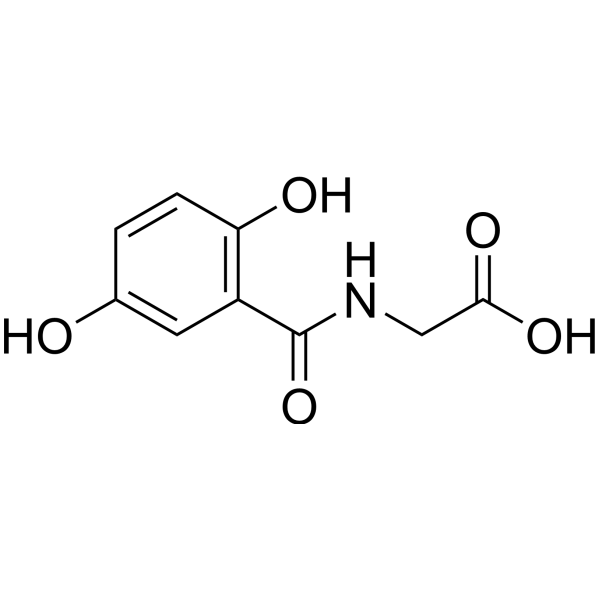
Gentisuric Acid is a metabolite of Aspirin (HY-14654). Gentisuric Acid activates GPR35. Gentisuric Acid inhibits HIF-1α and HIF-2α . Gentisuric Acid inhibits Mitomycin C (HY-13316)-induced genotoxicity and twin spots (mitotic recombination), reduces spot frequency without reducing survival, and modulates replication or repair of Mitomycin C-damaged DNA. Gentisuric Acid can be used in research on VHL-deficient renal cell carcinoma and Drosophila melanogaster infection .
loading...
    loading...
Cat. No.: HY-170844
CAS No.: 2379405-61-3
Target:  

Endonuclease

Research Areas:  

Cancer

MU147 is an MRE11 nuclease inhibitor and chemical probe with anticancer activity, exhibiting IC50 values of 3.7 μM and 0.8 μM against the nuclease activity of human MRE11 and the MRN complex, respectively. MU147 inhibits MRE11 exonuclease and endonuclease activities, preventing MRN-dependent DNA end resection and nascent DNA degradation at stalled replication forks in BRCA2-deficient cells. MU147 delays the DNA damage repair process, inhibits homologous recombination and alternative non-homologous end joining, downregulates ionizing radiation- or camptothecin-induced RPA/RPA32 phosphorylation, and reduces survival of BRCA2-deficient cells. MU147 directly binds MRE11 in cells and impairs its recruitment to damage foci. MU147 can be used in cancer-related research .
loading...
    loading...
Cat. No.: HY-161431
CAS No.: 3035072-48-8
Target:  

DNA/RNA Synthesis

Research Areas:  

Cancer

RTx-152 is a potent and selective Polθ-pol allosteric inhibitor with an IC50 of 6.2 nM. RTx-152 binds to the allosteric pocket of the Polθ-pol finger domain, locking it in a closed conformation on the DNA substrate, thereby effectively inhibiting its catalytic cycle. RTx-152 synergizes with Olaparib (HY-10162) in BRCA2-deficient cells and synergizes with PARP inhibitors in homologous recombination-deficient cells. RTx-152 can be used for research on homologous recombination-deficient cancers such as BRCA2 mutations .
loading...
    loading...
Cat. No.: HY-115552
CAS No.: 1551355-46-4
Purity:  99.01%
Target:  

PARP

Research Areas:  

Cancer

Simmiparib is a highly potent and orally active PARP1 and PARP2 inhibitor with IC50 values of 1.75 nM and 0.22 nM, respectively. Simmiparib has more potent PARP1/2 inhibition than its parent Olaparib (HY-10162). Simmiparib induces DNA double-strand breaks (DSB) accumulation and G2/M arrest in homologous recombination repair (HR)-deficient cells, thereby inducing apoptosis. Simmiparib exhibits remarkable anticancer activities in cells and nude mice bearing xenografts .
loading...
    loading...
Cat. No.: HY-151799
CAS No.: 2765180-17-2
Purity:  98.62%
Research Areas:  

Cancer

P62-RNF168 agonist-1 (compound 5a) is a low cytotoxicity P62-RNF168 agonist that enhances the interaction between P62 and RNF168. P62-RNF168 agonist-1 induces a reduction in H2A ubiquitination mediated by RNF168 and impairs homologous recombination-mediated DNA repair. P62-RNF168 agonist-1 also inhibits the growth of xenograft tumors in mice in a dose-dependent manner .
loading...
    loading...
Cat. No.: HY-E70016
CAS No.: 9027-67-2
Synonyms: TdT
Target:  

DNA/RNA Synthesis

Research Areas:  

Others Cancer

Terminal deoxyribonucleotidyltransferase (TdT) catalyses the condensation of deoxyribonucleotide triphosphates onto the 3' hydroxyl ends of DNA strands and adds N-regions to gene segment junctions during V(D)J recombination. Terminal deoxyribonucleotidyltransferase is expressed in immature, pre-B, pre-T lymphoid cells, and acute lymphoblastic leukemia/lymphoma cells .
loading...
    loading...
Cat. No.: HY-144874
CAS No.: 2756333-42-1
Purity:  98.03%
Target:  

PARP

Research Areas:  

Neurological Disease Cancer

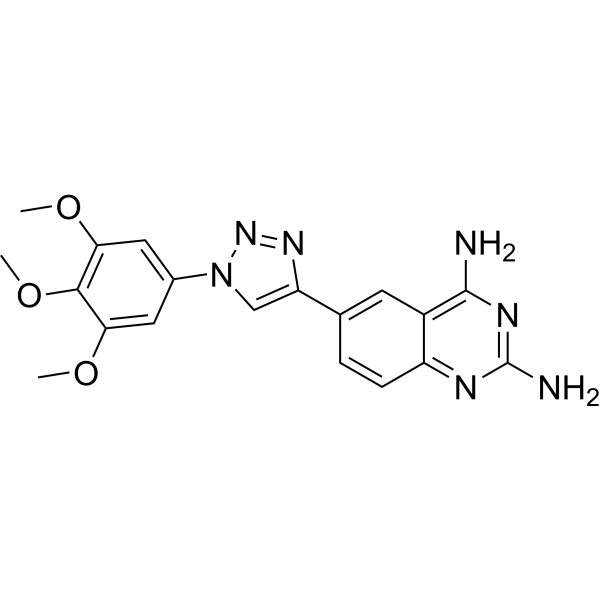
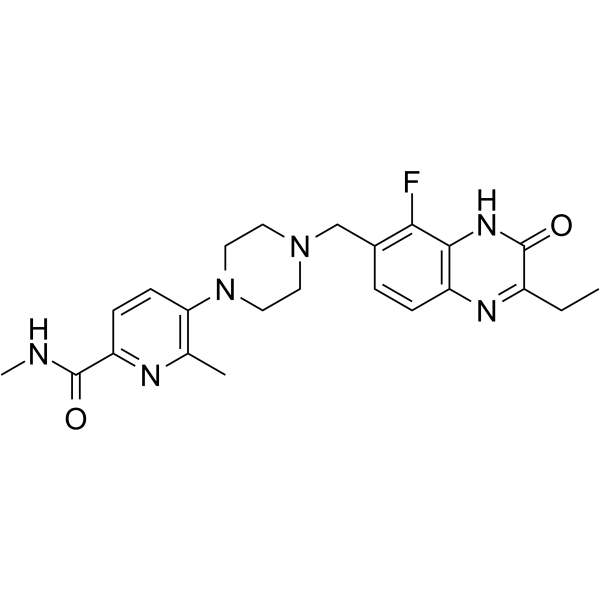
AZ3391 is a potent inhibitor of PARP. AZ3391 is a quinoxaline derivative. PARP family of enzymes play an important role in a number of cellular processes, such as replication, recombination, chromatin remodeling, and DNA damage repair. AZ3391 has the potential for the research of diseases and conditions occurring in tissues in the central nervous system, such as the brain and spinal cord (extracted from patent WO2021260092A1, compound 23) .
loading...
    loading...
Cat. No.: HY-136489
CAS No.: 763111-49-5
Target:  

PARP Apoptosis

Research Areas:  

Cancer

KU-0058948 is a potent PARP1 inhibitor with an IC50 of 3.4 nM. KU-0058948 induces the accumulation of DNA double-strand breaks through inhibition of PARP1, triggering chromosomal aberrations, cell cycle arrest, and apoptosis in homologous recombination-deficient cells, while impeding the recruitment of the NuRD/PcG complex to affect chromatin remodeling. KU-0058948 can be used for research on cancers such as myeloid leukemia .
loading...
    loading...
Cat. No.: HY-168979
CAS No.: 1606995-47-4
Synonyms: NMS-03305293; NMS-293
Target:  

PARP

Research Areas:  

Cancer

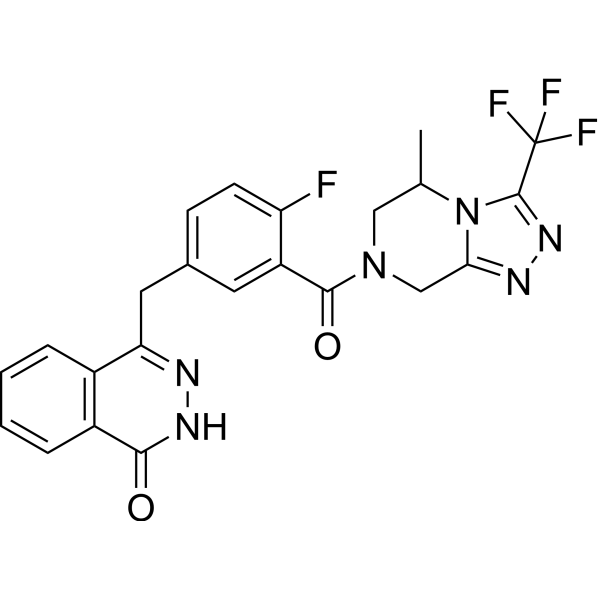
Itareparib (NMS-03305293; NMS-293) is a selective, orally active, blood-brain barrier-permeable PARP1 inhibitor with an IC50 < 0.01 μM. Itareparib does not form PARP1-DNA trapping complexes, avoids PARP-DNA "retention", reduces PAR levels and inhibits the growth of homologous recombination-deficient cells. Itareparib can be used in research on advanced solid tumors, recurrent gliomas and other conditions .
loading...
    loading...
Cat. No.: HY-175812
CAS No.: 1208829-24-6
Target:  

Endonuclease

Research Areas:  

Cancer

MU876 (Compound 32) is a MUS81 inhibitor with an IC50 of 0.5  μM. MU876 effectively inhibits MUS81-dependent homologous recombination (HR) and break-induced replication (BIR) pathways. MU876 sensitizes cancer cells to DNA-damaging agents, such as Cisplatin (HY-17394), through impairing their ability to repair DNA lesions. MU876 can be used for cancers chemotherapy research .
loading...
    loading...
Cat. No.: HY-122583
CAS No.: 1225141-73-0
Target:  

RAD51

Research Areas:  

Cancer

D-G23 is a selective RAD52 inhibitor. D-G23 disrupts RAD52-mediated DNA repair pathways and suppresses the growth of BRCA1- and BRCA2-deficient cancer cells. D-G23 is promising for research of homologous recombination-related cancers, such as hereditary breast cancer and ovarian cancer caused by BRCA1/2 mutations .
loading...
    loading...
Cat. No.: HY-124846
CAS No.: 907166-59-0
Target:  

Bcl-2 Family

Research Areas:  

Cancer

MI-223 is a Mcl-1 regulator (Kd = 160 nM). MI-223 binds to the BH1 domain, blocking Mcl-1-stimulated homologous recombination DNA repair, thus sensitizing cancer cells to DNA replication agents. MI-223 can be used in research on cancers such as lung cancer .
loading...
    loading...
Cat. No.: HY-136489A
CAS No.: 2108829-86-1
Target:  

PARP Apoptosis

Research Areas:  

Cancer

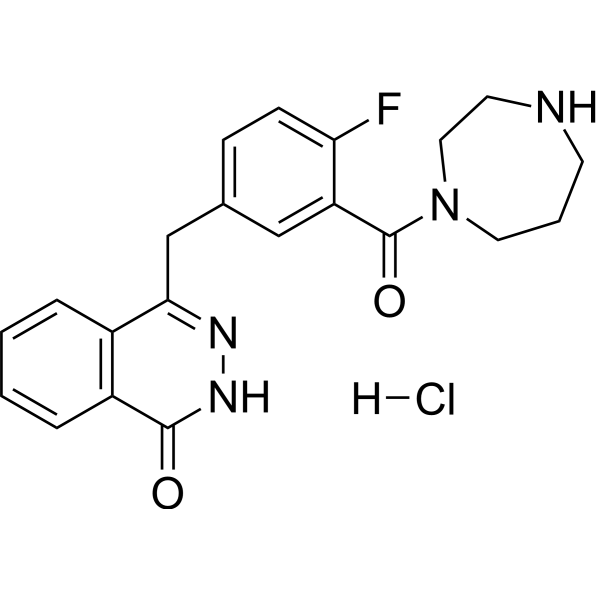
KU-0058948 hydrochloride is a potent PARP1 inhibitor with an IC50 of 3.4 nM. KU-0058948 hydrochloride induces the accumulation of DNA double-strand breaks through inhibition of PARP1, triggering chromosomal aberrations, cell cycle arrest, and apoptosis in homologous recombination-deficient cells, while impeding the recruitment of the NuRD/PcG complex to affect chromatin remodeling. KU-0058948 hydrochloride can be used for research on cancers such as myeloid leukemia .
loading...
    loading...

